
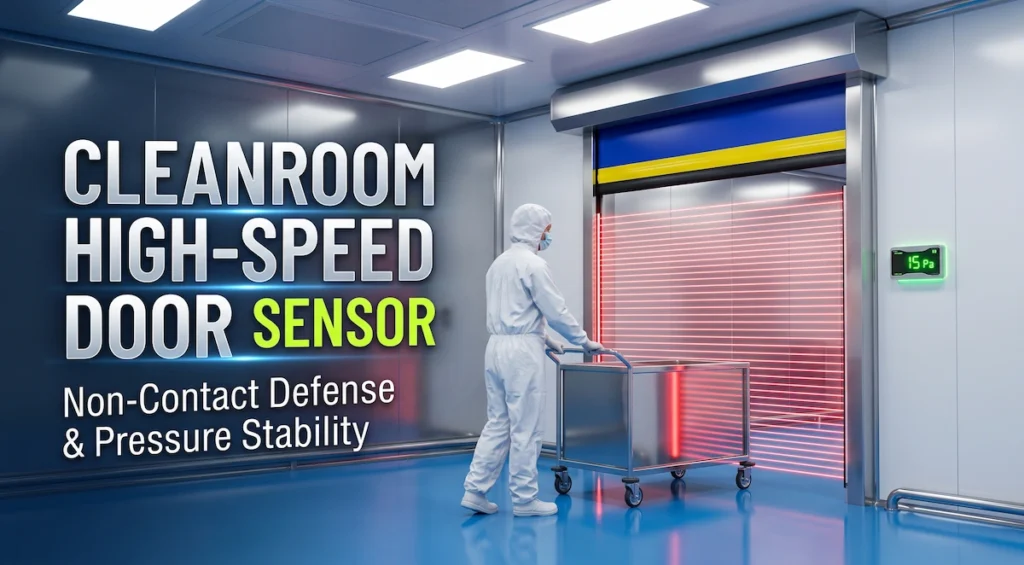
Introduction: The Operational Cost of Contamination and Pressure Loss
Selecting a reliable cleanroom high speed door safety sensor is vital in controlled environments such as solid dosage form manufacturing facilities, aseptic filling rooms for biopharmaceuticals, and semiconductor wafer cleanrooms, where entrances and exits serve as a critical barrier to strictly isolate airborne particles and microorganisms., and high-standard food processing areas, high-speed roll-up doors at entrances and exits serve as a critical barrier to strictly isolate airborne particles and microorganisms. To maintain the cleanliness levels specified by ISO 14644-1, high-speed cleanroom doors are typically configured to open and close rapidly at speeds ranging from 1.2 to 2.0 meters per second, thereby minimizing the time the door remains open. However, these access points face high-frequency, alternating traffic of personnel and logistics dozens or even hundreds of times a day: operators wearing full-body cleanroom suits, stainless steel transport carts loaded with pharmaceutical raw materials, and lightweight cleanroom material pallets all rush in and out, racing against the clock. This high-speed, fast-paced traffic keeps the entrances and exits constantly at extremely high risk of pinching and collisions.
For a long time, the traditional mechanical contact sensor technology widely used in industrial high-speed doors—the pneumatic safety edge—has revealed fatal hygiene and compliance flaws in the specialized environment of cleanrooms. The rubber casing of the mechanical safety edge is subjected to intense compression and friction against the floor every time the door closes. Over time, this high-frequency mechanical wear inevitably causes rubber polymer microparticles to flake off, directly becoming a source of particulate contamination in the airflow and triggering frequent alarm alerts from online particulate counters. More critically, the gaps and internal cavities of the hollow rubber strips in the air-cushioned safety edge readily trap condensation, high-sugar residues, and cleaning agents from the production area. Repeated exposure to moisture, combined with the ambient temperature of the facility, creates cleaning blind spots that become a breeding ground for stubborn spore-forming bacteria and Aspergillus niger colonies. If a swab sample taken during a cGMP or FDA unannounced inspection reveals microbial levels exceeding limits, the entire production line will face the catastrophic consequence of production shutdown and corrective action.
Furthermore, traditional safety bottom seals can only rebound after experiencing actual physical compression; this response delay of more than 0.3 seconds makes it extremely likely for the airtight zipper of the door curtain to derail and jam when colliding with stainless steel carts. If the door becomes jammed in a half-open position due to a malfunction, the carefully maintained 10 to 15 pascals (Pa) micro-pressure differential gradient between the clean corridor and the core production area will collapse completely within seconds. Unfiltered air and outdoor particulate matter will instantly flood in, resulting in the scrapping of an entire batch of high-value raw materials.
To resolve this issue at its source, modern controlled workshops are phasing out contact-type bottom edges entirely and upgrading door control safety systems to non-contact optical perimeter protection. By vertically embedding solid-state infrared safety light curtains (Cleanroom High-Speed Door Safety Sensor) on both sides of the door frame, the system can cut off the control circuit at millisecond speed the moment any cart frame or human limb approaches the descending edge of the door curtain, achieving an absolutely zero-contact suspension and reversal. This all-solid-state optical protection—which is friction-free, wear-free, and free of liquid accumulation dead zones—not only completely eliminates compliance risks associated with mechanical dust generation and microbial hiding places but also effectively protects the door’s airtight sealing system, providing a robust foundation for enterprises to maintain stable cleanroom pressure differential control and pass stringent EHS/GMP audits.
Cleanroom Contamination Risks: Why Contact Safety Edges Fail GMP Audits
In pharmaceutical solid dosage form production areas, aseptic biopharmaceutical filling lines, and high-precision microelectronics cleanrooms, the floors and entrance/exit areas are subject to extremely high pressure to maintain cleanliness compliance. Any seemingly minor component that continuously generates particles during movement—or provides a breeding ground for microorganisms—can directly disrupt the dynamic balance of a controlled environment. Traditional mechanical safety edges rely on large-volume rubber strips in contact with the floor to provide sealing and anti-impact cushioning. This mechanism, which operates through mechanical impact and deformation, often becomes an easily overlooked source of contamination within the facility during rigorous GMP and FDA on-site hygiene inspections.
Particle Shedding from Repetitive Floor Abrasion
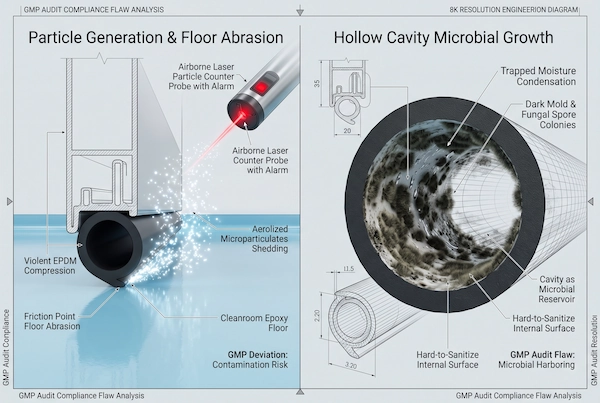
Cleanroom entrance curtains may open and close hundreds of times a day. During each full-closure cycle, the EPDM (ethylene propylene diene monomer) rubber air-cushioned bottom edge—mounted beneath the weighted bottom rail of the curtain—slams at high speed against the epoxy self-leveling or PVC anti-static flooring:
Microparticle shedding caused by continuous shear stress:
Rubber is a polymeric elastomer that undergoes intense instantaneous impact every time the door closes; the resulting slight lateral sway of the curtain and the thrust from air pressure differentials create high-frequency, micro-displacement shear friction between the rubber and the epoxy floor;
Under daily high-frequency compression and dry abrasion, the rubber’s surface structure gradually fatigues and undergoes microscopic flaking, producing a large amount of carbon black and polymer debris that is imperceptible to the naked eye but highly concentrated;
Airflow turbulence accelerates the dispersion of suspended particles:
The piston effect caused by the rapid descent of the high-speed door, combined with the high-speed laminar flow in the cleanroom, creates turbulent airflow at the gap at the bottom of the door, rapidly lifting micron- and even submicron-sized particles generated by rubber wear and dispersing them in all directions throughout the passageway;
These shed particles directly cause dramatic spikes in the readings of laser particle counters located near the door opening, immediately exceeding the maximum allowable concentrations of 0.5-micron and 5.0-micron airborne particles per cubic meter as specified by ISO 14644-1, resulting in unacceptable anomalies in environmental monitoring data.
Microbial Harborage in Rubber Crevices and Chemical Degradation
In addition to physical particle abrasion, the physical structure of contact-type safety edges poses a hidden “time bomb” in terms of microbial control:
Cleaning Dead Zones in Hollow Interiors and Multi-Layered Folds:
To effectively deform under pressure and generate air pressure pulses, air-cushioned safety bottom edges are typically designed as multi-chambered, multi-folded hollow tubular structures;
This design readily absorbs condensation from the air during daily cleanroom operations and, as the curtain descends, draws in sugar, protein, or pharmaceutical powder residue splashed onto the floor. When cleaning staff use dust-free mops to clean the floor, contaminated water inevitably seeps deep into the hollow chambers through the rubber seams;
The enclosed, humid, light-protected, and difficult-to-dry interior environment provides an ideal hidden breeding ground for Aspergillus niger, Bacillus spp., and Pseudomonas spp., and routine surface wiping and disinfection simply cannot penetrate the interior of the air tubes;
The Cycle of Chemical Disinfectant Corrosion and Cracking/Aging:
Pharmaceutical and food processing facilities conduct rigorous chemical disinfection procedures weekly or monthly, including frequent vaporized hydrogen peroxide (VHP) fumigation, daily manual wiping with 75% isopropyl alcohol (IPA), and spraying with high-temperature alkaline foaming detergents;
Although EPDM rubber possesses a certain degree of weather resistance, under years of alternating exposure to high-concentration strong oxidizing agents and organic solvents, its molecular chains undergo irreversible chemical cross-linking and oxidative breakage. Within a few months, the rubber casing undergoes a process ranging from whitening and loss of elasticity to surface cracking and powdering;
The microscopic fissures resulting from cracking further exacerbate the accumulation of dirt and chemical solutions, ultimately leading to total bacterial count levels exceeding standards in GMP microbial surface swab tests. This forces the production line to shut down completely to investigate the source of contamination and replace the base-edge consumables.
Pressure Differential Integrity: Eliminating Door Smashes and Infiltration
In biopharmaceutical and high-cleanliness electronics facilities, entrance and exit air curtains serve not only as passageway barriers but also as active valves that maintain the dynamic pressure differential balance of the entire heating, ventilation, and air conditioning (HVAC) system. To prevent airborne particles from lower-cleanliness areas from spreading into higher-cleanliness zones, engineering designs typically establish a stepped pressure differential of 10 to 15 pascals (Pa) between rooms of different cleanliness levels. This aerodynamic balance is extremely sensitive; should a high-speed door experience a mechanical collision or derailment due to sensor lag, the pressure differential barrier collapses instantly.
The Threat of Door Smashes to Cascade Pressurization
During routine, high-frequency material handling, traditional contact-type safety bottom edges—due to their inherent physical delay—often become the primary culprit in disrupting the facility’s gradient pressure differential:
Bottom beam crushing and zipper derailment caused by closing lag:
When workshop personnel push stainless steel carts loaded with pharmaceutical raw materials through the opening, if the door curtain is in the closing phase, traditional airbags cannot activate until the bottom rail strikes the metal edge of the cart with full force;
During that 300- to 500-millisecond period of compression and reaction lag, the downward momentum is sufficient to subject the self-repairing airtight zipper teeth on both sides of the curtain to intense lateral torsion and misalignment stresses, causing the sealing teeth to snap out of the side guide rails and resulting in the curtain fabric becoming firmly jammed;
The avalanche effect of minor pressure differentials caused by the door remaining open:
Once the door curtain becomes jammed after a collision or is locked in a half-open position due to a safety circuit trip, the previously sealed door opening instantly becomes a massive air pressure relief vent;
The 10 to 15 Pa positive pressure airflow inside the cleanroom is completely exhausted within seconds, causing the differential pressure gauge needle to instantly drop to zero and triggering a severe alarm in the Building Management System (BMS);
Contamination of the Core Sterile Area by Backflow of Lower-Grade Air:
The collapse of the pressure differential immediately causes severe airflow turbulence and reverse backflow at the passageway. Air from the outer non-clean corridors—and even the changing rooms—laden with dust particles and potentially unsterilized aerosols surges into the core production area;
This sudden cross-contamination not only results in the entire batch of semi-finished products currently being filled being scrapped but also requires the HVAC system to operate at full capacity for several hours to ventilate, purify the air, and revalidate the environment, causing incalculable production downtime losses.
Sub-20ms Interception: Safeguarding Zipper Seals and Air Exchange Rates
To maintain absolute stability in cleanroom pressure differentials and air changes per hour (ACH), entrance and exit door control systems must be capable of detecting obstacles within microseconds and bringing the door curtain to a complete stop before physical contact occurs:
Ultra-fast electromagnetic cutoff in less than 20 milliseconds:
The vertical safety light curtain uses a dense array of modulated infrared beams for continuous scanning. As soon as the front wheels or handle of a stainless steel cart extend 1 to 2 centimeters beyond the edge of the door frame, the photosensitive chip immediately detects a sudden change in light transmission;
The system’s built-in solid-state optocoupler directly and forcibly cuts off the inverter’s normally closed safety circuit within a time window of less than 20 milliseconds, causing the motor’s electromagnetic brake to engage rapidly. This causes the rapidly descending curtain to smoothly hover in midair—just tens of centimeters from the object—and then rebound upward immediately;
Zero physical impact, protecting the self-repairing airtight side teeth:
Because completely non-contact suspension is achieved, the weighted bottom rail of the door curtain maintains absolutely zero contact with the ground trolley, eliminating any lateral shear forces or torsional torque transmitted to either side of the curtain;
The polymer airtight zippers continuously engaged on both sides of the curtain remain in a smooth, natural vertical sliding state at all times, completely eliminating structural hazards such as zipper derailment, tooth fractures causing air leaks, or scratches to the wear-resistant lining of the guide rails;
Ultra-Fast Closing and Locking for Cleanroom Air Exchange Cycles:
Once an obstacle leaves the passageway’s projection area, the control system immediately resumes operation, and the door curtain rapidly descends to its designated position at a predetermined speed, minimizing the time the door opening remains exposed to the absolute minimum;
Complete airtight edge sealing combined with rapid and smooth closing logic ensures that the room’s air exchange rate and return air balance are not temporarily disrupted, firmly maintaining pressure differential fluctuations within safe and compliant limits.
For cleanroom entrances and exits with strict requirements for airtight containment and micro-pressure differential isolation, engineering design and retrofit teams can directly access the Cleanroom High-Speed Door Parts section to centrally select and configure self-healing zipper tracks, airtight bottom rail sealing kits, and high-precision vertical safety light curtains—all of which have undergone low-particle emission and sealing tests—to systematically eliminate potential risks of pressure differential imbalance.
High-Density Resolution: CL10-16L and CL15-16L Optical Grid Analysis
In the engineering and safety design of entrances and exits to cleanrooms and pharmaceutical production facilities, sensors must not only be fast but also possess extremely high geometric resolution. Unlike the large, heavily enclosed wooden pallets or large forklifts found in conventional industrial facilities, material handling equipment in cleanroom and controlled environments is characterized by being “lightweight, hollow-tubular, and featuring multi-layered, slender supports.” If the spacing between a sensor’s scanning beams is too wide, these lightweight, hollow carts can easily pass through the gaps between the beams. To address the unique materials traversing cleanrooms, using high-density infrared light grids to provide continuous coverage across the entire surface is the key method for eliminating geometric blind spots.
50mm and 75mm Pitch Spacing for Sterile Stainless Steel Trolleys
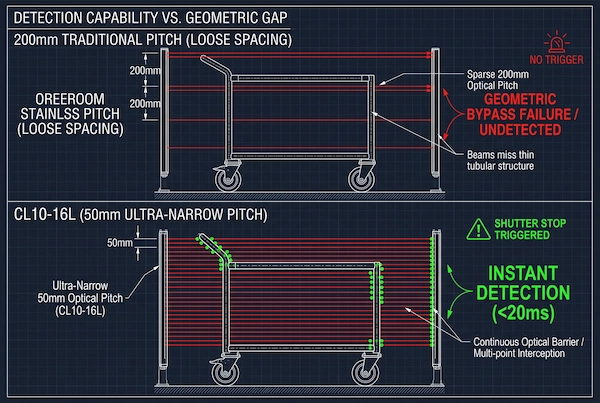
Lightweight transport trolleys made of welded 304 or 316L mirror-polished stainless steel are widely used in sterile pharmaceutical production areas. To meet GMP design requirements for easy cleaning and dust resistance, these trolleys typically use thin round tubes with diameters ranging from just 25 mm to 38 mm for their columns and wheel frame legs. The shelves feature large open areas, resulting in a very small overall wind-resisting surface area:
Fatal Detection Gaps in Traditional Sparse Light Curtains:
Standard industrial safety light curtains commonly available on the market typically have a center-to-center spacing of 150 mm to 250 mm;
When factory workers quickly push stainless steel transport carts through the safety gate, the slender metal side rails or the support tubes of the bottom wheels can easily pass horizontally through the parallel gaps between two infrared beams. As a result, the sensors fail to detect an obstruction even when the front of the cart has already intruded 10 to 20 centimeters into the descent path, causing the safety curtain to drop as usual and strike the cart;
CL10-16L (50 mm Ultra-Narrow Spacing) Dead-Zone-Free Grid Interception:
The CL10-16L features 16 sets of infrared transmitter and receiver units densely arranged vertically, with the center-to-center distance between adjacent light beams strictly reduced to just 50 mm;
Even the thinnest bottom wheel support tubes on a stainless steel cart or injection tray holders protruding from the edge of the tray will inevitably interrupt at least one or two infrared channels the moment they intrude horizontally, achieving true “interception upon contact”;
CL15-16L (75 mm Uniform Spacing) for High-Efficiency, Wide-Range Protection:
In clean transition airlocks with large clear door heights or where coverage of higher vertical spaces is required, the CL15-16L maintains a 75-millimeter spacing between optical axes;
This spacing ensures 100% detection of narrow-tube carts and double-deck material racks while providing a more generous vertical monitoring zone, completely eliminating the risk of perforated metal carts passing through the clean passageway.
Detecting Personnel Suited for Cleanrooms and Bulky Gowning Materials
In addition to transport carts, personnel moving within high-grade cleanrooms (ISO Class 5 to Class 7) also differ fundamentally in appearance from regular workers. Operators must wear full-body anti-static coveralls, high-top cleanroom boots, safety goggles, and face masks. This specialized attire poses even more rigorous identification challenges for optical sensing components:
Eliminating Interference from Specular and Diffuse Reflections in Anti-Static Fiber Fabrics:
High-grade cleanroom suits are typically woven from special polyester filaments interwoven with conductive carbon fibers. The fabric surface is dense and smooth, producing strong specular reflections under specific lighting conditions, which can easily cause stray light interference in low-quality unidirectional photoelectric sensors;
The CL Series light curtains employ infrared emission coding technology with specific high-frequency pulse modulation. The receiver responds only to a specific internal carrier frequency via hardware resonance, completely ignoring specular reflections caused by the highly reflective fabric of cleanroom suits and interference from strong LED lighting in the workshop, thereby eliminating system false alarms and failure-to-operate;
Millisecond-level tracking of subtle lower-body movements and the contours of loose-fitting coveralls:
When personnel push carts through the area, the friction between the anti-slip treads on their cleanroom shoes and the clean floor often results in small strides and a rapid walking pace. As they move, the folds in their pant legs and the height of their toes off the ground fluctuate frequently between 50 mm and 150 mm;
The lowest optical paths of the CL10-16L and CL15-16L start close to the ground. The low-positioned, dense light grid can sensitively capture the edges of the shoe tips as they protrude and the contours of the forward-swinging knees at the very first moment; even if a worker’s arm or elbow moves first, the light beam can be interrupted within microseconds;
Eliminating the “legs in the air” false positives caused by low-positioned single photoelectric sensors:
Many older workshops install only a single infrared beam sensor 30 cm above the floor at the bottom of the door. When workers step through, the single beam is highly susceptible to slipping through the gap between their legs or the space between the wheels of a cart, triggering the door curtain to suddenly drop and strike their heels or body; The high-density 16-beam matrix completely eliminates the geometric uncertainties associated with single-point sensing, establishing an impenetrable, intrinsically safe defense line for clean passageways where people and vehicles mix.
Depending on the span of the door opening and the dimensions of the carts, workshop design and construction departments can visit the dedicated product landing page for the CL Series Industrial Door Safety Light Curtain (0.5m – 2.5m) to directly select the high-density CL10-16L or CL15-16L models as needed, providing tailor-made optical protection for clean passages.
Materials Engineering: Smooth Anodized Aluminum vs. Corrosive Sanitizers
In conventional industrial facilities, sensor selection typically focuses on resistance to mechanical vibration and impact from drops; however, in controlled environments such as pharmaceutical production areas, bioreactor zones, and aseptic filling rooms, the microscopic surface properties of the material itself and its compatibility with chemical disinfectants are the key factors determining whether equipment can pass routine hygiene validation. Equipment housings in cleanrooms must withstand high-intensity chemical wiping and strong oxidative fumigation daily; even the slightest material defect or structural dead corner can become a source of microbial growth and metal corrosion and flaking.
Smooth Profile Architecture Without Dirt-Trapping Recesses
According to modern controlled environment engineering design standards (such as EHEDG and ISO 14644-4), any electrical components permanently installed in a cleanroom must adhere to the hygienic geometric principles of “easy to clean, no dead corners, and no particle retention”:
Integrally Extruded, Anodized 6063 Aluminum Alloy Profiles:
The CL Series safety light curtain enclosures are constructed entirely from high-purity 6063-T5 industrial aluminum alloy through a single-piece extrusion process, with the surface treated with a uniform, dense anodized sealing layer;
This process forms an aluminum oxide passivation film with a thickness of over 10 micrometers on the outer layer of the metal substrate, significantly enhancing surface hardness. The surface is not only scratch- and impact-resistant but also features extremely high flatness and extremely low roughness (Ra value better than 0.8 micrometers), which greatly reduces the microscopic adhesion of airborne microorganisms and aerosol dust;
Design Eliminating Grooves and Sanitary Dead Zones:
To facilitate modular mounting, traditional industrial light grids typically feature deep slider grooves, recessed reinforcing ribs, or exposed countersunk screw holes on the back and sides of the housing. These protrusions and recesses easily trap residual liquids and dust particles during routine cleanroom wiping, creating sanitary dead zones that are extremely difficult to clean;
The housing structure, optimized for cleanrooms, features a streamlined, smooth design with micro-curved transitions. It eliminates unnecessary deep grooves and exposed gaps, allowing cleaning staff to wipe the surface smoothly in a single direction using lint-free microfiber cloths. This ensures that disinfectant is evenly distributed across the entire surface and evaporates quickly, eliminating physical spaces where dirt and grime can accumulate.
Chemical Resistance to VHP, Isopropyl Alcohol, and Chlorine-Based Agents
To maintain extremely low microbial levels, sterile facilities implement extremely rigorous and frequent chemical disinfection protocols. From manual surface spraying and wiping after each daily shift to routine monthly full-facility sterilization, the disinfectants used possess strong oxidizing properties, high penetrating power, and the ability to dissolve organic solvents:
Optical Windows and Manual Wiping with 75% Isopropyl Alcohol (IPA):
Operators manually spray and wipe down door frames and sensor surfaces several times a day using 75% medical-grade isopropyl alcohol (IPA) and lint-free cloths;
Standard acrylic (PMMA) lenses rapidly swell and develop dense, fine hairline cracks when exposed to high-concentration alcohol-based solvents, causing a sudden drop in light transmittance that can lead to alarm failure;
The front optical filters of the CL series are made of modified, optical-grade, high-toughness polycarbonate (PC), which is completely chemically inert to alcohol-based solvents. Even after years of repeated wiping with alcohol, the surface remains as smooth as new, with virtually zero decline in infrared transmittance;
Resistant to vaporized hydrogen peroxide (VHP) deep fumigation:
During disinfection cycles when pharmaceutical production lines are shut down, vaporized hydrogen peroxide (VHP) or chlorine dioxide gas permeates every corner of the space; strong oxidizing free radicals rapidly penetrate and oxidize ordinary rubber and low-grade engineering plastics;
By employing highly oxidation-resistant fluorocarbon rubber (FKM) end cap seals and a high-barrier silicone potting process, the entire optoelectronic array is physically isolated from external chemical gases. Even after hundreds of VHP saturated steam sterilization cycles, the internal component leads remain smooth and rust-free;
Resistance to corrosion from sodium hypochlorite and quaternary ammonium salt disinfectants:
When exposed to sodium hypochlorite (chlorine-based disinfectant) at concentrations of 200 to 500 ppm—commonly used in the food and pharmaceutical industries—as well as composite double-chain quaternary ammonium salt disinfectants, the protective coating on the anodized aluminum alloy effectively blocks the penetration of chloride ions and prevents pitting corrosion. This prevents bubbling, peeling, or the formation of powdery oxides on the metal surface, thereby eliminating the critical risk of metal rust particles detaching and contaminating production lines.
Cleanroom Door Interlock Integration: Coordinating Airlocks and Sensors
In pharmaceutical plant clean corridors, personnel changing buffer rooms, and automated material transfer airlocks, doors are not merely individual units for opening, closing, and isolation; they are also critical nodes in the airflow control logic of the building management system (BMS). To prevent unfiltered outside air or low-cleanliness particles from flowing into high-core clean areas, airlock systems must rely on high-precision sensors and door interlock controllers to work in close coordination. If the signals from the entrance and exit safety sensors experience activation delays, contact bounce, or false alarm rebounds, the entire airlock interlock logic will become paralyzed, thereby disrupting the dynamic pressure differential balance within the facility.
Two-Door Airlock Interlock Logic and Safety Interlocking
Cleanroom airlock buffer passages generally enforce extremely strict “dual-door electronic interlock” logic: under no circumstances are both doors permitted to be open simultaneously. Only when the entry door has fully descended and closed into position, and the safety circuit has confirmed that the door opening is clear, will the electronic control system grant permission for the exit door to open.
When traditional mechanical contact-type edge seals and low-end photoelectric sensors are integrated into this interlock circuit, they frequently cause logic conflicts and deadlocks in the control system:
Collision rebound causes abnormal locking of the interlock circuit:
When an operator attempts to quickly clear a passage with a cart, if the door curtain collides with the cart, the air-cushion edge seal must undergo several centimeters of mechanical deformation before it can issue a rebound command;
This sudden impact and rebound sends an unexpected cyclic door-opening signal to the interlock mainboard, causing the entrance to oscillate repeatedly in a half-open state. As a result, the exit’s electromagnetic latch or motor brake is forcibly locked by the system and cannot be released, causing the entire personnel or material passageway to become deadlocked;
Ultra-fast, clean reset of the light curtain’s normally closed (NC) signal:
The CL series safety light curtains output highly reliable, passive, solid-state normally closed (NC) dry contact signals, which are directly connected to the safety chain of the high-speed door’s electrical control cabinet and the central airlock interlock PLC;
When a cart or person passes through the vertical light curtain, the contacts instantly disconnect at the hardware level to halt the downward movement; once the obstacle has completely passed through the door opening, the photosensitive array restores light transmission, and the solid-state contacts cleanly and decisively return to the normally closed (NC) state within microseconds, with zero mechanical contact bounce and zero residual sensing hysteresis;
This ultra-fast and pristine signal sequencing enables the door operator to complete a controlled closing immediately after the obstacle is removed and precisely relinquish passage rights the instant the door curtain reaches the bottom, ensuring that the second door opens smoothly according to the predetermined cycle time and eliminating airflow convection contamination caused by both airlock doors opening simultaneously.
Eliminating Trailing Coil Cords in Clean Airlocks
In addition to the need for precise alignment at the control signal level, the confined physical space inside airlocks imposes nearly exacting hygiene requirements on electrical wiring configurations. The traditional method of power and signal transmission—which relies on a trailing cable (spiral coil cord) that follows the bottom of the moving door—poses serious contamination and failure risks within the space-constrained airlock:
Dust stirred up by the swinging spiral coil cord and hard-to-reach dead zones:
The traditional safety bottom edge is installed inside the bottom beam of the vertically moving door curtain and must transmit signals back to the fixed control box via a black spiral elastic cable suspended from the outside of the upright column;
Clean airlocks are typically narrow, and the high-frequency opening and closing of the two door panels creates strong piston-like airflow and negative pressure from return air. The suspended spiral cable swings violently from side to side under the disturbance of high-speed airflow, not only causing it to strike and wear down the outer casing of the stainless steel door posts—generating dust—but also leading to the accumulation of large amounts of fine, hard-to-remove dust within the dense gaps of the spiral coils;
Cable snagging and metal fatigue-induced breakage:
In narrow material airlocks, the corners of stainless steel carts are highly prone to snagging the spiral cable as it sways with the airflow, causing connectors to be forcibly pulled apart. Frequent rapid stretching and contraction further cause the copper core to fracture due to fatigue within a short period, triggering false anti-pinch alarms and causing the entire airlock to shut down;
Cleanliness Advantages of the Static 5-Pin M8 Aviation Connector on the Door Frame Uprights:
The CL Series safety light curtain directly bolts the transmitter and receiver aluminum alloy light columns to the inner sides of the stationary guide rail uprights on both sides of the door opening, completely eliminating any mechanical constraints associated with the movement of the curtain;
Signal and power cables are integrated into a single shielded cable, securely locked in place at the top or bottom of the light curtain via an industrial-grade 5-pin M8 threaded sealed aviation connector. The wiring is completely embedded within the sealed cable channels reserved on the inner side of the guide rails, running statically all the way to the top distribution box;
The entire door opening facade is free of any suspended, exposed, or swinging cable harnesses, eliminating the risks of mechanical wear and dust accumulation. This ensures the interior surfaces of the airlock remain uniformly smooth, fully complying with the hygiene standards for ISO Class 5 and higher cleanrooms.
Optical Redundancy and Secondary Sensing: Incorporating Polarized Retro-Reflective Technology
In core biopharmaceutical filling areas, high-cleanliness food processing workshops, and high-grade changing room buffer zones, safety and cleanliness protection often adhere to “dual redundancy” engineering standards. In addition to covering the entire door opening with a dense safety light curtain as an active defense, many stringent hygienic environments also require an additional secondary confirmation barrier installed at the absolute lowest position—just a few centimeters above the floor. However, in high-humidity workshops that face daily exposure to acid and alkali sprays and high-pressure hot water rinses, traditional two-sided wired through-beam sensors have been widely criticized for their cumbersome alignment process, the need for multiple wall-drilling holes, and high susceptibility to water accumulation and moisture. The introduction of single-sided reflective sensing technology with polarized optical properties has become the preferred solution for establishing a redundant safety network at floor level.
Complementary Threshold Protection with Polarized Retro-Reflective Sensors

At the entrances and exits of aseptic liquid filling workshops or automated bottle packaging lines, material handling often involves fast-moving low pallets, single-row conveyor rollers, or extremely low pallets positioned just a few centimeters above the ground. At these specific locations, adding secondary protection at the ground reference line is critical:
Establishing a ground-level safety redundancy line:
Although vertical light curtains already cover most of the mid-to-low-altitude three-dimensional space, installing an independent single-point beam that runs horizontally across the threshold at the critical gap 100 mm to 150 mm above the floor at the very bottom of the door opening creates a “surface + line” dual-logic closed loop with the overhead vertical light curtain;
Should an extremely thin pharmaceutical container accidentally slip from the bottom of a cart and become lodged directly beneath the door frame, this floor-level beam will trigger a final normally-closed interlock cutoff when the door curtain reaches its lowest position, preventing the bottom seal from crushing the container and causing the pharmaceutical solution to spill;
Polarizing filters eliminate false-transmission blind spots caused by mirror-finished metal surfaces:
The interior of the cleanroom is filled with electrolytically polished 316L stainless steel cleanroom tanks, mirror-finished pharmaceutical equipment housings, and aluminum material racks; When infrared light emitted by standard diffuse-reflection or low-quality reflective sensor systems strikes these mirror-finished metal surfaces, it is highly prone to intense, perpendicular reflection back toward the receiver. This causes the sensor to falsely detect that the “light path is unobstructed” even when an obstacle is clearly wedged under the door, leading to catastrophic damage;
An optical system equipped with a built-in polarizing filter forces the light waves emitted from the transmitter into linearly polarized light at a specific angle. Only when the beam strikes a specialized microprism reflector and undergoes a 90-degree phase shift will the polarizing analyzer at the receiver end recognize it as a valid light signal; unshifted light reflected from mirror-like stainless steel or wet floors is directly filtered out, ensuring absolute anti-pinch reliability in a fully stainless steel cleanroom environment.
No Alignment Hassles in Washdown Environments
In work areas such as meat processing, dairy filling, or those requiring year-round foam washing and hot water rinsing, the difficulty of performing mechanical maintenance on electrical components directly determines the availability of the passageway:
Single-side wiring completely eliminates the alignment challenges associated with through-beam sensors:
Traditional through-beam sensors require power and signal cables to be laid on both the left and right sides of the door jamb, with transmitters and receivers installed at each end;
In workshops subjected to intense high-pressure water jets daily, door posts are constantly exposed to minor external vibrations and water impact. This causes the transmitters and receivers on both sides to experience slight axial misalignment, resulting in beam deviation, loss of lock, and false alarms; maintenance electricians must frequently travel back and forth between the door posts to re-calibrate the laser alignment, consuming significant labor hours;
Reflective photoelectric sensor technology integrates a high-power modulated emitter, a precision photosensitive receiver, and an output relay into a compact, protective housing on one side. On the opposite side of the door jamb, only a purely passive, sealed microprism reflector needs to be bolted into place;
Installation personnel need only complete a one-time wiring connection on a single side. During commissioning, thanks to the reflector’s wide beam divergence and acceptance angles, the light spot can be captured and locked within seconds, completely eliminating daily misalignment alarms caused by micro-vibrations in the door frame;
Reduces the risks associated with wall-penetrating wiring and cleanroom drilling:
Random drilling and wiring through cleanroom color-coated steel partition walls are strictly prohibited, as every through-hole is a potential airtight leak and a hiding place for microorganisms;
The single-side wiring architecture reduces cable entry and exit points by 50%. All wiring is concentrated and routed downward within the door jamb on the side closest to the electrical control box, minimizing the need for drilling into color-coated steel panels and silicone sealing repairs, and fully complying with design specifications for food and pharmaceutical engineering.
For applications requiring the rapid establishment of a secondary safety redundancy channel at the bottom of the door under steam-washing conditions, the engineering team can directly adopt the IRR-7R Retro-Reflective Photoelectric Sensor. With its superior polarization-based anti-glare algorithm, single-sided wiring-free architecture, and fully enclosed waterproof design, it forms a highly effective, complementary safety system with the vertical light curtain for door control.
Engineering Comparison: Cleanroom Safety Technologies Matrix
When selecting equipment for pharmaceutical plants, biopharmaceutical production facilities, and aseptic food packaging lines, many equipment managers or general contractors often treat safety edges and photoelectric sensors as ordinary hardware components, basing their comparisons solely on the initial purchase price. However, in the highly controlled environment of a cleanroom, the physical form, cleaning dead zones, material durability, and electrical response time of different sensing technologies directly determine the facility’s compliance performance and operational costs over the subsequent years of operation. By establishing an engineering comparison matrix covering hygiene validation, environmental control, and electrical reliability, the generational gaps between various sensing components within controlled facilities become clearly evident.
H3: Systematic Evaluation for Pharmaceutical and Food Facilities
To provide objective data support for the mechanical and electrical engineering, automation retrofit, and EHS validation departments of cleanroom facilities, the table below systematically compares three common safety sensor technology solutions for cleanroom entrances and exits—the CL Series high-density facade safety light curtains, traditional EPDM mechanical airbag safety bottom edges, and single-beam door-bottom photoelectric sensors—based on core engineering dimensions such as cleanliness rating, hygiene dead zones, chemical resistance, response speed, and downtime risk:
| Technical Evaluation Criteria | CL Series High-Density Vertical Safety Light Curtains | Traditional EPDM Mechanical Air-Cushioned Safety Edge | Single-beam door bottom photoelectric sensor | Impact of Cleanroom Engineering and Compliance Assessment |
| Particle Emission Level (Rated per ISO 14644-1) | Compatible with ISO Class 1 through Class 5All-solid-state semiconductor technology; static column mounting; zero physical contact; no mechanical wear or dust generation | For ISO Class 8 or non-cleanroom areas onlyEach time the rubber edge drops, it strikes the epoxy floor with great force, causing friction that sheds large amounts of polymer particles | Compatible with ISO Class 5 to Class 7Fixed installation causes no wear or dust generation, but does not protect against mechanical particles generated when the door curtain’s bottom beam strikes the floor | The bottom edge of contact-type air-cushion doors directly causes airborne particle counts around the door opening to exceed limits, violating high-level cleanroom standards. |
| Hygiene Blind Spots and Risk of Microbial Growth | Extremely low (zero blind spots)Smooth, micro-radius transition housing made of anodized 6063 aluminum alloy; no deep grooves or hard-to-reach corners; cleans with a single wipe of a lint-free cloth | Extremely High (Severe Risk)The rubber’s folded, multi-chambered hollow structure easily traps condensation and residual materials; the damp, dark interior fosters the growth of spore-forming molds | LowCompact housing, but cleaning residue tends to accumulate in the gaps between the rear brackets of the dual-sided probes and the wiring | The hollow interior of traditional air-cushion doors cannot be wiped down and sterilized during routine cleaning, making them a major source of contamination in on-site GMP microbial surface swab spot checks. |
| Corrosion Resistance and Service Life Under Chemical Disinfection | Over 3 Years of Stable OperationOptical-grade modified PC filter resists alcohol-based wipes; fluorocarbon rubber seals withstand high-frequency VHP fumigation and chlorine-containing sprays | Rapid aging within 3 to 6 monthsRubber polymer chains rapidly crack, harden, and lose elasticity when exposed to 75% alcohol and strong oxidizing agents | 1 to 2 yearsStandard acrylic lenses are prone to whitening and cracking with repeated exposure to alcohol, reducing light transmittance and causing false alarms | Frequent replacement of rubber bottom edges due to surface cracking not only incurs maintenance costs but also introduces external contamination from repeated construction work. |
| Response Speed and Differential Pressure Protection Capability | Less Than 20 Milliseconds (Zero-Contact Hover)Light-speed cutoff; brakes engage and the door reverses while still in mid-air, protecting the door curtain’s self-repairing zipper and airtight structure | 300 to 500 milliseconds (rebound after impact)Mechanical deformation and pneumatic transmission lag exacerbate the direct impact of the bottom beam on the cart, making it highly likely for the zipper to derail and jam | 50 to 100 milliseconds (low-level single point)Effective only for a single point on the floor surface; cannot detect hollow suspended carts and cannot prevent high-level collisions or derailments | When the door curtain collides with the car and becomes jammed, the 10–15 Pa micro-pressure differential in the clean corridor collapses within seconds, causing severe backflow of non-clean air. |
| Wear on Moving Parts and Downtime Rate Due to Core Breakage | 0% failure rate (static wiring)Transmitter and receiver bolted to the door frame; 5-pin M8 aviation connector with static wiring, eliminating mechanical bending fatigue | 1 to 2 cable breaks and system stoppages per yearThe high-frequency repetitive stretching of the helical spring cable at the bottom of the door causes the internal copper core to fatigue and break easily or become dislodged by the cart | 0% failure rate (static wiring)Static installation on both sides of the door frame, but wiring must be routed through holes drilled in the wall on both sides, increasing the number of potential airtightness leakage points | A broken or jammed follow-up spiral cable can cause critical airlock doors to remain open, forcing production cycles to come to a complete halt while waiting for electricians to troubleshoot the issue. |
Long-Term Sanitation Validation and Audit Readiness
In the full lifecycle operations of pharmaceutical and high-cleanroom manufacturing facilities, simply evaluating the initial purchase price difference of hardware is often short-sighted. After introducing contact-type air bladder bottom edges, companies must continuously bear significant hidden compliance costs and operational and maintenance burdens over a 3-year operational cycle:
Significantly reduce the labor hours required for routine aseptic cleaning and environmental validation:
With traditional air-cushion door bottoms, cleaning and Quality Assurance (QA) personnel must perform deep manual scrubbing and brushing of the rubber folds at the base of multiple doors every week, and must periodically cut open aged air tubes to extract condensation from the inner walls for microbiological culture testing;
After switching to a safety light curtain with a fully smooth, anodized aluminum alloy frame—which features a flat surface with no blind spots—cleaning staff need only wipe the surface once in the same direction with a lint-free cloth saturated with 75% isopropyl alcohol during routine cleaning. The time required to clean a single door is reduced from 15 minutes to less than 30 seconds, saving large cleanrooms hundreds of hours annually in labor costs for disinfection and wiping;
Completely eliminates the risk of batch write-offs caused by airflow backflow:
During dynamic production, if a single critical material airlock door becomes jammed and inoperable for 30 minutes—due to a broken air bladder or collision with a cart—the loss of pressure differential in the facility is sufficient to render the current batch of high-value active pharmaceutical ingredients (APIs) in that area—which are in the process of being filled or exposed—unusable, resulting in economic losses often amounting to hundreds of thousands of dollars;
Solid-state safety light curtains feature contactless in-air braking in less than 20 milliseconds, physically preventing door curtain distortion and the disengagement of self-repairing zippers at their source, thereby ensuring the airtight seal of the door opening and the absolute continuity of HVAC air exchange balance;
Establish routine GMP/FDA audit compliance capabilities:
When facing drug regulatory authorities (such as FDA on-site inspections or NMPA cGMP unannounced inspections), the exposed and wear-prone lower edge of rubber air bladders is highly susceptible to auditors issuing “Deficiencies” specifically regarding “particle shedding” and “inability to achieve effective and thorough sterilization”;
Equipping the facility with a non-contact light curtain system that complies with cleanroom engineering standards not only provides comprehensive non-contact protection test documentation and certification of material resistance to chemical disinfection but also eliminates all trailing cables and water-collecting grooves, ensuring that entry and exit passages remain in a compliant, inspection-exempt state at all times, thereby solidifying the certification status of the core production line.
Regulatory & Certification Standards: FDA cGMP and ISO 14644 Compliance
In pharmaceutical engineering, biopharmaceuticals, and high-end medical device manufacturing, access control systems for doors are not only critical for occupational safety but are also directly integrated into pharmaceutical plants’ compliance and quality management systems. As global drug regulatory agencies continue to intensify their scrutiny of “exogenous particulate contamination” and “cross-contamination risks,” traditional approaches to industrial door hardware configuration have long failed to meet modern hygiene validation standards. Whether facing on-site audits by the U.S. Food and Drug Administration (FDA) or undergoing controlled environment classification testing by the International Organization for Standardization (ISO), the adoption of contactless optical facade sensing is the technological cornerstone for ensuring that cleanroom entrances and exits pass compliance inspections.
Aligning Doorway Safety with FDA cGMP Sanitation Mandates
In the modern pharmaceutical industry, U.S. Federal Regulation 21 CFR Part 211 (Current Good Manufacturing Practice, or cGMP) is globally recognized as the most authoritative statutory production standard. In particular, Section 211.65 (Equipment Construction) and Section 211.67 (Equipment Cleaning and Maintenance) impose explicit requirements on all electromechanical components operating within manufacturing facilities: any equipment surface exposed to the production environment must be designed to be easily cleaned and sterilized, and must not react with drug ingredients, adsorb particles, or release exogenous contaminants into the air.
When compared to these statutory provisions, the bottom edges of traditional mechanical contact-type air curtains present significant compliance gaps:
Violation of the statutory requirement for “ease of thorough cleaning and sterilization”:
The folded rubber bellows, internal multi-chamber air ducts, and coiled spring cables that sway with the curtain of traditional air curtains are riddled with physical crevices and blind spots;
When FDA inspectors conduct on-site swab sampling, it is extremely difficult to ensure that no cleaning agent residues remain inside the rubber crevices or that microbial levels do not exceed limits, making it highly likely that the cleaning validation will be deemed unreliable;
Surface Material Compatibility Fully Complies with cGMP Hygiene Standards:
The CL Series safety light curtains feature a streamlined, anodized 6063 aluminum alloy housing and optical-grade modified polycarbonate windows, with smooth, non-porous surfaces that are wear- and scratch-resistant;
The component surfaces can directly withstand frequent disinfection with high-concentration isopropyl alcohol (IPA) and vaporized hydrogen peroxide (VHP) without experiencing surface chalking, swelling, discoloration, or the release of any chemical particles into the controlled air, fully meeting the stringent standards of 21 CFR Part 211 regarding the harmlessness of equipment in contact with the environment.
Impact-Free Operation Ensures Compliance with ISO Class 5 to Class 8 Particulate Limits
In addition to surface cleanliness, cleanroom entrances and exits are the most challenging weak points when it comes to controlling airborne particle concentrations. ISO 14644-1 (the standard for classifying air cleanliness) sets extremely stringent upper limits for the number of airborne particles with diameters greater than or equal to 0.5 micrometers and 5.0 micrometers per cubic meter of air. In high-frequency material flow through ISO Class 5 to Class 8 areas, the motion characteristics of high-speed door curtains directly determine whether particle concentration levels exceed the limits:
Avoiding mechanical impacts that stir up particles deposited on the floor:
When mechanical edge seals are used, a motion lag of 0.3 to 0.5 seconds causes the weighted bottom rail, descending at high speed, to inevitably strike the floor or carts, generating intense mechanical vibrations;
This instantaneous impact not only causes rubber particles to peel off but also dislodges fine particles settled in cracks on the floor, creating a high-concentration particle cloud around the door opening that lasts for several minutes and triggers continuous alarms from the online particulate matter monitoring sensors;
Protecting the airtight, self-repairing zipper and eliminating vortex suction:
The light curtain completes optical interruption within a time window of less than 20 milliseconds, allowing the door curtain to hover smoothly in the air and rebound immediately, ensuring absolutely zero contact between the door curtain’s bottom rail and the cart or the ground;
Zero-impulse interception not only protects the highly airtight, self-repairing zipper guide rails on both sides of the curtain from twisting, disengagement, and damage, but also maintains a controlled laminar airflow state at the edges of the cleanroom doorway, preventing violent air turbulence and backflow caused by curtain derailment and air leakage;
Maintaining a controlled particle settling balance in the cleanroom:
The curtain can close smoothly and fully at the fastest cycle rate, sealing the slight pressure differential across the door opening. This allows the clean air supply system to rapidly resume the directed sweeping and settling of particles, ensuring that airborne particle counts remain consistently within the controlled threshold limits.
For specific mechanical calculations regarding bottom-edge impact and the mechanisms of damage caused to industrial door tracks, please refer to the detailed force test data in Safety Light Curtain vs Safety Edge: Stop Roll-Up Door Crushes.
Cleanroom High-Speed Door Safety Sensor FAQ
When planning or retrofitting access control and safety systems for cleanroom entrances and exits, engineering contractors, MEP maintenance personnel, and QA validation engineers typically focus on specific implementation details such as material tolerance limits, cleanroom compliance restrictions, detection accuracy for narrow components, and micro-pressure differential protection. The following provides in-depth answers to the four most common engineering questions encountered in pharmaceutical plants, aseptic food processing facilities, and semiconductor manufacturing facilities.
Can the CL Series withstand daily 70% IPA wiping and routine VHP cycles?
Absolutely. The CL Series has been specifically engineered with materials and encapsulation processes reinforced to withstand the harsh chemical disinfection conditions typical of cleanrooms.
Sterile pharmaceutical and biotechnology facilities implement frequent physical and chemical sterilization protocols; ordinary consumer-grade or general-purpose industrial sensors are highly prone to rapid aging and failure in such environments. The key reason the CL Series can withstand harsh disinfection conditions over the long term lies in its dual material barrier:
Anodized 6063 aluminum alloy housing:
The surface of the cylindrical metal housing features a dense, high-hardness aluminum oxide passivation layer that exhibits exceptional chemical inertness toward 75% isopropyl alcohol (IPA), ethanol, quaternary ammonium disinfectants, and chlorine-based disinfectants (sodium hypochlorite);
Even when subjected to manual spraying several times a day and direct wiping with lint-free cloths, the metal outer layer does not discolor, bubble, or suffer from pitting and flaking, eliminating the risk of metal debris being released due to housing wear;
Modified optical-grade polycarbonate (PC) viewing window:
Unlike traditional acrylic (PMMA) materials, which tend to swell, turn white, and develop microcracks when exposed to alcohol, this viewing window is made of high-toughness modified PC material. It withstands wiping with organic solvents and offers excellent UV resistance and anti-aging properties, maintaining stable infrared transmittance year-round;
Resistant to vaporized hydrogen peroxide (VHP) deep fumigation:
The interior of the housing is fully potted, and all joint surfaces and cable connectors are sealed with fluorocarbon rubber (FKM) O-rings resistant to strong oxidation, achieving an IP65 protection rating or higher;
During periodic saturated VHP or chlorine dioxide gas in-situ sterilization performed while the system is shut down, highly permeable, strongly oxidizing aerosols cannot penetrate the sensor’s interior, thoroughly protecting the internal optical semiconductors and processing circuits from corrosion and damage.
Why are pneumatic safety edges strongly discouraged in ISO Class 5 cleanrooms?
In high-purity controlled environments such as ISO Class 5 (Class 100) and above, traditional mechanical contact-type pneumatic safety edges are explicitly classified as high-risk non-compliant components, primarily due to three insurmountable hygiene and mechanical flaws:
Microscopic dust generation caused by rubber rolling on the floor:
Frequent opening and closing of high-speed roll-up doors causes the EPDM rubber bladder mounted at the bottom of the door to repeatedly strike and compress the epoxy self-leveling floor with great force when the door is fully closed, accompanied by continuous shear and dry friction generated by the swaying of the door curtain;
The polymer rubber surface is highly prone to fatigue-induced peeling, continuously releasing microscopic polymer debris—invisible to the naked eye—into the surrounding clean air, directly causing frequent alarm triggers on the in-line laser particle counter and compromising controlled particle concentration standards;
Condensation accumulation and microbial growth within the hollow interior:
To transmit air pressure pulses under pressure, the air bladder must maintain a hollow cavity design. During temperature fluctuations in the workshop and floor cleaning processes, the inner cavity draws in condensation vapor and residual cleaning solution through the air holes;
The interior of this enclosed cavity—which remains constantly damp, shielded from light, and impossible to thoroughly wipe down and sterilize manually—serves as an ideal breeding ground for stubborn microorganisms such as Aspergillus niger and spore-forming bacteria, making it highly likely to trigger catastrophic sample test failures in GMP microbial environmental monitoring;
Dust accumulation and mechanical core breakage in the follow-up spiral cable:
The high-speed up-and-down movement of the door curtain relies on a spiral spring cable suspended from the outer side of the upright column to transmit electrical signals. Under the high-speed turbulent airflow in high-grade airlocks, the swinging cable is highly prone to accumulating hard-to-clean dust in its spiral grooves; frequent bending and pulling also cause fatigue fractures in the copper core, resulting in false open circuits in the safety circuit, which causes the door to jam in the fully open position and completely compromises the cleanroom barrier.
How does the 50mm beam pitch on the CL10-16L prevent narrow stainless steel pushcarts from passing through?
By densely packing the beam center-to-center spacing to 50 millimeters on the vertical plane, the CL10-16L completely eliminates—based on the principles of geometric projection—any blind spots where thin-tube metal frames could pass through the gaps in the light curtain.
Lightweight 304/316L stainless steel carts with no blind spots are commonly used for material handling in cleanrooms. Their upright posts and wheel frame support tubes typically have diameters ranging from 25 mm to 38 mm, with large open areas in the center:
Blocking the lateral penetration gaps in traditional light curtains:
The beam spacing of standard industrial light curtains is often as wide as 150 mm to 200 mm or more. If a single thin round tube handle extending from the front of the cart or a low-profile single cantilever wheel axle at the bottom is pushed horizontally into the curtain, it is highly likely to pass precisely through the gap between two parallel beams, causing the sensor to fail to detect the object and resulting in the cart being struck;
Dual Interruption via a High-Density 16-Beam Matrix:
The CL10-16L tightly arranges 16 sets of modulated infrared beams within the limited clear opening of the gate frame, reducing the center-to-center distance between adjacent optical axes to 50 millimeters;
Regardless of the angle at which the cart is pushed through the opening, the narrow metal front surface or protruding shelf edges will inevitably block at least one—and possibly two—of the high-density light paths simultaneously;
Eliminating Mirror-Like Reflection Interference:
The electrolytically polished stainless steel surface of the cart is highly prone to intense specular reflections. The CL series employs a specific carrier coding algorithm and narrowband filtering technology to recognize only the direct modulated signals from the corresponding transmitter, completely blocking false “pass” signals caused by strong reflected light spots and ensuring instant detection as soon as the front of the cart enters within 2 centimeters.
How does fast optical braking prevent room pressure differential alarms?
Through high-speed photoelectric hard-stop in less than 20 milliseconds and suspension with absolutely zero physical contact, the system protects the rapid door’s core airtight sealing components, eliminating at the source micro-pressure differential leaks and alarms caused by damage to the door curtain.
In pharmaceutical clean corridors between production rooms, the heating, ventilation, and air conditioning (HVAC) system relies on a minute pressure differential of 10 to 15 pascals (Pa) to block uncontrolled air leakage. The response mechanism of the door sensors is directly linked to the stability of this pressure differential:
Eliminating physical collisions to protect the self-healing airtight zipper:
Traditional airbags have an activation lag of 0.3 to 0.5 seconds. When a heavy beam descending at high speed strikes an obstacle, it generates lateral torsional shear forces, which can easily cause the airtight zipper teeth—tightly interlocked on both sides of the door curtain—to derail and become jammed in the guide rails;
When a cart or person intrudes, the optical sensor detects the intrusion in microseconds and cuts off the inverter’s safety normally-closed circuit within less than 20 milliseconds. The servo motor’s electromagnetic brake engages instantly and rebounds along the same path, causing the door curtain to come to a smooth stop in mid-air. Throughout the process, there is absolutely zero contact with the obstacle, eliminating any external impact forces on the zipper’s side teeth and the wear-resistant sealing strip;
Ultra-fast closing and reset to maintain air changes per hour (ACH):
Since no mechanical derailment or deformation occurs, once the obstacle is removed, the door curtain requires no manual reset and can immediately descend smoothly and under control at a high speed of over 1.5 meters per second to close completely;
The time the door opening remains open is strictly limited to the shortest safe physical limit, preventing positive pressure leakage or negative pressure backflow caused by the door remaining locked in the open position. This eliminates differential pressure alarm triggers caused by airflow turbulence, ensuring the long-term stability of air cleanliness balance in the controlled area.