Industry News

inductive vehicle loop installation guide - pouring black epoxy compound into driveway saw-cut

Inductive Vehicle Loop Installation: Turns Calculation, Driveway Saw-Cuts & Sensor Selection

Introduction: The Foundation of Reliable Access Control In our hands-on experience with after-sales maintenance of barrier gate systems and vehicle access control, we have discovered a harsh engineering reality: 90% of on-site “phantom false alarms” (where the barrier rises or lowers automatically without a vehicle present) and dangerous “mid-cycle barrier drop” incidents are not caused
Inductive Vehicle Loop Installation: Turns Calculation, Driveway Saw-Cuts & Sensor Selection Read More »

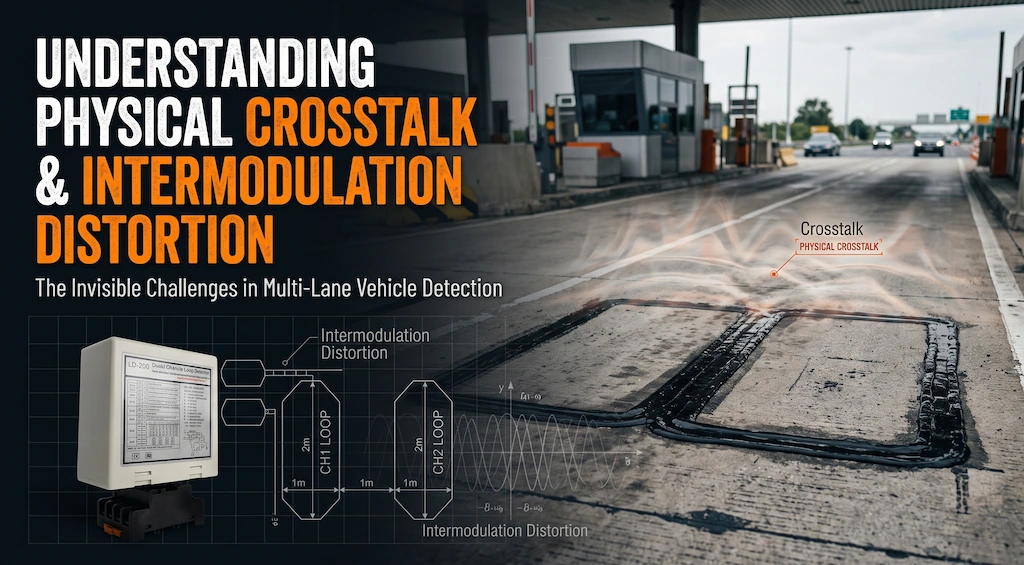
vehicle loop detector crosstalk frequency - real-world intermodulation distortion in adjacent lanes

Eliminating Vehicle Loop Crosstalk: 20–100kHz Frequency Tuning & Sensitivity Matching

Introduction: The Invisible Threat in Multi-Lane Access Control During the commissioning of high-traffic multi-entry/multi-exit toll islands or systems with multiple parallel barrier gates, engineering teams often encounter an extremely frustrating phenomenon: even when the lane is clearly empty, the barrier gates frequently raise and lower on their own. Faced with these erratic “ghost vehicle” false

Eliminating Vehicle Loop Crosstalk: 20–100kHz Frequency Tuning & Sensitivity Matching Read More »

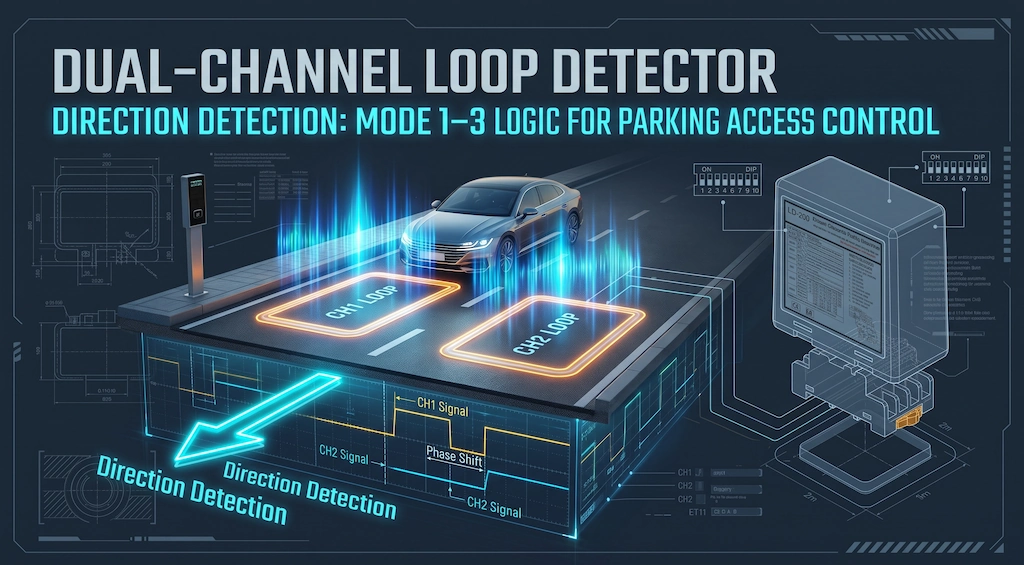
dual channel loop detector direction detection - phase shift analysis for vehicle movement vectors

Dual-Channel Loop Detector Direction Detection: Mode 1–3 Logic for Parking Access Control

Introduction: Eliminating Directional Blind Spots in Access Control Deploying a high-precision dual channel loop detector direction detection system is the core hardware defense for resolving traffic flow chaos in modern commercial parking lots, one-way toll plazas, and single-lane, two-way ramps in older underground parking garages.In complex, dynamic traffic scenarios, traditional single-coil sensor solutions can only

Dual-Channel Loop Detector Direction Detection: Mode 1–3 Logic for Parking Access Control Read More »

parking barrier gate loop detector - comparing 0-second delay crash versus 2-second anti-smash relay hold during tailgating

Boom Barrier Anti-Smash Loop Logic: LD-100 Relay Delays, Pulse Output & Fault Self-Tests

Introduction: The Critical Timing of Barrier Gate Anti-Smash Systems Deploying and configuring a properly configured parking barrier gate loop detector is the most critical line of defense for preventing frequent incidents of falling barriers striking vehicles in commercial parking lots and logistics parks. At high-traffic, heavy-duty hubs or toll lanes, boom barriers must raise and

Boom Barrier Anti-Smash Loop Logic: LD-100 Relay Delays, Pulse Output & Fault Self-Tests Read More »

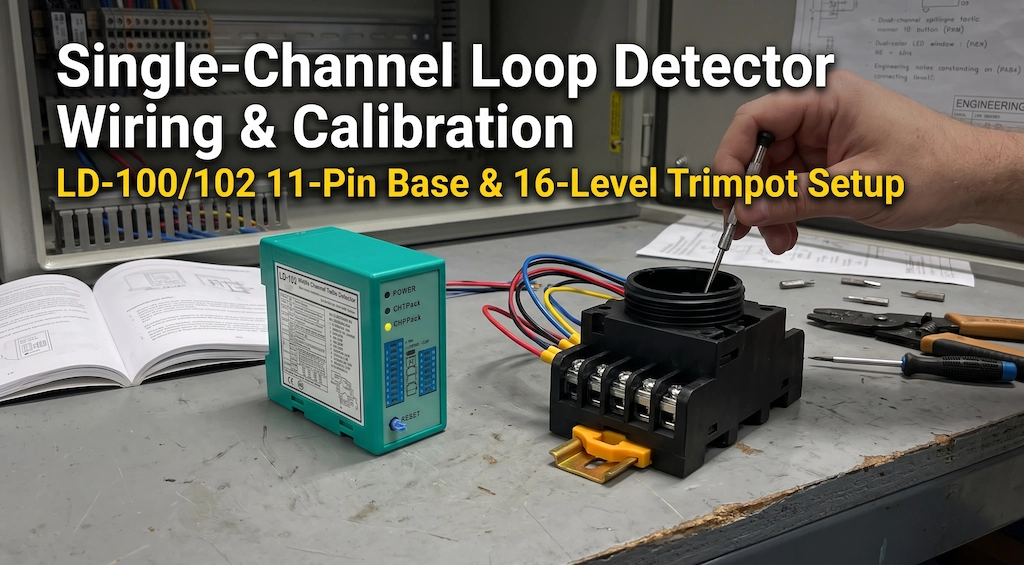
single channel vehicle loop detector wiring - LD-100 industrial module with 11-pin DIN-rail mounting base Image Caption:Figure 1: Industrial hardware architecture of the LD-100 / LD-102 single-channel vehicle loop detector featuring a plug-in module and standard 11-pin DIN-rail socket.

Single-Channel Loop Detector Wiring & Calibration: LD-100/102 11-Pin Base & 16-Level Trimpot Setup

Introduction: The Electrical and Physical Realities of Inductive Loop Detection Proper single channel vehicle loop detector wiring and commissioning directly determine the efficiency of access control systems and their safety thresholds in the day-to-day operations of commercial complexes, modern logistics hubs, and upscale residential communities. Many frontline engineering teams frequently encounter two typical types of

Single-Channel Loop Detector Wiring & Calibration: LD-100/102 11-Pin Base & 16-Level Trimpot Setup Read More »

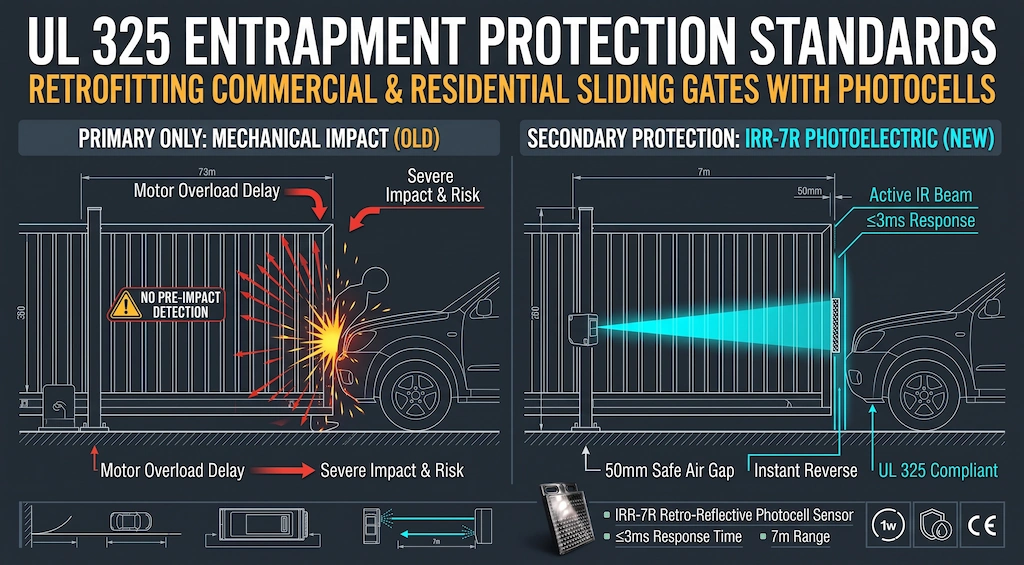
sliding gate safety photocell sensor ul325 - comparing motor internal overload lag versus 3ms non-contact optical stop

UL325 Entrapment Protection Standards: Retrofitting Commercial & Residential Sliding Gates with Photocells

Introduction: The Legal and Mechanical Reality of Non-Compliant Gates In various commercial parks, logistics transfer entry and exit points, and high-end villa communities, upgrading existing sliding gates with a reliable UL325 sliding gate safety photocell sensor system is no longer merely a routine maintenance task—it has become an essential safeguard for legal compliance and the

UL325 Entrapment Protection Standards: Retrofitting Commercial & Residential Sliding Gates with Photocells Read More »

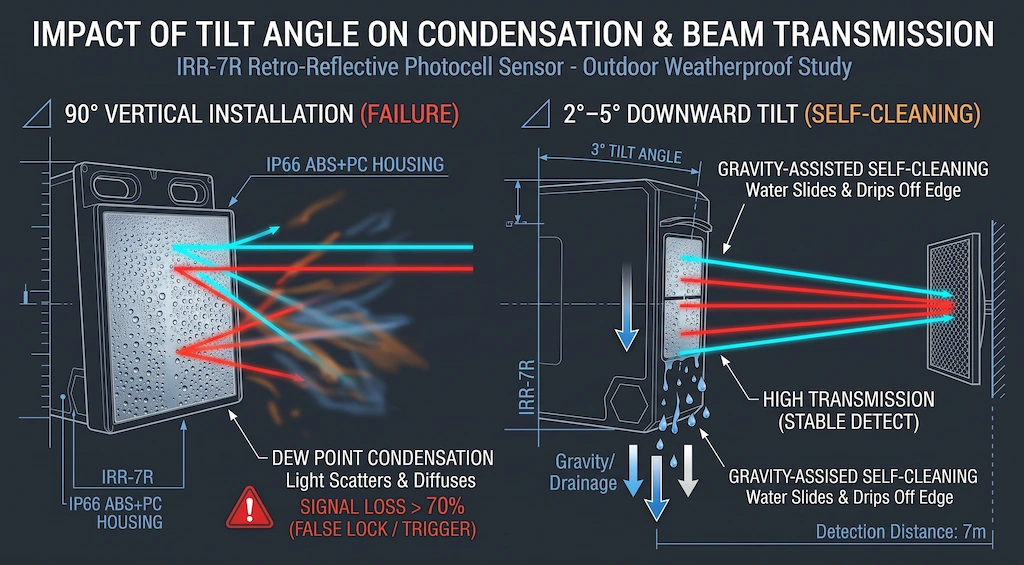
weatherproof photocell sensor ip66 outdoor gate - lens condensation scattering vs 2 to 5 degree drainage tilt

Weatherproof Access Control: Preventing Lens Condensation and Sunlight Blinding in IP66 Photocells

Introduction: The Outdoor Reliability Paradox In the day-to-day operation and maintenance of commercial access control and industrial gate systems, selecting and deploying a qualified weatherproof photocell sensor ip66 outdoor gate unit is the key factor in ensuring the all-weather availability of the entire access system. Whether it’s barrier gates in open-air parking lots, heavy-duty sliding

Weatherproof Access Control: Preventing Lens Condensation and Sunlight Blinding in IP66 Photocells Read More »

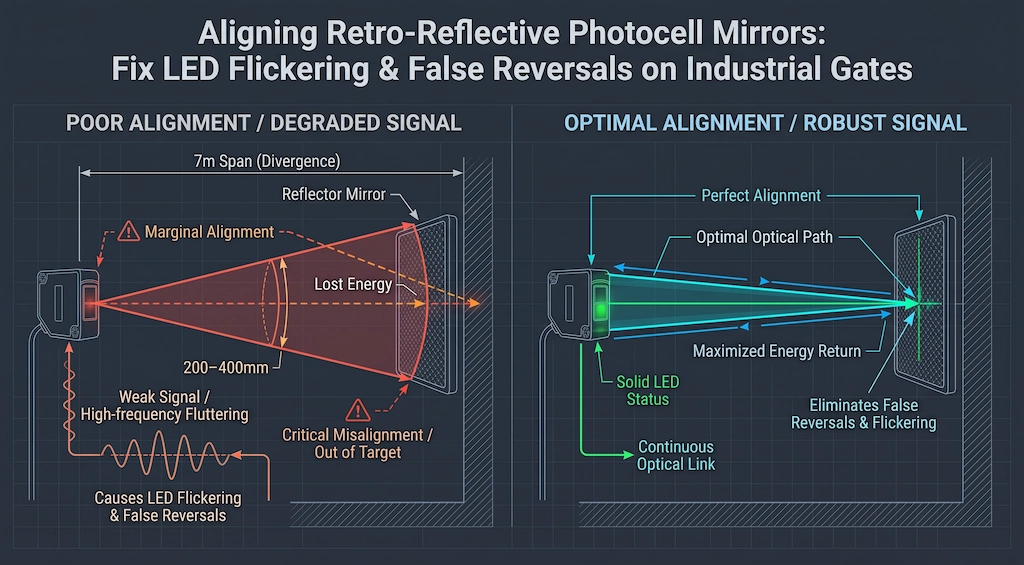
retro reflective photocell alignment troubleshooting - 7m infrared cone divergence and reflector margin alignment

Aligning Retro-Reflective Photocell Mirrors: Fix LED Flickering & False Reversals on Industrial Gates

Introduction: The Invisible Light Trap at 7 Meters In the installation and maintenance of commercial turnstiles, high-frequency industrial folding doors, and large-scale logistics sliding doors, mastering retro reflective photocell alignment troubleshooting is essential for field service engineers to prevent costly gate failures. When the door opening width or lane span is extended to the maximum

Aligning Retro-Reflective Photocell Mirrors: Fix LED Flickering & False Reversals on Industrial Gates Read More »

high speed door photocell sensor wiring 3ms - comparing 20ms sensor latency versus 3ms optical response at 2.0m per s

High-Speed Roll-Up Door Entrapment Protection: Wiring 3ms Optical Sensors to Inverter Control Boards

Introduction: Stopping Curtain Descent at 2.0 m/s In modern high-turnover warehouses, precision manufacturing cleanrooms, and temperature-controlled cold chain corridors, the standard configuration of a 3-millisecond safety circuit for high-speed door photocell sensors is a critical engineering requirement for preventing equipment damage and personal injury from pinching. To maintain strict airtightness, dustproofing, and temperature control standards

High-Speed Roll-Up Door Entrapment Protection: Wiring 3ms Optical Sensors to Inverter Control Boards Read More »

retro reflective photocell sensor single side wiring - comparing pavement trenching vs single-side mounting

Retro-Reflective vs. Through-Beam Photocells: How Single-Side Wiring Cuts Gate Installation Costs by 70%

Introduction: The Hidden Cost Savings in Industrial Access Control In renovation projects for vehicle entrances and exits at industrial logistics parks, deploying a retro reflective photocell sensor single side wiring system directly determines the on-site construction schedule and total project cost. For bonded freight corridors and heavy-duty manufacturing facilities, this single-sided approach eliminates disruptive pavement

Retro-Reflective vs. Through-Beam Photocells: How Single-Side Wiring Cuts Gate Installation Costs by 70% Read More »