
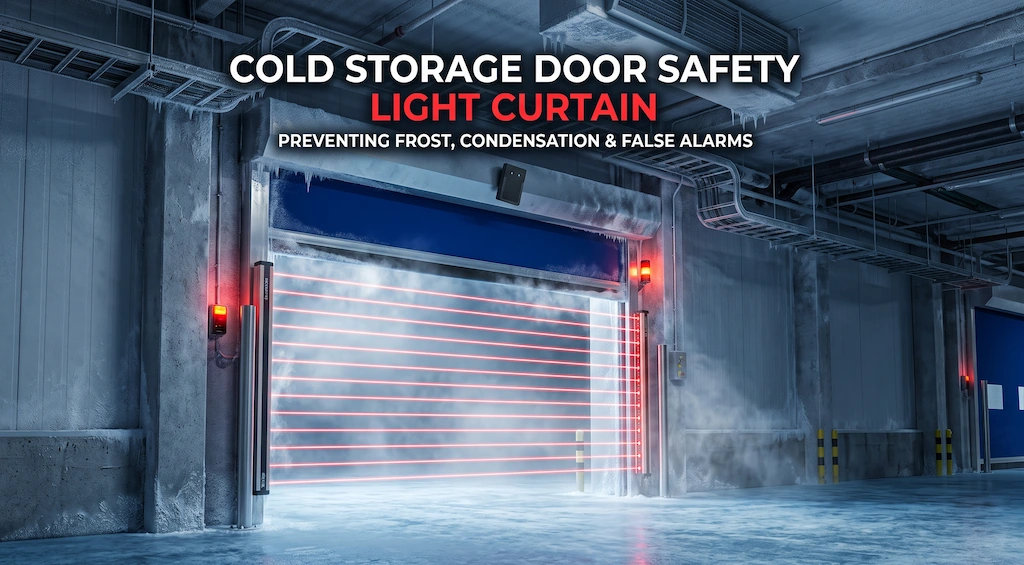
Introduction: The Refrigeration Costs of Sensor Malfunctions and Incorrect Door Reversals
In modern cold chain logistics centers, low-temperature multi-level cold storage facilities, and food quick-freezing processing workshops, installing a reliable cold storage door safety light curtain system is the cornerstone for controlling energy consumption and ensuring safety along access routes throughout the entire cold chain facility. At cold storage entrances and exits, which experience hundreds of high-frequency operations daily, high-speed insulated cold storage doors shoulder the critical responsibility of physically retaining cold air and blocking out warm, humid air, often opening and closing at speeds exceeding 1.5 meters per second. However, according to daily maintenance and troubleshooting records from frontline cold chain facilities, more than 75% of persistent issues—such as doors abnormally bouncing back mid-close, failing to seal properly, or even being forcibly kept open with padlocks—are not rooted in the variable-frequency drives or the mechanical tracks themselves, but rather in “optical sensor blindness” caused by the extreme physical conditions at the door opening.
The cold storage door opening is the interface within the entire facility where physical temperature and humidity fluctuations are most extreme. When the external environment consists of high-humidity air ranging from +15°C to +30°C, while the deep-freeze storage area is maintained at extremely low temperatures of -20°C or even lower, the massive pressure differential caused by the door curtain rising drives hot, humid air from outside to surge into the cold storage passageway instantly. Due to the physical dew point effect, this highly humid vapor condenses within seconds onto the filter lenses of vertically mounted infrared sensors, forming micron-sized water droplets. As the cold air continues to draw in moisture, this condensation on the lenses rapidly solidifies into tiny ice crystals. For optical systems that rely on infrared dot-matrix beam detection, condensation and frost cause severe divergence, refraction, and attenuation of the emitted light beam; Once the receiving end fails to detect the rated intensity of the infrared photon flux, the control algorithm interprets this as “goods or personnel obstructing the door opening,” thereby issuing a “pinch protection” stop command. This causes the cold storage door to repeatedly bounce violently upward while descending, trapping it in an endless loop where it cannot lock into place.
Once the door fails to close smoothly due to a false sensor alarm, the resulting energy consumption and chain reaction of safety issues can be catastrophic. According to comprehensive industry data from the ASHRAE Cold Storage Design Guidelines, for every additional 60 seconds that a 3-meter-wide, 4-meter-high high-speed cold storage door remains open, the heat load pouring in from the outside is sufficient to cause the evaporator coils to become completely covered in thick frost prematurely. This forces the refrigeration unit to significantly extend its high-power electric defrost cycles, directly causing electricity costs for industrial compressors to skyrocket exponentially. Even more dangerous is that after warm, humid air enters, moisture continuously condenses along the floor and guide rail channels, rapidly forming slippery “invisible black ice” on the entrance and exit surfaces and causing hard icicles to form on both sides of the door frame. Forklifts entering or exiting at high speeds are highly prone to skidding and losing control, which not only seriously endangers the lives and safety of warehouse workers but can also result in equipment downtime costing hundreds of thousands of yuan due to violent collisions with the guide rails.
The Thermodynamics of Freezer Entrances: Why Traditional Sensors Fail
In deep-freeze warehouses and quick-freeze food processing facilities, the high-speed insulated roll-up doors at the entrances and exits are subjected to the most severe physical and thermodynamic stresses in the entire building. Not only do extreme temperature differences of over 35°C exist between the inside and outside of the door opening, but these are also accompanied by extremely high differences in air vapor pressure. Standard industrial door sensors are primarily designed for ambient indoor temperatures or ordinary weather-resistant environments. Once exposed to this extreme interface of hot and cold air convection, their optical sensing systems and mechanical cushioning mechanisms will fail within a very short time.
Condensation, Frosting, and Optical Scattering Physics
Every time a high-speed cold storage door opens and rises, an invisible thermodynamic air displacement interface forms instantaneously at the door opening:
Transient Dew Point Water Vapor Deposition Mechanism:
The temperature outside the cold storage facility typically ranges from +15°C to +25°C, with relative humidity consistently maintained within the high-humidity range of 60% to 80% year-round; meanwhile, the temperature inside the facility is maintained at a constant -18°C to -25°C year-round;
When the door curtain rapidly rolls up to form a physical passage, the high-density cold air inside the cold storage facility flows outward along the floor, while the lighter, warm, and humid air from outside forcefully surges into the opening from above;
This intense thermal convection causes the air temperature at the interface to instantly drop below the dew point of the warm, humid air; the sensor housing and filter lens—which lack special thermal protection—are already in a low-temperature state in the cryogenic environment. Within seconds of the high-humidity water vapor coming into contact with the icy lens, countless micron-sized, fine water droplets condense and form on the polycarbonate (PC) panel;
Physical Model of Frost Formation and Infrared Spot Scattering:
As the cold airflow from the cold storage continues to sweep over the surface, the microscopic water droplets adhering to the sensor lens rapidly freeze into fine ice crystals within tens of seconds, forming a rough, uneven crust of frost on the lens surface;
Safety light curtains typically rely on an array of parallel, narrow light beams emitted by the transmitter’s collimating lens. When these modulated infrared pulses pass through a surface covered with water mist and frost, the effects of total internal reflection and Fresnel scattering are amplified exponentially;
More than 80% of the infrared light energy is randomly refracted and scattered in all directions, causing the effective photon flux reaching the opposite receiver to drop sharply and fall below the lower threshold of the photosensitive component. Unable to detect the synchronized pulse sequence, the microprocessor at the receiving end mistakenly interprets this as “the door opening being completely blocked by an obstacle,” thereby locking the output to a normally closed open signal, causing the cold storage door to violently rebound and rise midway through the closing process.
Mechanical Edge Freeze-Up vs. Non-Contact Optical Defense
In addition to standard single-beam photoelectric sensors being prone to “optical blindness” caused by condensation and frost, the traditional contact-type safety edge at the bottom of cold storage doors is also particularly vulnerable during winter and defrost cycles:
Physical degradation of mechanical air-cushion rubber seals in extreme cold:
Traditional safety edges rely on EPDM (ethylene propylene diene monomer) rubber strips or neoprene tubes embedded within the bottom rail of the door curtain;
When exposed to extremely low temperatures of -20°C for extended periods, the plasticizers within the polymer rubber rapidly precipitate and harden, causing the rubber to lose its elasticity and suffer severe physical cracking;
Once the rubber loses its flexibility and resilience, internal air pressure pulses cannot be effectively transmitted to the pressure switch when the air-cushioned bottom edge is compressed. This results in the sensor failing to activate when vehicles or personnel are crushed, eliminating the anti-crushing protection function;
Internal air circuit blockage caused by frozen defrost water:
During the high-speed opening and closing of rapid doors, moisture seeping in from the outside condenses on the surface of the bottom beam rubber seal due to cold air; snowmelt blown by the defrost fan flows down the curtain and into the hollow cavity of the rubber seal, where it subsequently freezes into solid ice columns during overnight shutdowns at low temperatures;
When the internal hollow rubber tube is completely blocked by frost, or the built-in photoelectric transmitter and receiver tubes are sealed off by frozen water, the control board frequently receives false “crush-triggered” open-circuit alarms, causing the entire door to repeatedly emergency stop and become inoperable;
The Breakthrough Value of Non-Contact Full-Facade Light Curtains:
Compared to mechanical rubber seals—which are “passively impacted” and highly prone to freezing and failure—vertically arranged multi-beam non-contact safety light curtains form a high-density infrared safety barrier along the door curtain’s descent path, extending from several millimeters above the ground to nearly two meters in height;
Whether it’s a forklift’s tines, the edge of a pallet, or an operator’s body, as soon as an object enters the scanning area, the system can initiate a contactless safety stop before any physical contact occurs;
This completely eliminates the risks of door curtain derailment caused by rubber aging and tearing, frozen air hoses, and high-altitude impacts, comprehensively upgrading the passive defense of traditional mechanical bottom edges to highly redundant active protection.
For comprehensive, quantified real-world test data comparing contactless light curtains to traditional airbag bottom edges in low-temperature freezing environments—covering mechanical impact wear, response time, and annualized maintenance costs—maintenance engineers can directly refer to Safety Light Curtain vs Safety Edge: Stop Roll-Up Door Crushes to thoroughly evaluate the service life performance of different protection technologies under harsh temperature conditions.
IP67 Ingress Protection and Sub-Zero Thermal Engineering
When standard industrial sensors fail in cold storage environments, the most critical cause is often not the aging of optical components, but rather the “internal breathing” effect caused by insufficient airtightness of the housing. When a sensor is moved from a room-temperature environment into a cold storage facility, or when the cold storage door is opened, causing the surrounding air to cool rapidly, the air pressure inside the sensor housing drops along with the temperature, creating a negative-pressure cavity. If there are micron-level gaps in the sealing structure, high-humidity water vapor from the outside will be forced into the housing, where it condenses directly on the surfaces of precision PCBs and infrared emitter chips, causing electrical micro-short circuits or optocoupler breakdown. Therefore, in cryogenic, high-humidity environments, stringent physical sealing ratings and wide-temperature thermal redundancy are prerequisites for long-term, maintenance-free operation of the equipment.
Seamless Aluminum Extrusion and Gasket Sealing Standards
Designed to withstand the frequent temperature fluctuations and high-humidity environments typical of cold-chain corridors, the CL20 and CL25 series safety light curtains set an industry-standard benchmark for mechanical housing construction and physical sealing protection:
Compact Anodized Aluminum Alloy Frame:
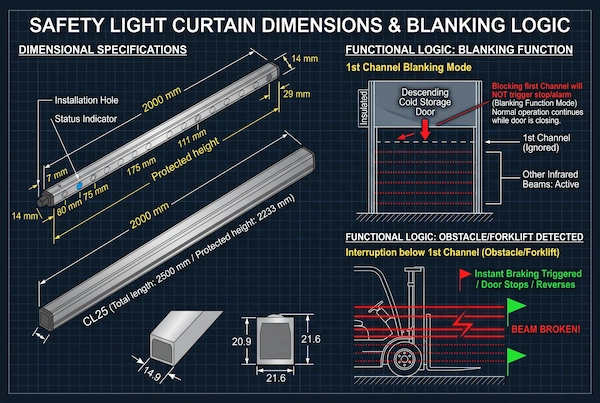
The columns are constructed from precision-extruded, seamless, one-piece aluminum alloy profiles, with cross-sectional dimensions strictly controlled at 14.9 mm by 21.4 mm;
The ultra-narrow cross-sectional design not only significantly reduces the likelihood of accidental scrapes from forklifts entering or exiting, but its robust metal rigidity also withstands the continuous mechanical resonance and impacts generated by the door posts during high-speed operation, eliminating the issues of brittleness and deformation that ordinary plastic enclosures experience at low temperatures;
IP67-Rated Fully Sealed Water- and Dust-Proof Construction:
The CL20 series meets the stringent ingress protection criteria defined by IEC 60529 (IP Code Standard), achieving a verified IP67 rating; the end caps at both ends of the housing, the wiring entry/exit ports, and the joint surfaces of the front polycarbonate (PC) filter window all utilize specialized low-temperature-resistant polyurethane continuous foam injection and weather-resistant fluororubber sealing gaskets;
During routine cleaning, defrosting, disinfection, and high-pressure water jet washing in cold storage facilities, the IP67-rated airtight housing can withstand brief immersion and high-pressure water jets, completely preventing liquid condensation, defrost vapor, and high-humidity airflow from seeping into the internal optical chamber through any gaps;
Cold-resistant and moisture-proof 5-pin M8 aviation connector:
The 5-core quick-connect cable extending from the rear of the light curtain is equipped with an industrial-grade 5-pin M8 threaded metal aviation connector;
The mating points of the male and female aviation connectors are fitted with high-resilience, oil-resistant, and low-temperature-resistant O-rings. Once securely tightened, these form a mechanical barrier that completely seals out moisture, preventing oxidation, corrosion, or poor contact at the terminals caused by thermal cycling.
-20°C to +60°C Operating Range Validation
The primary technical challenges for electronic components in extremely low-temperature environments are “temperature drift” and material embrittlement. According to official technical manuals, the CL20 and CL25 series safety light curtains are rated for an operating temperature range of -20°C to +60°C. This engineering specification ensures long-term reliability in cryogenic conditions:
Thermal Stability of Infrared Emission Wavelengths:
When the temperature of a standard infrared light-emitting diode (LED) drops abruptly from room temperature to -20°C, the center wavelength of the emitted infrared light shifts toward the blue by several nanometers to tens of nanometers because the semiconductor bandgap widens with decreasing temperature;
The CL series utilizes an industrial-grade wide-temperature-range emitter array paired with a matched narrow-band infrared receiver chip, ensuring that the wavelength response curves remain precisely aligned even under extreme low-temperature conditions of -20°C. This guarantees stable and consistent light flux across the beam path, eliminating false obstruction alarms caused by wavelength mismatch at low temperatures;
Deep-cold, delay-free drive via internal microprocessor and solid-state relays:
Both the internal main control chip and the solid-state photoelectric relays have undergone cold-temperature thermal stress screening. They activate without warm-up delay in ultra-low-temperature environments of -20°C, and the millisecond-level rapid cutoff logic exhibits no hysteresis;
Crack-Resistant Cables Designed for Low Temperatures:
The outer sheath of the 5-core black shielded cable is made of a low-temperature-resistant modified engineering elastomer. Even when subjected to static stress or slight bending at -20°C for extended periods inside deep-freeze warehouses, the sheath’s molecular chains will not harden or crack, nor will the copper cores break, ensuring a continuous and stable electrical connection for the door’s safety circuit.
Engineering teams currently planning low-temperature cold chain warehousing or upgrading cold storage sliding door and high-speed roll-up door systems can directly consult the COLD STORAGE DOOR PARTS category to access comprehensive hardware solutions for cold storage doors, including freeze-resistant safety light curtains, low-temperature-resistant track seals, industrial insulated door curtains, and anti-frost drive components.
Eliminating Mid-Closing Bounces: The Blanking Function in Freezers
In the daily operation of high-speed doors for cold storage facilities, what causes maintenance personnel even more headaches than a completely failed sensor is when the door suddenly jerks and bounces back halfway through its descent, getting stuck in a vicious cycle of “descending—false alarm—rebounding—descending again.” This malfunction is often accompanied by significant cold air leakage and rapid frost buildup at the top of the door opening. Many on-site technicians mistakenly attribute this to drift in inverter parameters or track jams, but upon disassembly and inspection, they find that all mechanical components are functioning normally. The root cause actually lies in the heavy, specialized structure of cold storage insulated door curtains and the strong convective heat plumes they generate, which disrupt the detection logic of standard sensors.
Top-Down Thermal Plume and Heavy Insulated Curtain Dynamics
Cold storage doors differ fundamentally from standard workshop PVC rapid roll-up doors in terms of physical construction and operating environment:
The physical sagging characteristics of heavy-duty insulated curtain fabric and weighted bottom rails:
To meet thermal insulation and frost resistance requirements, cold storage door curtains are filled with high-density insulating foam material. The thickness of the entire curtain far exceeds that of ordinary single-layer door curtains, resulting in greater physical rigidity when sagging;
The very bottom of the curtain is typically equipped with a widened and thickened flexible, impact-resistant, weighted bottom rail, and multiple layers of low-temperature-resistant rubber sealing skirts are sewn along the bottom;
When the servo motor drives the curtain to descend vertically at a high speed of over 1.5 meters per second, the heavy bottom rail—under the combined effect of gravity and friction from the guide rails—forms a large-area, continuous, and opaque physical barrier the moment it passes through the beam plane of the door opening;
Downward Surge of the Top Thermal Plume Caused by Curtain Disturbance:
When a cold storage door opens, a large mass of humid, warm air from the outside typically accumulates above the door opening;
As the curtain unrolls rapidly from the top reel, the surface of the curtain drives the overlying humid, warm airflow downward, causing it to tumble and compress, resulting in intense localized air turbulence;
If there are slight gaps allowing light to pass through at the seams of the curtain itself, or if the weighted bottom rail fails to remain perfectly vertical during its downward swing, standard photoelectric sensors will interpret the rapid movement of the curtain itself as a “sudden intrusion of an external obstacle,” thereby triggering a millisecond-level braking response and forcing the curtain to rebound mid-descent;
The critical flaw in traditional single-beam photoelectric sensors or standard light curtains:
Standard through-beam sensors cannot distinguish between “the curtain closing properly” and “a forklift illegally intruding”;
As soon as the light beam is blocked by the curtain, the system immediately cuts off the safety signal, preventing the heavy insulated door from lowering smoothly to the ground and sealing in the cold air.
First-Channel Concealment Mode Configuration
To completely eliminate false rebounds caused by the curtain lowering, it is necessary to rely on the Adaptive Blanking / Concealment Mode algorithm, which incorporates built-in dynamic timing logic. The CL Series safety light curtains do not require external complex control boxes or computer debugging software; mode settings can be configured directly at the hardware level using a single configuration cable:
First-Channel Blanking and Sequential Release Logic (Top-Down Blanking):
The manual explicitly states: In Adaptive Blanking Mode, blocking the first channel (i.e., the topmost beam of the light curtain) will not trigger an alarm or stop the door;
When the cold storage door curtain descends under control, its downward trajectory naturally progresses from top to bottom in sequence—the first beam at the very top is the first to be interrupted by the bottom rail of the curtain;
Upon detecting this “continuous and orderly top-down blocking” sequence, the light curtain’s internal chip immediately recognizes that the door itself is performing a closing action. It then intelligently masks, step by step within microseconds, the light beam signals continuously blocked by the curtain below, allowing the heavy cold storage door to slide all the way to the ground smoothly to form a seal;
Instant Anti-Crush Boundary for Lateral Sudden Intrusions:
In stark contrast to the curtain’s top-to-bottom obstruction, when a forklift, pallet, or worker enters or exits, the obstruction path cuts across horizontally. Consequently, the bottom or middle light beams—which are closer to the ground—are inevitably interrupted first, while the first channel at the very top of the light curtain remains unobstructed;
Once the algorithm detects that “a channel other than the first channel is interrupted first” or that “a bottom beam is obstructed by a foreign object before the curtain has fully descended,” the obstruction-tolerance logic is instantly overridden within microseconds, and the system immediately reverts to full-surface hard cutoff, commanding the motor to engage the brake and halt the descent;
On-Site Hardwiring Configuration Specifications (Green Wire Setup):
Normal Full-Block Mode (Normal Mode): Short the green wire (Green wire) at the receiver directly to the black wire (GND / 0V). The light curtain operates in standard non-blanking mode; any single beam being blocked will immediately trigger an alarm (consistent with standard infrared photoelectric characteristics);
Cold Storage Door Curtain Blanking Mode (Blanking Model): In the receiver-end wiring harness, completely disconnect the green wire and keep it independently floating and insulated (not connected as the Blanking model); contact with any ground wire, enclosure, or terminal inside the control box is strictly prohibited;
Once the internal chip in the receiver detects that the green wire pin is floating at high impedance, it will automatically load and lock in the first-channel blanking algorithm, thereby completely eliminating the problem of frequent false triggers and bounce-backs when heavy, insulated cold storage door curtains close at high speed.
Optical Density and Protection Height: Selecting Between CL20 and CL25
When selecting safety systems for cold storage doorways, a common mistake made by many installers is to “focus solely on the doorway width without considering the geometric dimensions of objects that might pass through or the optical axis density.” Cold chain logistics corridors often experience frequent forklift operations, the movement of hand pallet trucks and pallets, and the constant flow of personnel. If the spacing between light beams is too wide, the tips of low, horizontally extended steel forks can easily “slip through” between two beams without triggering an interception; conversely, blindly pursuing extremely high beam density while ignoring differences in effective protection height and waterproof ratings may result in wasted equipment investment or system failure due to water ingress during high-pressure washing. A scientifically sound selection must strike a strict balance between protection height, detection blind spots, and the severity of on-site conditions.
Specifying 8-Beam vs. 16-Beam for Forklift and Pallet Traffic
Choosing between an 8-beam and a 16-beam system essentially involves a physical verification of the “minimum detectable cross-section” within the on-site traffic flow:
Geometric Interception Boundaries for the 8-Beam Configuration (Economy-Class Standard Passageway):
In the CL20-8L, the 8 beams are evenly distributed across a protection height of 1,729 millimeters, with a center-to-center beam spacing of 259 millimeters; in the CL25-8L, the beam spacing is further increased to 342 millimeters;
Applicable Scenarios: Suitable for large warehouse aisles with relatively uniform traffic and standardized cargo sizes, such as the entry and exit of standard palletized, stretch-wrapped cargo as a whole, or high-lift forklifts passing directly through doorways;
Engineering Limitations: Beam spacings ranging from 259 mm to 342 mm mean that, at specific heights, there is a risk of detection blind spots for unloaded, thin forklift tines (only 40 mm to 80 mm thick), small cardboard boxes that have tilted and slipped, or a person’s arm extended sideways; Therefore, the 8-beam configuration is typically recommended for use in combination with ground-mounted magnetic induction coils or overhead radar, with external sensors detecting vehicle movements first;
Minor obstacle detection capability of the 16-beam configuration (high-density, precision protection):
The CL20-16L densely integrates 16 pairs of photoelectric sensors within a height of 1,729 millimeters, with the center-to-center distance between optical axes reduced to 111 millimeters; meanwhile, on the 2.5-meter-long CL25-16L, the center-to-center distance between optical axes is only 147 millimeters;
Advantages in Interception Precision: The high-density light grid with center-to-center distances ranging from 111 mm to 147 mm completely eliminates horizontal blind spots. Regardless of the ground clearance at which a forklift extends its forks, as long as the edge of the forks or the pallet feet intrude into the light curtain’s plane, they will inevitably block at least 1 to 2 adjacent beam channels, ensuring the system brakes instantly before the object contacts the bottom beam of the curtain;
Safety Redundancy for Mixed Pedestrian and Vehicle Traffic: For buffer room entrances where both electric pallet trucks pass through, and stock clerks wearing thick winter gear frequently walk, the 16-beam configuration can precisely detect pedestrians’ calves, ankles, or the wheels of hand carts, providing an extremely high margin of safety against pinching.
Cold Storage Dimensional and Optical Specifications Matrix
The physical clear span of a cold storage door opening directly determines the selection criteria for light columns. The CL20 is suitable for standard 2-meter door openings and provides the highest level of IP67 sealing protection; the CL25 extends the protected area to over 2.2 meters, covering doors with high clear spans. The table below, compiled from the manufacturer’s engineering manual, provides cold storage installers with a quantitative comparison of selection parameters:
| Specifications | CL20-8L | CL20-16L | CL25-8L | CL25-16L |
| Total Length | 2000 mm | 2000 mm | 2500 mm | 2500 mm |
| Effective Protection Height | 1729 mm | 1729 mm | 2227 mm | 2233 mm |
| Number of Photocells | 8 bundles | 16 bundles | 8 bundles | 16 bundles |
| Beam Pitch | 259 mm | 111 mm | 342 mm | 147 mm |
| Protection Level | IP67 | IP67 | IP65 | IP65 |
| Operating Temperature | -20°C to +60°C | -20°C to +60°C | -20°C to +60°C | -20°C to +60°C |
| Operating Voltage and Current | DC 12–24 V (<65 mA) | 12–24 V DC (<65 mA) | 12–24 V DC (<65 mA) | 12–24 V DC (<65 mA) |
| Effective Operating Range | 1 to 8 meters | 1 to 8 meters | 1 to 8 meters | 1 to 8 meters |
| Aviation Connector Standard | 5-conductor M8 threaded male connector | 5-conductor M8 threaded male connector | 5-conductor M8 threaded male connector | 5-conductor M8 threaded male connector |
Conclusions on Selection Based on Engineering Environments:
If cold storage aisles are subject to daily exposure to defrost water and close-range washing with high-pressure disinfection hoses, the CL20 series—which features IP67-rated sealing—is the preferred choice (e.g., the CL20-16L is recommended for mixed pedestrian and vehicle traffic, while the CL20-8L is recommended for aisles used exclusively by large forklifts);
If the door opening has a high clearance and is used by three-way stacking forklifts with high masts, and the installation environment is primarily in a low-temperature, dry area, the CL25 series—with a protection height exceeding 2.2 meters—should be selected to eliminate blind spots where the top of the door could be struck.
For cold chain projects requiring non-standard customization to fit specific door frame dimensions or the selection of low-temperature-resistant cable lengths (standard options include 4 meters, 8 meters, and 16 meters), maintenance and installation teams can directly access CL Series Industrial Door Safety Light Curtain (0.5m – 2.5m) to access a one-stop solution for complete specifications and technical drawings of anodized aluminum alloy safety light curtains ranging from 0.5 meters to 2.5 meters.
Penetrating Heavy Steam and Mist: RD79-6M Millimeter-Wave Radar Integration
During peak throughput periods in large cold-chain warehouses and quick-freezing aisles, cold storage doors may need to open and close frequently—dozens or even hundreds of times per hour. When hot, humid outside air repeatedly collides violently with the cold air inside the warehouse—which is several dozen degrees below zero—thick, billowing steam, resembling white fog, often rises instantly in the doorway area. Under certain extreme conditions of humidity and temperature differences, even safety light curtains equipped with high-quality optical filters will reach their limit of light penetration within a few seconds when the density of water mist peaks. To completely eliminate this “temporary sensor blindness” under such harsh environmental conditions, industrial-grade cold storage doors must go beyond purely optical defenses by incorporating high-frequency microwave sensing technology—which is unaffected by airborne particles—to establish a true all-weather, multi-physical-field redundant protection system.
79 GHz Radar Wave Propagation in Dense Condensation
There is a fundamental difference in the physical mechanisms underlying the ability of infrared optical systems and high-frequency radar waves to penetrate suspended media:
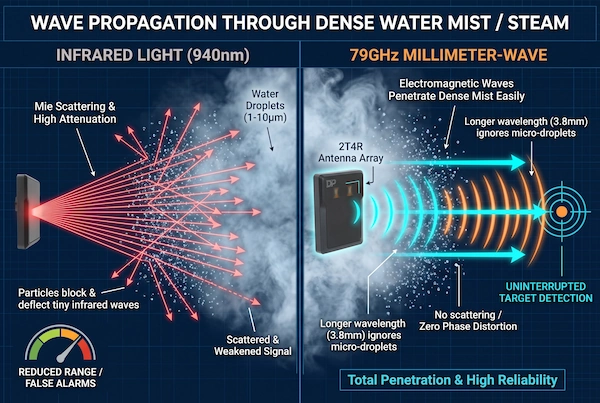
Scattering and attenuation of infrared light waves in a medium of microscopic water droplets:
Conventional safety light curtains utilize infrared and near-infrared electromagnetic waves with nanometer-scale wavelengths (typically between 850 nanometers and 940 nanometers);
White fog formed at the interface between cold and warm air is essentially a suspended aerosol composed of liquid water droplets with diameters ranging from 1 micrometer to 10 micrometers;
Since the wavelength of infrared light is on the same order of magnitude as the geometric dimensions of the water mist particles, intense Mie scattering occurs; dense fog not only significantly refracts and diverges the light beam, but the strong absorption of near-infrared energy by water molecules also causes the light intensity to decay exponentially, preventing the photodetector at the receiving end from capturing sufficient light flux;
Penetration Characteristics of 79 GHz Millimeter-Wave Electromagnetic Waves:
The RD79-6M operates in the 79 GHz ultra-high-frequency millimeter-wave band, with an electromagnetic wavelength of approximately 3.8 millimeters;
The wavelength of millimeter waves is hundreds or even thousands of times the diameter of tiny water mist particles suspended in the air; as the electromagnetic waves pass through dense water vapor, ice crystals, dust, splashing condensation, and even violently churning thermal air plumes, they experience virtually no noticeable phase distortion or energy scattering;
This microwave frequency band possesses exceptional all-weather penetration capabilities. Even in environments with heavy evaporative mist where visibility is less than half a meter, the radar antenna can still stably transmit and receive frequency-modulated continuous wave (FMCW) signals, eliminating the persistent on-site issues at cryogenic entrances and exits, such as “false stops caused by mist” and “false alarms triggered by evaporative mist.”
Dual-Mode Sensor Synergy: 2-in-1 Opening and Anti-Crush Redundancy
The integrated application of a top-mounted array radar and a vertical light curtain mounted on the column is the standard configuration for achieving unmanned passage and zero door-collision incidents in modern cold-chain logistics:
Separation of people and vehicles with 4-centimeter-level longitudinal ranging accuracy:
The RD79-6M hardware integrates an advanced 2T4R (two-transmit, four-receive) antenna array architecture, delivering an impressive 4-centimeter distance resolution;
The sensor features a built-in high-performance edge computing core that uses radar Doppler shift characteristics and target radar cross-section (RCS) to precisely distinguish the attributes of moving targets entering or exiting the passageway—whether they are large electric forklifts approaching at high speed, low-speed hand-pushed pallet jacks, or stock clerks walking slowly while wearing winter coats;
On-site engineers can use the “GL Control” Bluetooth mobile app on their smartphones to wirelessly configure the radar’s detection range, vehicle/pedestrian filtering rules, and sensing boundaries without climbing a ladder, thereby preventing the gate from frequently opening by mistake due to unrelated pedestrians passing by or vehicles traveling sideways;
2-in-1 Multifunctional Integration:
This device not only serves as a “smart door-opening trigger” for vehicles approaching the doorhead area but also provides precise monitoring of the “anti-crushing safety zone”;
While a forklift has not yet fully exited the door opening, the radar beam maintains continuous spatial detection to prevent the door curtain from closing prematurely;
Multi-layered Redundant Closed-Loop System Across the Entire Facade and Space:
First Line of Defense (Spatial Depth Detection): The RD79-6M radar, installed directly above the cold storage door header, monitors a three-dimensional fan-shaped space ranging from 1 to 6 meters in front of the door. Unaffected by ice reflection on the ground or white mist at the entrance, it reliably handles both active door opening in response to rapidly approaching forklifts and anti-pinch monitoring for obstacles beneath the door;
Second Line of Defense (Door Opening Vertical Pinching Protection): The CL20/CL25 safety light curtains, installed on the inner sides of the guide rails on both sides of the door opening, focus on safeguarding the narrow two-dimensional vertical area directly below the door curtain. Relying on dense infrared beams, they precisely detect low-lying forklift tines and human limbs;
This combination of “millimeter-wave radar for spatial penetration anti-crushing protection + anodized aluminum alloy light curtains for vertical anti-pinch protection” completely overcomes the environmental limitations of single-optical sensors, establishing an impenetrable, highly reliable safety barrier for cold chain high-speed doors.
At cold storage entrances and exits characterized by extreme cold, high humidity, and severe icing, if intelligent sensors with strong fog penetration, support for wireless mobile configuration, and compatibility with extreme climates are required, engineers can directly select the RD79-6M 79GHz Millimeter-Wave Barrier Gate Radar Sensor. This device features a rugged, IP66-rated industrial-grade weatherproof housing with a calibrated operating temperature range of -40°C to +80°C. Combined with the vehicle-pedestrian separation algorithm of its 2T4R antenna array, it ensures exceptional continuous operation for cold storage passageways even in dense condensation fog.
Field Installation Guidelines for Sub-Zero Environments
Under harsh operating conditions characterized by extremely low temperatures, high humidity, and the coexistence of cold and hot air convection, even when professional safety light curtains with an IP67 protection rating and wide-temperature capabilities are selected, the equipment will still frequently experience localized condensation, icing, and misalignment of the light beam if the on-site mechanical installation location is improperly chosen or violates the principles of aerodynamics. The installation of high-speed cold storage doors is by no means a simple matter of “drilling holes and tightening bolts.” It is essential to comprehensively incorporate the thermodynamic boundary layer, the airflow trajectory of the air curtain, and the drainage of gravity-fed condensate into the mechanical structural design to eliminate environmental blind spots at their source.
Airflow Boundary and Thermal Curtain Positioning
High-power industrial air curtains are typically installed above cold storage door openings to create a high-speed wall of air when the door curtain is open, thereby preventing the exchange of hot and cold air between the interior and exterior of the storage facility. The mounting points for the two aluminum alloy columns of the light curtain must precisely avoid the direct impact zone of the air curtain’s airflow:
Install them on the deep-cold side of the air curtain’s airflow isolation line:
During installation, the transmitter and receiver columns must be secured to stationary columns inside the cold storage facility, on the inner side of the vertical airflow curtain created by the air curtain unit, ensuring the light curtain remains entirely within the facility’s constant low-temperature zone;
It is strictly prohibited to install the light curtain directly below the air curtain unit’s air outlet or on the hot, humid side outside the cold storage facility;
If the hot airflow from the air curtain directly strikes the light curtain columns, it will cause the aluminum alloy housing to heat up, while the guide rail tightly pressed against the back remains in a deep-cold state. The extreme local temperature difference will force moisture from the humid, warm air outside the warehouse to “condense” onto the surface of the polycarbonate lenses within seconds, forming severe and irreversible condensation droplets;
Avoiding Heat Transfer via Thermal Bridges and Ensuring Secure Fastening:
Cold storage door frame columns are typically made of heavy-duty stainless steel or thick-walled carbon steel profiles, which conduct heat extremely rapidly at low temperatures and undergo significant cold contraction;
When installing the light curtain mounting brackets, low-temperature-resistant insulating thermal barrier shims must be installed between the aluminum alloy columns and the steel door frame to break the metal “thermal bridge” and mitigate the mechanical thermal stress impact on the printed circuit boards (PCBs) inside the columns caused by drastic fluctuations in ambient temperature;
All fastening bolts must be fitted with stainless steel spring washers and coated with a neutral, low-temperature anti-loosening thread sealant to completely counteract the continuous high-frequency vibrations transmitted to the door frame when the cold storage door curtain opens and closes at speeds exceeding 1.5 meters per second, thereby preventing slight angular drift of the optical axis.
Condensation Drainage and Optical Window Maintenance
Given that trace amounts of condensation are unavoidable in cryogenic environments, on-site installation and routine cleaning and maintenance must adhere to strict physical drainage and anti-fogging specifications:
Slightly Forward-Tilted Drainage Geometry:
When calibrating the vertical axes of the transmitter and receiver ends using a level, while ensuring the horizontal coaxiality tolerance (with an offset within ±3 millimeters), the two columns may be set at a slight forward tilt toward the floor of the door opening (with the tilt controlled within 0.5 degrees);
This slight forward tilt utilizes the gravitational flow effect to direct minute defrost water droplets condensing on the outer casing surface to slide down the vertical casing and drain away, rather than remaining horizontally for extended periods at the edges of the horizontal lens’s micro-pores and forming a water film;
“Wet Wiping” and Scratch Prevention Guidelines for Optical Windows:
The polycarbonate (PC) optical filter window serves as the core physical pathway for infrared beam transmission and reception;
During routine inspections, dust removal, and defrosting operations, it is strictly prohibited to wipe the lens with a damp cloth or cleaning solution containing moisture; in a storage environment at -20°C, the moment a damp cloth comes into contact with the cold PC panel, any residual moisture will instantly freeze into a rough, hard shell of ice, causing the light curtain to fail on the spot;
The official maintenance manual explicitly stipulates: When cleaning the optical viewing window, you must use a dry, soft, lint-free, dust-free cloth to gently wipe in a single direction;
Avoid using hard tools to forcefully remove ice:
If a thin layer of frost forms on the lens surface due to the door remaining open for an extended period, it is strictly prohibited to scrape or chip away the ice layer with a metal scraper, flathead screwdriver, or industrial utility knife blade. This prevents permanent microscopic scratches on the optical panel, which could cause the infrared light path to diverge and lose alignment. The correct procedure is to use a handheld portable defrosting heat gun to gently blow warm air on the affected area to melt the frost, and then immediately use a dry, soft microfiber cloth to quickly absorb and remove any liquid water droplets.
Low-Temperature Troubleshooting Matrix: 4 Common Freezer Faults
Under extreme operating conditions—such as sub-zero cryogenic temperatures and high-humidity convection—a malfunctioning cold storage door control system often results in significant cold air leakage and risks of food spoilage. On-site maintenance technicians frequently encounter typical faults such as doors remaining open, continuous alarms from the transmitter, the door jerking and bouncing repeatedly while closing, or a complete failure of the anti-pinch function. In most cases, these issues are not caused by internal sensor hardware burnout, but rather by sudden voltage drops in cables due to the deep-cold environment, blindness caused by condensation and frost buildup, loose terminal connections, or disrupted timing sequences. Based on the troubleshooting logic outlined in the original manufacturer’s user manual and drawing on frontline cold chain engineering and maintenance experience, this section organizes the four most common types of on-site electrical and optical path faults in cold storage facilities into a standardized troubleshooting checklist to help field engineers accurately pinpoint issues and quickly reset the system to restore operation.

Step-by-Step Diagnostic Solutions for Refrigeration Technicians
When faced with emergency stops, alarms, or logic deadlocks in cold storage door operators, technicians should first inspect the two-color status indicator light at the top of the column. Combining this with the door’s operational trajectory, they should follow the engineering steps below to conduct a systematic troubleshooting and resolution process:
| Fault Symptoms | Root Cause Analysis | On-Site Engineering Solutions |
| The system refuses to close the door after a defrost cycle | Condensation of defrost moisture on the surface of the receiving lens causes infrared light scattering and blockage. After the cold storage defrost cycle ends, a large amount of high-temperature, high-humidity moisture surges out and condenses on the cold optical window, forming a dense water film or fine frost;2. The receiving tube cannot capture the rated luminous flux, so the system detects a persistent obstruction and locks into the normally closed cutoff state. | 1. Use a clean, dry, lint-free soft cloth to wipe the PC filter windows on both the receiver and transmitter ends in one direction; 2. If frost buildup is severe, do not scrape it off with hard metal tools. Instead, use a portable heat gun to gently melt the frost and quickly blot away surface moisture; 3. Check the airflow angle of the air curtain unit at the entrance and recalibrate the air deflector to ensure the hot airflow avoids the light curtain column. |
| The transmitter’s red light flashes rapidly (Red Light Fast) | Excessive voltage drop in the power supply line at extremely low temperatures, resulting in an end-point voltage below 9V1. Extremely low temperatures inside the cold storage cause an increase in the resistance of the copper core wires; combined with long-distance transmission over a 16-meter cable, this leads to severe line loss and voltage drop;2. Under low-temperature, high-load conditions or during the instantaneous startup of the inverter, the transient voltage trough of the switching power supply drops below the 9V lower limit, triggering the under-voltage self-protection mechanism. | 1. Use a digital multimeter to measure the operating voltage under load by placing the probes directly on the red and black power supply wires at the base of the M8 aviation connector on the transmitter end; 2. If the voltage is below 9V, increase the cross-sectional area of the copper core in the main power supply line, or replace it with an industrial-grade 24V regulated power supply that offers greater load redundancy and lower ripple; 3. If the measured voltage exceeds 28V, immediately inspect the external rectifier circuit to eliminate the risk of overvoltage breakdown. |
| The door operator opens and closes normally but lacks anti-pinch protection | On-site wiring error, or mismatch between normally open (NO) and normally closed (NC) logic1. The white wire (COM) and yellow wire (Signal) are not correctly connected to the safety circuit terminals (Safety/Stop) on the mainboard, or there is a loose connection;2. The control board requires an NC (normally closed) safety circuit, but the light curtain is in its factory default NO (normally open) state, or a previous configuration change was not successfully saved. | 1. Verify the physical crimping of the white and yellow wires to ensure they are connected in series as passive dry contacts to the variable-frequency drive control board; 2. Disconnect the system power for 5 seconds, then restore power; within the 60-second “golden window” after power-up, use the green wire to lightly touch the black wire (GND) 5 times in succession; 3. After confirming that the red light at the top of the receiver is flashing to indicate a successful self-test, disconnect the green wire to permanently set the yellow wire’s output mode to NC (Normally Closed). |
| The door curtain repeatedly bounces back up while lowering | Light leakage from the insulated door curtain, discontinuous bottom beam coverage, or accidental grounding of the green wire1. The green wire at the receiver end is accidentally connected to the black GND wire, causing the system to be locked in Normal Mode (unobstructed mode);2. Light is passing through gaps in the curtain as it descends, or the bottom beam is sagging or vibrating, disrupting the timing requirements for continuous beam obstruction;3. Accumulated ice, snow, or debris from cargo on the floor of the door opening is blocking the lowest set of beams prematurely. | 1. Open the receiver’s junction box and confirm that the green wire is completely floating and insulated; this will force the activation of adaptive blanking mode; 2. Check the alignment of the curtain guide rails to ensure the weighted bottom rail is flat and smooth, eliminating any gaps that allow light to pass through; 3. Remove any accumulated ice or snow from the floor of the door opening and the underside of the guide rails to prevent the bottom light beam from being abnormally blocked prematurely. |
After completing the procedure according to the steps above, observe the status of the column indicator lights: if both the transmitter and receiver display a steady blue light (Blue light constant), this indicates that the optical axis has been geometrically aligned, the power supply is stable, and the photosensitive circuit has returned to standby monitoring mode. You may then proceed with the dynamic anti-pinch braking and closed-loop interlock tests.
Preventive Maintenance and Anti-Frost Operational Checklist
The harsh operating conditions of cold storage facilities mean that sensor maintenance must never follow a passive, reactive “fix it when it breaks” approach. In environments characterized by intense convection between hot and cold air and continuous defrosting, issues such as moisture leakage, terminal oxidation, micro-icing, and loosening of fasteners due to cold contraction often occur silently before the system shuts down. Establishing routine preventive inspection and electrical circuit measurement procedures is essential to ensuring that cold storage doors achieve zero false alarms and zero door collisions under high-frequency logistics throughput.
Daily Inspection and De-Icing SOP
The cold storage facility management team should incorporate the following inspection items into the standardized operating procedures (SOPs) for each shift handover, with maintenance electricians and on-site supervisors signing off to confirm completion:
Removal of Ice Buildup from Entrance/Exit Guide Rails and Floor:
During daily shift handoffs, special attention must be paid to inspecting the inner walls of the stainless steel vertical guide rails on both sides of the door frame, as well as the floor directly beneath the door opening;
Promptly use a rubber de-icing scraper to remove accumulated snow and fine ice fragments from the guide rail grooves and seal brushes to strictly prevent micro-icing inside the guide rails from obstructing the door curtain’s descent, causing mechanical jamming, and disrupting the continuous sequence of light beam obstruction;
Thoroughly remove any protruding “black ice” and scattered pallet debris from the floor to prevent physical obstructions at the bottom of the door opening from prematurely blocking the lowest light beam path, which could trigger false alarms and cause the door to bounce back during descent;
Inspection of M8 Aviation Connector Sealing O-Rings and Mechanical Integrity:
Inspect the 5-pin M8 threaded aviation connectors extending from the transmitter and receiver ends;
Manually check whether the knurled metal nuts have become slightly loose due to mechanical resonance caused by the door’s prolonged high-speed opening and closing;
Confirm that the low-temperature-resistant rubber O-ring at the connector joint is tightly compressed and free of cracking or aging, preventing high-humidity defrost moisture from outside the warehouse from seeping into the pins through thread gaps and causing inter-pin leakage;
Lens Surface Cleanliness and Frost-Free, Water-Free Maintenance:
Inspect the polycarbonate (PC) filter windows at both ends;
If a fine film of condensation or a thin layer of frost is detected on the surface, it must be gently wiped away in one direction using a dry, lint-free microfiber cloth;
Never wipe with a damp cloth, and never scrape the panel with sharp metal tools, to prevent scratching the optical surface or causing instantaneous icing on-site.
Inverter Safety Loop Continuity and Fail-Safe Verification
Every two weeks, or after each major defrost maintenance of the cold storage facility, technicians must use a calibrated digital multimeter to perform static impedance measurements and dynamic anti-pinch verification on the safety loop connected to the inverter control board:
Static Cold-State and Power-On Dry Contact Impedance Measurement:
Power-Off Safety Verification: Disconnect the main power supply to the control panel. Set the multimeter to the ohms (resistance) range and use the probes to directly measure the impedance between the yellow wire (Signal) and the white wire (COM) at the receiver end. The measured value must be infinite (displayed as “OL” for open circuit), confirming that the internal solid-state optocoupler relay provides absolute isolation when de-energized;
Power-On Normal State (Aligned and Light-Transmitting) NC Closed-Contact Impedance: Power the system back on. While the indicator lights at both the transmitter and receiver ends are steadily blue (with no obstruction), measure the closed-contact resistance between the yellow and white wires. The measured impedance must be consistently less than 0.5 ohms; if the impedance drifts to several tens of ohms or higher, this indicates aging internal contacts or poor oxidation at the crimped terminals, and immediate action must be taken;
NC Instantaneous Disconnection Verification (Light Blocking Trigger): Use an opaque shield to interrupt any one of the infrared beams; the receiver’s indicator light should switch to a steady red light, and the multimeter reading must instantly jump to infinite open circuit (OL) within milliseconds;
High-Speed Full-Travel Dynamic Penetration Interception Test:
Use a rigid test object that complies with safety standards (base cross-section 200 mm × 200 mm, height 700 mm) and place it on the left, center, and right sides of the door opening, respectively;
Activate the cold storage door to close the insulated curtain downward at the rated full speed of 1.5 meters per second or higher;
When the curtain descends to a position near the top of the test object, the safety light curtain must interrupt the normally closed circuit within microseconds, causing the servo motor’s mechanical brake—driven by the variable frequency drive—to engage instantly;
Acceptance Criteria: The weighted bottom rail of the curtain must come to a smooth, suspended stop within a safe clearance height of 50 to 100 millimeters above the top of the test object, and immediately reverse direction and rise smoothly; under no circumstances may the bottom rail come into physical contact with any obstacle during the entire process.
Maintenance engineers installing new systems on-site or encountering control board model changes—who need to redefine the 5-core cable configuration, verify the wiring of the yellow signal wire’s passive dry contact, or perform polarity conversion without disassembling the machine—may directly refer to the specialized guide How to Wire Safety Light Curtain: M8 Pinout, NO/NC & Blanking to master the complete illustrated details of standard 5-core M8 aviation connector wiring and the 60-second “5-touch GND” reverse normally-closed logic.
Cold Storage Maintenance FAQ: Anti-Frost & Reliability
In the day-to-day maintenance of low-temperature cold storage facilities, quick-freezing sliding doors, and entry/exit points for fresh produce cold chain logistics, frontline engineering and technical personnel often encounter various sporadic and complex malfunctions caused by sudden environmental changes. This section provides in-depth answers to four of the most representative practical engineering issues: false alarms caused by alternating hot and cold air when doors open, IP rating selection criteria, the cooperative redundancy logic between radar and light curtains, and the crack resistance of low-temperature cables.
Why does my safety light curtain trigger false alarms every time the freezer door opens?
The core cause is the “sudden drop in dew point and optical Mie scattering-induced blindness” triggered by the intrusion of a high-humidity, hot airflow the moment the cold storage door opens.
Mechanism of transient dew point water vapor condensation:
The internal temperature of the cold storage facility typically remains around -20°C year-round, while the buffer room or loading dock outside the facility is often in a high-humidity environment ranging from +15°C to +25°C;
When the door curtain rises rapidly, the lighter, hot, and humid air from outside surges at high speed toward the top of the door opening, driven by the pressure difference, while the high-density cold air inside the facility surges out along the floor;
This intense thermal convection causes the temperature at the interface to instantly drop below the dew point of the warm, humid air; since the light curtain module is in a deep-cold state, within seconds of the warm, humid air coming into contact with the icy filter lens, dense, micron-sized water droplets rapidly condense on the surface of the polycarbonate lens;
Infrared Beam Scattering and Missed Targets:
The fine water droplets and the resulting micro-frost cause strong refraction and divergence of the near-infrared collimated parallel beams in the 850- to 940-nanometer range, causing the light flux captured by the opposite receiving end to plummet instantly; the microprocessor misinterprets this as the channel being obstructed by an object and outputs an open-circuit signal to prevent the gate curtain from closing;
Engineering Mitigation Measures:
Airflow Isolation: The light curtain posts must be installed on the deep-cold side of the airflow isolation line from the hot-air curtain unit (Air Curtain) at the top of the door opening; under no circumstances should hot air blow directly onto the light curtain housing;
Functional Configuration: Ensure that the green wire at the receiver end is suspended and insulated; enable Adaptive Blanking mode to suppress beam fluctuations caused by door movement, allowing the door to close rapidly and complete the loop.
What is the practical difference between IP65 (CL25) and IP67 (CL20) in cold storage?
The key difference lies in the structural resistance to water penetration and sealing capabilities when exposed to high-humidity defrosting, standing water, immersion, water vapor-induced negative pressure suction, and high-pressure disinfection spray washing.
IP65 (CL25 Series) Protection Specifications:
The CL25 is rated at IP65, providing complete protection against the ingress of foreign objects and dust, and withstanding low-pressure water jets from any direction;
Applicable Scenarios: Suitable for large entry/exit passages in conventional cold storage facilities with high ceilings (door height exceeding 2.2 meters), where the entrances and exits are primarily in relatively dry conditions and are not subject to frequent close-range high-pressure water jet washing;
IP67 (CL20 Series) Deep-Cold Heavy-Duty Application:
The CL20 Series’ overall sealing structure meets the stringent IP67 rating; its internal circuit boards and optical component chambers are sealed using a full potting process or high-resilience, low-temperature-resistant sealing rings;
Performance Limits: IP67 means the device will not leak even after being submerged in 1 meter of water for 30 minutes;
Practical Value in Cold Storage: During defrost cycles in cold storage facilities, large amounts of liquid condensation often flow down and wash over the door jambs; in food-processing cold storage facilities, door frames are also thoroughly sprayed and cleaned daily with medium- to high-pressure hot water or disinfectant jets. The CL20’s IP67 fully sealed construction completely prevents water molecules from being drawn into the light curtain’s dark chamber due to the “negative pressure breathing effect” caused by internal and external temperature differences, offering superior weather resistance and reliability.
How does the RD79-6M radar complement the optical light curtain in dense fog?
The two systems—one based on microwave penetration and the other on close-range optical 3D protection—work together to form a complementary dual-redundancy circuit that provides “environmental interference resistance + all-around, zero-blind-spot anti-pinch protection.”
Physical Advantages of 79 GHz Millimeter Waves in Penetrating Water Vapor:
The RD79-6M utilizes 79 GHz ultra-high-frequency electromagnetic waves with a wavelength of approximately 3.8 millimeters;
The wavelength of millimeter waves is far greater than the geometric diameter of water droplets suspended in the air (1 to 10 micrometers). As the electromagnetic waves penetrate dense, evaporative white fog and thermal plumes, they experience virtually no energy scattering or attenuation, enabling precise detection even in conditions of diffuse fog where visibility is insufficient to the naked eye;
Dual-Mode Sensing and Collaborative Functional Division:
Array Radar (Spatial Depth Perception and Door-Opening Trigger): The RD79-6M, mounted above the door header, covers the frontal sector of the passageway. Equipped with a built-in 2T4R antenna array, it provides 4-centimeter-level ranging and vehicle-pedestrian separation algorithms to accurately identify approaching forklifts in heavy fog and trigger the door to open, while simultaneously performing anti-crushing monitoring beneath the door;
Vertical Light Curtain (3D Anti-Pinch Protection Directly Below the Door Curtain): The CL20/CL25 safety light curtains, installed on the inner side of the vertical guide rails in the door opening, focus on protecting the narrow two-dimensional area directly below the door curtain. Relying on dense infrared beams, they precisely detect low-lying forklift tines and human limbs;
This coordinated architecture ensures that the cold storage door will not fail to close due to false alarms caused by sudden dense fog, while also eliminating collision accidents in blind spots, thereby achieving stable, round-the-clock operation.
Will the light curtain cable crack or stiffen at -20°C?
No. The CL Series comes standard with an industrial-grade, 5-core, cold-resistant cable that has undergone cryogenic physical modification, providing exceptional resistance to bending and cracking at low temperatures.
Low-Temperature-Modified Engineered Elastomer Sheath:
In standard commercial PVC cables, when the ambient temperature drops below 0°C, the plasticizers rapidly harden and precipitate, causing the cable to become as stiff as an iron rod. Even slight bending or stretching due to door-operating machinery vibrations can result in through-cracking, exposing the copper conductors and causing electrical leakage;
The outer sheath of the 5-core cables in the CL series utilizes specialized cold-resistant polyurethane (PUR) or weather-resistant elastomers, which maintain the toughness and elasticity of the molecular chains even within the specified temperature range of -20°C to +60°C;
Multi-strand fine annealed copper wires and shielding:
The internal conductors are composed of multiple strands of ultra-fine annealed oxygen-free copper wire twisted together, providing a bending fatigue life far exceeding that of ordinary single-strand copper cores;
The cable incorporates a built-in high-density tinned copper mesh shielding layer and an aluminum foil interference-suppression layer. Even under high-frequency mechanical vibrations caused by the high-speed opening and closing of cold storage door motors, the internal conductors will not suffer from fatigue-induced strand breakage, ensuring long-term stable signal transmission.