


RD79-6M 79GHz Millimeter-Wave Barrier Gate Radar Sensor (Bluetooth & RS485)
✓ 79GHz Millimeter-Wave Technology (2T4R Antenna Array, 4cm Range Resolution)
✓ 2-in-1 Dual Function: Anti-Crush Safety & Vehicle Approach Triggering
✓ Pedestrian & Vehicle Target Separation to Prevent Accidental Gate Drops
✓ Wireless Bluetooth App Tuning via “GL Control” Mobile Application
✓ Universal Barrier Compatibility: Straight, Folding, Fence & Advertising Gates
✓ Industrial IP66 Weatherproof Housing with -40°C to +80°C Operating Limits
$179.00 Original price was: $179.00.$139.00Current price is: $139.00.


🚚 Ships within 24-48 hours | 🛡️ 1-Year Quality Warranty
RD79-6M 79GHZ HIGH-PRECISION BARRIER GATE RADAR SENSOR OVERVIEW
The RD79-6M is an industrial-grade 79GHz millimeter-wave radar sensor engineered specifically for parking entrance/exit management, commercial barrier gates, and toll collection systems. Utilizing automotive-grade RF SoC architecture and Linear Frequency Modulation Continuous Wave (LFM-CW) technology with a 2T4R antenna array, it delivers exceptional 4cm distance resolution and millisecond-level response times under 100ms.
Key Operational Advantages:
Anti-Crush & Trigger Dual Operation: Functions as an anti-fall safety sensor to prevent arm descent onto vehicles/pedestrians, or as an approach trigger to actuate barrier gate opening.
Intelligent Target Filtering: Identifies distinct radar signatures to separate pedestrians from motor vehicles, balancing lane throughput with anti-pinch protection.
Fast Bluetooth Commissioning: Mobile configuration via the GL Control App allows field technicians to calibrate 3D detection boundaries without physical potentiometers.
All-Weather 24/7 Reliability: IP66 rated aluminum alloy and PC enclosure delivers continuous operation across rain, snow, and extreme ambient temperatures from -40°C to +80°C.
TECHNICAL SPECIFICATIONS & ELECTRICAL RATINGS
| Parameter Specification | Technical Rating & Working Limits |
| Operating Frequency | 79.0 GHz – 81.0 GHz (LFM-CW Technology) |
| Distance Resolution | 4 cm (High-Precision 2T4R Antenna Array) |
| Detection Modes | Anti-Crush Mode | Trigger Mode | Inclined-Mount Trigger |
| Target Differentiation | Vehicle Only | Pedestrian & Vehicle Combined Detection |
| Barrier Arm Compatibility | Straight Poles, Folding Arms, Fences, Advertising Barriers |
| Communication Interfaces | Wireless Bluetooth BLE & Industrial RS485 (Green B- / Yellow A+) |
| Response Time | < 100 ms (< 500 ms decision time) |
| Operating Voltage & Power | DC 12–24V | Average Current: 200mA @ 12V (Power: 1.2W) |
| Relay Output | Dry Contact Relay: Blue (COM) & White (NO) |
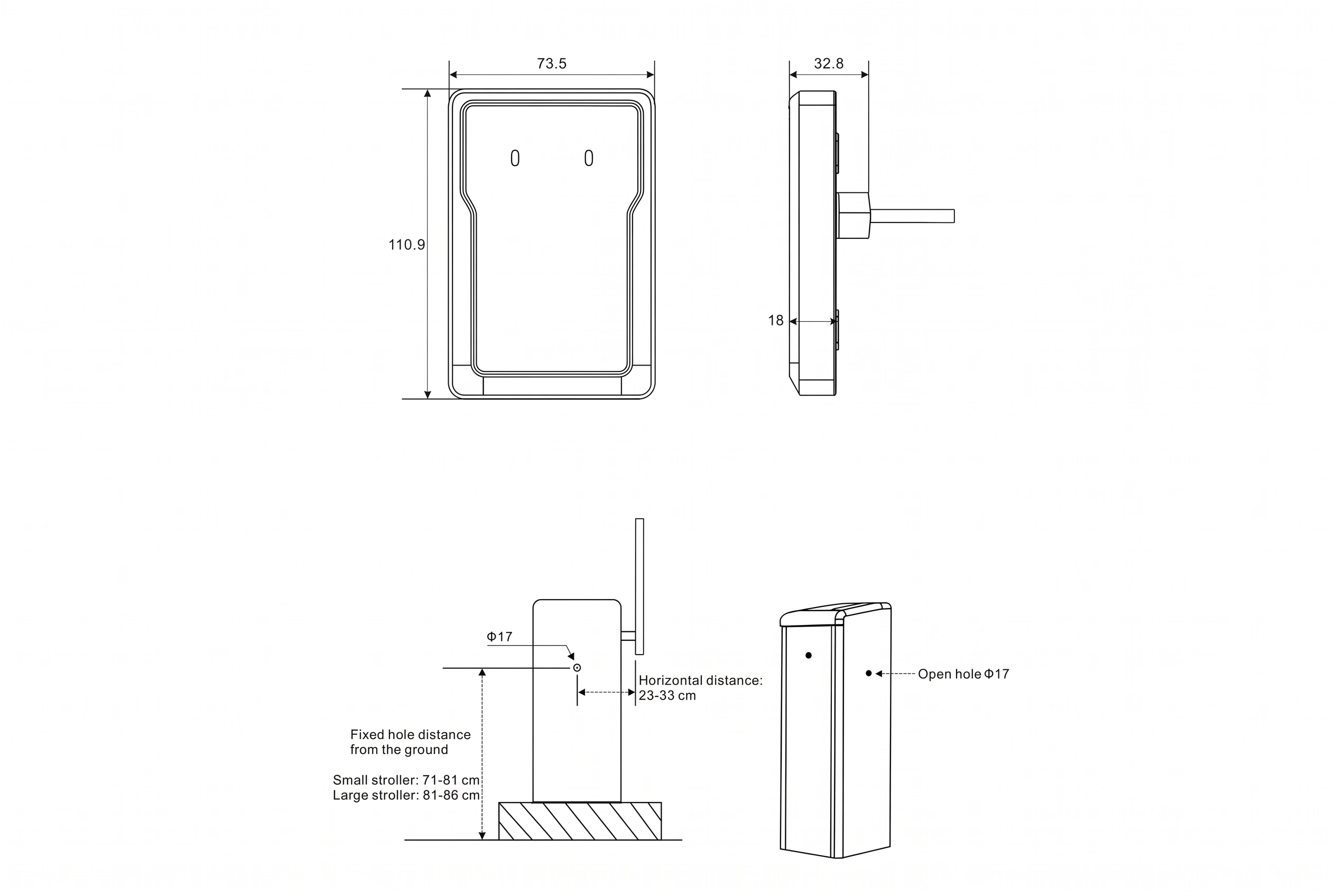
| Housing & Dimensions | PC + Aluminum Alloy | 73.5 mm × 110.9 mm × 32.8 mm |
| Ingress Protection | IP66 Weatherproof Industrial Rating |
| Operating Temperature | -40°C to +80°C (-40°F to 176°F) |

CABLE WIRING DEFINITIONS & WIRELESS BLUETOOTH APP CONFIGURATION
Color-Coded 8-Core Cable Lead Definitions:
Red: DC Power Input (+12V to +24V DC, 12V/1A recommended)
Black: Power Ground (GND)
Green: RS485 Communication Data B-
Yellow: RS485 Communication Data A+
Blue: Barrier Controller Relay Common (COM)
White: Barrier Controller Relay Normally Open (NO)
Brown & Orange: Factory Reserved Interface Leads
APPLICATION SCENARIOS & BARRIER GATE CABINET MOUNTING SETUP
Key Applications:
Parking & Garages: Prevents barrier arm descent onto vehicles or pedestrians.
Toll & Access Lanes: Fast vehicle approach triggering for LPR camera capture.
Mixed Traffic Gates: Distinguishes pedestrians, motorcycles, and automobiles.
Loop Replacement: Installs without roadway cutting, trenching, or slot sealing.
Cabinet Mounting Guidelines:
Installation Height: 71–81 cm (small vehicles) / 81–86 cm (heavy vehicles).
Horizontal Offset: Drill 23–33 cm from the barrier arm pivot axis.
Hole Size: Standard Φ17 mm pass-through hole on the cabinet face.
Calibration: Fast Bluetooth BLE boundary setup via the GL Control app.
1x RD79-6M 79GHz Radar Sensor Unit
1x 8-Core Pre-Wired Cable Harness
1x Cabinet Mounting Nut & Gasket Kit
1x Quick Setup User Guide

FREQUENTLY ASKED QUESTIONS & RADAR CALIBRATION
Q1: Why choose a 79GHz radar sensor over traditional inductive ground loops?
A: The RD79-6M radar eliminates roadway cutting, epoxy sealing, and wire damage caused by asphalt movement. It detects both pedestrians and vehicles, connects wirelessly via Bluetooth for instant calibration, and operates reliably in rain, snow, and extreme temperatures.
Q2: How do I configure the radar detection boundary on site?
A: Download the “GL Control” app on iOS or Android, connect to the radar via Bluetooth (Default password: 123456), and adjust the Left/Right lateral distance (0.5m–1.5m) and forward detection distance (up to 6.0m) directly on the visual grid.
Q3: When must Background Learning be performed?
A: Background learning must be executed during initial installation or whenever environmental elements (such as traffic cones, signs, or bollards) are added within the detection zone. Ensure the barrier arm is raised, clear all targets from the area, and tap “Bg Learn” in the app.
Q4: Can the RD79-6M be used for both entrance triggering and anti-crush safety?
A: Yes. The device integrates both modes. In “Trigger Mode”, it sends a pulse to open the gate when a vehicle approaches. In “Anti-Crush Mode”, it holds the relay active to keep the arm open while any vehicle or pedestrian is detected beneath the barrier.
Q5: What should I do if the radar drops connection or triggers false gate lowering?
A: Verify that the power supply provides a stable 12V–24V DC with at least 1A current capacity. Clean the radar front surface of heavy snow or dirt accumulation, and perform a new Background Learning procedure with the arm raised.