
Introduction: The Operational Cost of Reactive Door Safety
When evaluating safety light curtain vs safety edge systems at high-traffic entrances and exits across automated high-bay warehouses, cold-chain facilities, and manufacturing plants, high-speed roll-up doors typically operate at demanding speeds of 1.0 to 2.0 meters per second. These passageways handle hundreds or even thousands of high-speed trips by forklifts, stackers, and AGVs every day. For on-site facility operations managers and electrical teams, the most frustrating—and most common—hidden cost pitfall is the impact accidents caused by sagging door curtains.
Every time the door strikes a forklift fork or vehicle body, it triggers a chain reaction of damage: the heavy-duty, wind-resistant bottom rail bends and twists severely on the spot; the sliders inside the zipper-style self-repairing guide rails on both sides disengage and jam; and even the upper roller is subjected to torsional impact, causing damage to the gears of the variable-frequency servo motor. The resulting emergency repairs often take 4 to 8 hours. Not only do the costs for a single spare part replacement and labor run into the thousands of dollars, but the logistics shutdown and production line stoppages caused by the paralysis of the main thoroughfare also result in irreparable operational losses.
The root cause of this persistent collision vicious cycle lies in the widespread and long-standing use of traditional mechanical contact sensing technology in the industry—the pneumatic or conductive safety edge. The underlying control logic of mechanical safety edges follows a typical passive, reactive architecture: only after the rubber airbag is physically compressed by an external force—generating an internal pressure wave that activates a microswitch—can the control board detect the obstacle signal and issue a braking command. This physical mechanism—where “impact must occur before braking”—leaves absolutely no room for cushioning when faced with heavy-duty forklifts weighing several metric tons and possessing immense inertia. The slight delay between the moment the safety edge is compressed and the actual application of the brakes is sufficient to generate a devastating mechanical impact.
To put an end to the tragic incidents of doors being smashed at high-traffic entry and exit points, industrial safety systems must make a complete shift from passive physical force-based countermeasures to active, non-contact photoelectric defense. By vertically deploying a continuous-scanning, area-covering safety light curtain along the door frame posts, the system can forcibly cut off the variable-frequency drive’s safety circuit with a millisecond-level optical response the moment an obstacle approaches the door’s path, thereby achieving a safe suspension and reverse movement with zero physical contact. This proactive protection mechanism, which blocks collision forces at the source, not only completely eliminates mechanical wear and tear caused by the bottom rail and guide rails but also helps companies confidently meet the stringent EHS and workplace safety compliance requirements of regulations such as OSHA and the European EN 12453 standard.
The 0.3-Second Lag: Why Contact Safety Edges Fail Under High-Speed Operation
When faced with an accident involving a person being struck by a door curtain, many workshop managers’ first instinct is to suspect that the safety bottom edge has been completely damaged. However, testing reveals that when a person presses down on the rubber strip at the bottom with their hand, the door curtain does indeed spring back up responsively. This phenomenon reveals a harsh engineering reality: while safety bottom edges may appear to function normally during low-speed or static testing, the inherent physical lag in their underlying mechanism under real-world dynamic conditions—such as high-speed material handling—means they are unable to prevent direct, mechanical impact damage.
Mechanical and Pneumatic Transmission Delays in Safety Edges
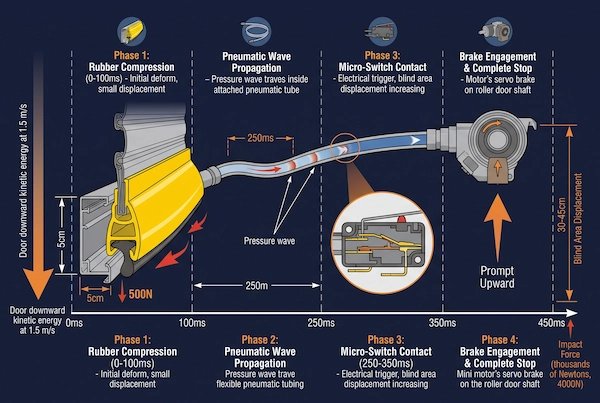
The activation of traditional pneumatic safety edges or conductive rubber safety edges essentially relies on an extremely long and complex physical chain of events:
Physical compression deformation of the rubber housing: The bottom beam must first make solid contact with the forklift tines, vehicle body, or cargo below, applying sufficient downward mechanical pressure to cause deep indentation and collapse of the thick EPDM rubber chamber;
Fluid transmission of pressure waves along the tubing: Once the chamber is compressed, the faint air pressure pulse generated must travel along the slender tubing to the mechanical pneumatic microswitch mounted on the side of the bottom beam;
Contact Closure and Signal Transmission via Follow-Along Circuitry: Driven by the air pressure, the micro-switch’s reed closes physically, transmitting the electrical signal back to the wall-mounted control panel via a spiral cable that curls along with the curtain or through a wireless RF transmitter;
Control board processing and motor electromagnetic braking: Upon receiving a change in the input terminal status, the main PLC or variable-frequency drive board executes internal firmware logic operations, issues an emergency stop and power-off command, and finally, the motor’s mechanical electromagnetic brake applies the brake to decelerate and reverse the door.
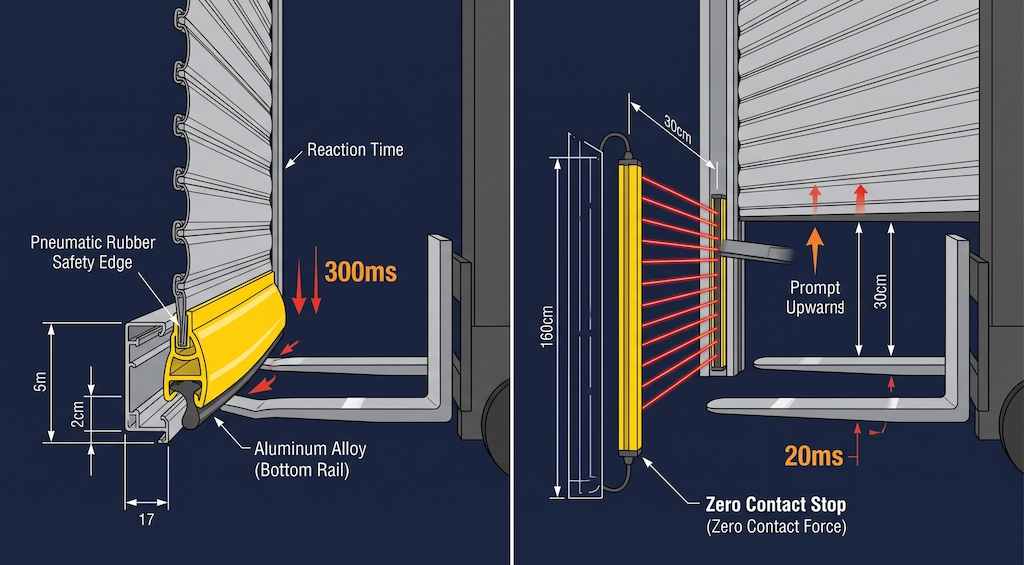
Starting from the moment the bottom rail’s rubber contacts a hard object, completing this entire “mechanical compression—fluid transmission—contact closure – microprocessor processing – electromagnetic braking” mechanical-electrical closed-loop process, an unavoidable physical lag of 0.3 to 0.5 seconds inevitably occurs in industrial settings. On slow-moving residential garage doors, this delay of a few hundred milliseconds may be inconsequential, but on modern high-speed industrial doors where every second counts, even this brief 0.3-second delay can be the root cause of a disaster.
Downward Kinetic Impact Force on Forklift Tines
To quickly seal off workshops and isolate hot and cold air, modern high-speed roll-up doors are typically set to lower the curtain and aluminum alloy bottom rail at a vertical speed ranging from 1.0 meters per second to 1.5 meters per second.
During this 0.3-second “blind spot,” the variable-frequency drive motor remains in full-power downward drive mode, and the brake calipers have not yet engaged. If a forklift with its steel tines extended forward happens to be positioned directly beneath the door at this moment, the bottom rail of the door curtain will continue to force a vertical displacement of 30 to 45 centimeters downward within that brief 0.3-second interval.
When the bottom rail—weighing tens of kilograms and containing high-rigidity steel counterweights or wind-resistant aluminum profiles—collides at a linear velocity of 1.5 meters per second with the extremely hard forged steel forks, the mechanical kinetic energy cannot be fully absorbed by the soft rubber layer. Instead, it generates an instantaneous destructive impact force of up to several thousand newtons within the extremely short contact area:
Severe bending and twisting of the wind-resistant aluminum alloy bottom beam: The force is concentrated on the narrow contact surface with the forks, generating a powerful localized load that directly causes the extruded aluminum alloy profile to kink into a V-shape; the rubber edging at the bottom is instantly crushed and torn apart by the hard object;
Self-repairing zipper guide rails disengage and fracture: The bottom rail rebounds upward upon impact and tilts laterally. Enormous torsional shear forces violently pull along both sides of the curtain fabric, forcibly tearing the internal high-molecular-weight polyethylene wear-resistant strips in the guide rails. This causes widespread detachment of the self-repairing zipper teeth and even forcibly pulls the entire aluminum alloy guide rails on both sides off the steel door columns, deforming them in the process;
Damage to the servo motor drive gears: The powerful recoil torque is transmitted in reverse through the winding shaft to the motor reducer at the top, causing tooth surface spalling or tooth breakage inside the precision gearbox, which completely strips the entire door drive system of its braking capability.
This demonstrates an inescapable law of physics: as long as the sensing mechanism relies on “collision contact,” a 0.3-second mechanical delay will always exist, and the kinetic energy generated by the high-speed free fall of industrial equipment will inevitably lead to catastrophic mechanical failure.
Millisecond Non-Contact Sensing: How Safety Light Curtains Prevent Physical Impacts
To completely break free from the passive vicious cycle of mechanical edge strips—where “impact occurs first, followed by rebound”—the only engineering solution is to move the protective boundary from the physical surface into the vertical space. Unlike airbags that passively wait to be compressed, the Safety Light Curtain establishes a proactive defense network in the open area of the door opening. By completely transforming the sensing logic from “contact-based mechanical sensing” to “non-contact optical interruption,” the light curtain system initiates braking and interception the instant an obstacle approaches the door curtain—before it makes contact.
Under 20 ms Optical Interruption Before Threshold Penetration
The core mechanism of the Safety Light Curtain involves vertically mounting high-precision infrared emitter and receiver arrays on the guide rail columns on both sides of the high-speed roll-up door. Once powered on, the arrays project dense, parallel, modulated infrared beams at an extremely high frequency across the entire vertical projection of the door frame, forming a blind-spot-free vertical optical barrier that covers the clearance beneath the door.
This optical network demonstrates an overwhelming time advantage in its operational sequence:
Light-Speed Interception and Zero-Travel Penetration: The moment a forklift’s extended, suspended steel forks, tilted cargo on a pallet, or a worker’s protruding limb crosses the edge of the door column, the infrared light flux is interrupted within microseconds;
Hard-cut response in less than 20 milliseconds: After the high-speed master microprocessor inside the receiver detects a beam interruption, the built-in solid-state photoelectric relay directly and forcibly cuts off the normally closed (NC) safety circuit within a time window of less than 20 milliseconds;
Millisecond-level mid-air suspension and reversal: The moment the variable frequency drive receives the signal that the normally closed contact has opened, it immediately cuts off the servo motor’s drive power and activates the mechanical brake. The door curtain’s bottom rail achieves a smooth mid-air suspension with minimal displacement—just a few centimeters from its descent—and then smoothly reverses direction, maintaining absolute physical separation from the obstacle throughout the entire process.
This ultra-fast electrical response—less than 20 milliseconds—minimizes the physical compression and pneumatic transmission timing of traditional airbags, which can take up to several hundred milliseconds, truly achieving “the door hasn’t even touched the obstacle, yet the brake has already engaged.”
Eliminating Torsional Stress on Self-Repairing Zipper Door Guides
Modern high-frequency logistics passages commonly use self-repairing zipper-style high-speed roll-up doors. The core technical advantage of this door type lies in the dense, continuous teeth on both sides of the curtain, which engage smoothly with the aluminum alloy guide rails on either side. If the door is slightly derailed by an external force, it can automatically reset and re-engage as it rises, thanks to the self-repairing derailment wheels at the top. However, this precision mechanism is most vulnerable to asymmetric torsional forces caused by an impact on a single side of the curtain’s bottom rail.
If a traditional air-cushioned bottom edge is used, the bottom rail will slam down onto a hard forklift tine within 0.3 seconds of falling. The immense impact force will instantly convert into lateral shear force and violent torsional torque:
Damage to the self-repairing reset wheels and ultra-high molecular weight polyethylene inserts: The bottom rail warps and tilts upon impact, causing the zippers on both sides to be violently torn sideways. This results in the wear-resistant ultra-high molecular weight polyethylene inserts mounted on the inner walls of the guide rails being gouged and deformed, and the bearings of the reset guide wheels may even be snapped off;
Zipper tooth fractures and irreversible tearing of the curtain fabric: The impact torque is concentrated on a few localized zipper teeth, making it extremely likely for the teeth to fracture and fall off. This causes the entire curtain to lose its airtight, self-healing capability, ultimately rendering it unusable and requiring complete replacement.
However, by deploying a vertical safety light curtain, the non-contact hovering and recovery mechanism eliminates the impact force. The door curtain’s bottom rail and the zipper components on both sides remain in a state of symmetrical, balanced gravitational sag throughout the descent, completely eliminating the transmission of any lateral shear forces or abnormal torque to the guide rails, thereby fundamentally ensuring the service life of the entire door’s precision mechanical components.
For high-traffic main logistics corridors, facility management teams can use the High-Speed Roll-Up Door Parts section to centrally configure high-toughness, self-repairing components and vibration-resistant column light curtain kits, systematically eliminating the risk of structural damage during routine maintenance.
Feature-by-Feature Engineering Matrix: Light Curtains vs. Safety Edges
When evaluating the retrofitting and upgrading of industrial door control systems, equipment procurement and operations and maintenance departments often fall into the misconception that “non-contact light curtains are expensive, while traditional air-cushion safety edges are inexpensive and durable.” However, evaluating the value of safety components solely based on unit purchase price completely obscures the vast differences between the two technologies in terms of mechanical architecture, response time, electrical lifespan, and long-term total cost of ownership. A feature-by-feature technical comparison of these two types of sensors under identical engineering conditions clearly reveals the generational gap between them.
Comprehensive Technical Comparison Table
To provide clear data support for facility retrofits and electrical component selection, the following section presents a systematic comparison of industrial door safety light curtains and mechanical contact-type airbag safety bottom edges, covering core electrical metrics, mechanical structure, monitoring coverage, and environmental resilience:
| Evaluation Criteria | Industrial Door Safety Light Curtain | Traditional Mechanical Airbag Safety Edge | Engineering Impact and Safety Outcomes |
| Response Latency | Less than 20 milliseconds (solid-state optocoupler with ultra-fast hard cutoff) | 300 to 500 milliseconds (mechanical deformation + pneumatic transmission) | Light curtains can cause the gate to hover in mid-air before it comes into contact with an obstacle, whereas airbags inevitably result in a hard collision. |
| Detection Envelope | Full-height continuous grid (covering 0.5 m to 2.5 m) | Single linear contact point at the bottom only (covers only the lower edge of the door curtain) | Light curtains eliminate blind spots caused by mid-to-high-level suspended forks and tilted cargo, while airbags have a three-dimensional detection gap of up to 80%. |
| Contact Force | 0 Newtons (Fully non-contact, proactive detection) | Hundreds to thousands of newtons (rebound from the momentum of the falling door curtain) | Light curtains cause zero shear damage to self-repairing zipper tracks, whereas airbag impacts can easily cause aluminum alloy bottom beams to warp and become unusable |
| Mechanical Wear and Consumables | Solid-state optoelectronic semiconductors, zero physical mechanical wear | Rubber casing cracks under pressure; internal airbag leaks through micro-pores | Light curtains have a service life of several years, while airbags typically experience performance degradation due to aging or wear within 6 to 12 months |
| Wiring Reliability | Wiring fixed to stationary door frame posts, zero repetitive tension | Spiral-wound cable following the door curtain or battery-powered wireless transmitter | Light curtains eliminate the risk of broken cores or wires, whereas the spring-loaded wires in airbags are prone to snapping or tearing, and wireless units require frequent battery replacement |
| Temperature Stability | Wide temperature compensation from -20°C to +60°C, ensuring stable light transmission | Rubber hardens and contracts at low temperatures, making air pressure sensors highly prone to failure | Light curtains produce zero false alarms in cold storage facilities and workshops during the height of summer, whereas airbags are highly prone to false shutdowns and lockups due to low temperatures in northern regions during winter |
| Door Closure Compatibility (Door Descent Logic) | Features intelligent blanking for automatic self-shielding during door descent | Pressure is applied as the door curtain descends, resulting in unimpeded downward detection | Light curtains support smooth and continuous closure of the door curtain without triggering false rebound loops |
Total Cost of Ownership (TCO): Hidden Repair Bills vs. Solid-State Durability
When conducting an initial cost analysis of equipment, the unit purchase price of a set of traditional airbag safety edges is typically only 40% to 60% of that of a high-quality safety light curtain. It is precisely this seemingly attractive initial price difference that causes many factory management teams to overlook the staggering total cost of ownership (TCO) over the following three years.
Behind the “low-price” facade of traditional air-cushion safety edges lie three major hidden cost black holes that continuously eat away at maintenance budgets:
Extremely Frequent Replacement of Follow-Along Cables and Wireless Modules:
High-speed roll-up doors open and close hundreds to thousands of times a day. During continuous high-speed stretching and rebound, the internal copper wires in the coil cord—which is attached to the side of the door curtain—are highly prone to hidden fractures due to high-frequency metal fatigue.If a wireless RF bottom edge is used instead, battery life typically lasts only 3 to 6 months with frequent activation, and it drops dramatically in cold storage environments. A broken cable or depleted battery will directly cause the door operator’s safety circuit to remain open, resulting in the door becoming stuck and inoperable. Hundreds of dollars are spent annually on cable replacements and battery maintenance alone;
High costs for spare parts and emergency repair labor resulting from frequent bottom-beam impact incidents:
Due to the unavoidable 0.3-second delay in the airbag system, incidents where the door curtain bends the wind-resistant aluminum alloy bottom beam or cracks the self-repairing zipper guide rails are common in forklift aisles. On average, one to two incidents of bottom beam deformation or zipper disengagement occur each year. The hardware costs alone—including the replacement of custom aluminum profiles, the repair of wear-resistant guide rails, and the purchase of curtain repair parts—can range from $500 to $1,200 per incident, not to mention the half-day of labor required from two outsourced maintenance electricians on-site;
Production line shutdowns and cold air loss caused by the shutdown of critical entry and exit points:
In food processing facilities, cold chain warehouses, or automated final assembly workshops, damage to high-speed doors on main thoroughfares resulting in downtime of 4 hours or more directly leads to severe heat exchange between the interior and exterior of the facility. This causes massive waste of electricity and risks of raw material spoilage, and may even force downstream assembly lines to reduce production or shut down due to disrupted material flow.
In contrast, industrial door safety light curtains utilize all-solid-state semiconductor emitter and receiver chips. Their entire structure is securely mounted to the door frame columns and remains stationary, not participating in any of the door curtain’s reciprocating mechanical movements. This fundamentally eliminates wear from movement, cable fatigue from tension, and damage from impacts against the door.
Calculated over a 3-year operational cycle, installing a facade safety light curtain reduces the rate of damage to the door’s bottom rail to zero, eliminating all costs associated with replacement cables and losses from emergency repairs and production downtime. Typically, within 3 to 6 months of operation, the cost savings from preventing a single potential bottom beam collision incident are sufficient to fully recoup the initial difference in purchase and retrofit costs. This robust, durable, and consumable-free solid-state optical system represents a cost-effective investment that truly aligns with modern lean management principles.
Harsh Operating Conditions: Cold Storage, Washdown, and Material Fatigue
While conventional sensors may barely function in a standard, warm, and dry assembly workshop, the reliability gap between the two types of sensor components becomes infinitely greater when the application is moved to harsh, extreme industrial environments. The sub-zero temperatures of cold chain logistics warehouses, high-pressure hot alkaline water washdowns in food and pharmaceutical production areas, and year-round exposure to industrial dust and oil constitute the “litmus test” for sensor lifespan. Under these harsh conditions, mechanical pressure strips based on polymer rubber and pneumatic transmission often rapidly deteriorate, while industrial-grade all-solid-state light curtains demonstrate rock-solid environmental resilience.
Rubber Hardening and Air Bladder Failure in Freezing Facilities
In fresh produce freezers and cryogenic storage aisles ranging from -10°C to -25°C, traditional mechanical air-bladder safety edges are the most common source of service calls for maintenance electricians:
Low-temperature glass transition causes rubber to become brittle and harden:
The EPDM or standard rubber materials used in most commercially available safety edges undergo a rapid glass transition in sustained sub-zero environments, causing the originally soft polymer elastomer to harden into a brittle state resembling hard plastic;
When the door curtain descends and touches the floor or makes slight contact with an obstacle, the hardened and brittle rubber casing cannot undergo sufficient elastic deformation. It is highly prone to irreversible transverse cracking upon compression, directly damaging the internal airtight chamber;
Deterioration of the gas’s physical properties and false alarms caused by cold contraction:
Gas possesses the natural physical property of thermal expansion and contraction. When the warehouse door frequently opens and closes, alternating between the sub-zero temperatures inside the cold storage and the ambient-temperature air in the passageway, the air density inside the air duct fluctuates dramatically;
Cold contraction causes a sudden drop in normal air pressure within the chamber; even minor pressure fluctuations can often trigger micro-switches—which are extremely sensitive to pressure differentials—resulting in frequent false rebounds and persistent “open” lockouts during the door’s closing cycle, leading to massive cold air leakage and uncontrolled warehouse temperatures;
Condensate Freezing and Blockage of the Air Pressure Pathway:
The temperature difference between the interior and exterior of the door inevitably causes condensation droplets to form on the rubber inner wall. The condensation accumulates at the bends in the air tube and rapidly freezes into a solid ice plug, completely blocking the air pressure transmission circuit;
In this state, even if the bottom beam strikes the forklift tines with full force, the internal air pressure pulse cannot penetrate the ice plug to reach the sensor terminals, causing the entire anti-pinch protection system to fail and triggering a serious mechanical crushing accident.
IP65 and IP67 Enclosure Resilience in the Face of Extreme Temperature Fluctuations
Designed to withstand extreme temperature fluctuations and liquid washdown conditions, the CL Series industrial safety light curtains eliminate all mechanical moving parts and pneumatic/hydraulic components, achieving comprehensive environmental resilience upgrades through material science and enclosure design:
Extruded aluminum alloy profiles and polymer optical filters:
The entire light curtain housing is constructed from high-strength 6063 extruded and anodized aluminum alloy, offering exceptional bending stiffness as well as scratch and corrosion resistance;
The front optical lens window is made of high-toughness polycarbonate (PC) filter material that is UV-resistant and chemical-resistant; even after years of exposure to industrial oil mist, organic solvents, and floor dust, it will not yellow, become brittle, or experience a decline in light transmittance;
IP65 and IP67 Industrial-Grade Deep Potting Sealing:
The core circuit boards and photoelectric arrays across the entire product line are fully encapsulated using a closed-cell silicone foam potting process, preventing the intrusion of even the smallest water vapor molecules;
The base models meet the IP65 standard for dust and splash protection, while heavy-duty, high-end models are upgraded to the IP67 rating for deep water resistance, enabling them to withstand dozens of high-pressure water jet washings and repeated disinfectant wipes daily in food and pharmaceutical production facilities;
Wide-temperature thermal drift compensation from -20°C to +60°C:
Industrial-grade temperature compensation networks are integrated into both the infrared LED array at the transmitter end and the phototransistor at the receiver end. Even when ambient temperatures fluctuate drastically between the extreme cold of -20°C and the intense heat of +60°C, the emission center wavelength and photoconversion gain remain locked within the optimal matching window, fundamentally eliminating electrical desynchronization and false alarm rebounds caused by sudden changes in ambient temperature.
Whether in high-traffic entrances and exits of frld storage facilities or in extremely demanding sterile washing rooms, businesses can directly visit the CL Series Industrial Door Safety Light Curtain (0.5m – 2.5m) product page to select from protection heights ranging from 500 mm to 2,500 mm and various IP protection ratings, providing a one-stop solution to door safety challenges in harsh operating conditions.
Door Type Matching: High-Speed Spiral vs. Heavy-Duty Fabric Doors
In the design of doorways for industrial buildings, the physical isolation and traffic flow requirements of different passageways determine that the mechanical structures of the doors used on-site vary significantly. Rigid spiral high-speed roll-up doors rely on rigidly hinged metal panels to withstand strong winds, while soft-curtain high-speed roll-up doors rely on flexible, high-strength PVC curtains to achieve frequent, rapid opening and closing. Due to significant differences between these two mainstream industrial door types in terms of downward inertia, operating speed, and electrical wiring configurations, traditional mechanical safety bottom edges exhibit distinctly different structural flaws when used with them. Matching sensor components to specific door types is a prerequisite for preventing mechanical collisions.
Rigid High-Speed Spiral Doors: Zero Tolerance for Slat Collisions
Rigid high-speed spiral doors are typically installed at main factory entrances, as exterior doors for large, heavy-duty workshops, or at the perimeter boundaries between cleanrooms and heavy industrial zones. This type of door employs high-power servo drives and a dual-spiral guide rail structure, with linear opening and closing speeds generally ranging from 1.5 meters per second to 2.5 meters per second or higher.
Since the entire door consists of dozens of double-layered extruded aluminum alloy panels filled with high-density polyurethane foam and connected by hinges, the total weight of the door panels often ranges from 150 kilograms to over 300 kilograms. Under the combined effects of extremely high downward impact velocity and massive mechanical weight, traditional mechanical contact-type airbag edge seals are completely ineffective in protecting hard-shell spiral doors:
The downward impact energy causes the door panel hinges to fail instantly:
When a metal door weighing several hundred kilograms plunges downward to close at a speed exceeding 2.0 meters per second, the rubber airbags at the bottom simply do not have enough time to provide sufficient cushioning compression travel the moment they come into contact with the forks;
During the 0.3-second mechanical lag—before the pressure wave reaches the electronic control box—the immense gravitational inertia directly causes the aluminum alloy door panel beneath the contact point to sustain severe dents or complete fractures, while the precision hinges and polyurethane sealing strips between the door panels are instantly torn apart;
Replacing parts after a single impact often means scrapping the entire lower aluminum alloy door panel module, and the cost of re-manufacturing and laser-calibrating the guide rails can easily run into the thousands of dollars;
Non-contact interception is the only compliant solution for rigid doors:
Faced with the risk of violent impacts against rigid metal door bodies, the system must completely cut off downward momentum while the door panels are still at a safe distance from the obstacle;
The use of a vertical safety light curtain enables the safety circuit to be interrupted within a time window of less than 20 milliseconds when a forklift or cargo intrudes into the door opening’s projection area. The variable-frequency servo motor uses an electromagnetic brake to suspend the metal door panel mid-air and emergency-retract it, completely preventing a destructive metal-on-metal collision.
For heavy-duty, rigid high-speed doors operating in complex environments with substantial door panel weight, equipment management departments can directly access the High-Speed Spiral Door Parts section to centrally select and configure guide wheel assemblies and high-precision vertical safety light curtains that have passed rigorous high-impact and vibration testing, thereby eliminating the risk of beam damage associated with large-span rigid doors.
Fabric Roll-Up Portals: Eliminating Moving Spiral Cable Snags
Unlike rigid doors, PVC soft-curtain high-speed roll-up doors prioritize high-frequency throughput efficiency and lightweight design. However, the biggest issue with traditional safety edge sensors on soft-curtain doors is not the impact force, but rather the fragile structure of their electrical wiring.
Traditional air-cushion edge seals are permanently installed inside the movable bottom rail, which travels up and down with the curtain. To transmit the signal from the pressure-activated contacts at the bottom to the fixed control box on the wall, the system must either suspend a black spiral coil cable on the outside of the door frame jambs or install a wireless RF transmitter inside the bottom rail. This “moving wiring” leads to endless mechanical failures during high-frequency daily operation:
High-frequency mechanical tension causes the spiral cable’s conductors to break:
The door curtain opens and closes thousands of times a day, and the spiral cable suspended on the side is repeatedly stretched and compressed like a spring at a speed of over 1 meter per second;
Under years of repeated bending and stretching, the copper-core cables are highly prone to internal metal fatigue and hidden fractures at the base of the injection-molded connectors. Cable core breaks can trigger false alarms in the control panel indicating that the safety edge has been activated, causing the gate to remain stuck in the open position and unable to close. This requires an electrician to climb to a high vantage point and spend hours using a multimeter to check for continuity segment by segment;
Spiral cables can be snagged, scraped, or pulled by strong winds or passing forklifts:
When drafts blow through the workshop,o r forklifts speed past, spiral cables hanging naturally on the outside of the support columns will swing significantly from side to side;
The swinging cables are highly prone to getting caught on irregularly shaped angle iron on forklift-loaded pallets, stretch wrap, or the tool bags of accompanying workers. When the door curtain is rolled up, the cables are forcibly torn and pulled out, potentially even damaging the bottom beam mounting base in the process;
Elimination of Cable Fatigue Caused by Fixed Installation on Door Frame Uprights:
The safety light curtain eliminates the need for a trailing cable structure at the bottom of the door curtain. The transmitter and receiver columns are securely fastened to the stationary surfaces on the inner sides of the door frame uprights on both sides using industrial bolts, and the cables are routed statically through the guide rails to the control box via a 5-pin M8 aviation connector;
No matter how fast the door curtain moves up or down, the cable itself remains 100% stationary, completely eliminating metal fatigue caused by repeated bending and preventing accidents where suspended cables are snapped or pulled out by external mechanical forces. This reduces the long-term electrical failure rate of soft-curtain high-speed roll-up doors to zero.
Geometric Blind Zones: Forklift Tine Penetration Case Study
When designing anti-crushing and anti-collision systems for industrial high-speed doors, many engineers tend to focus solely on whether there are obstacles on the floor beneath the door, while overlooking the fact that the most dangerous hazards on-site are often suspended in the air. Due to their physical structure, air-cushioned edge-sealing strips can only passively detect vertical pressure coming directly from below. When faced with slender, forward-projecting, and freely moving material-handling equipment, this one-dimensional contact detection system completely exposes catastrophic geometric blind spots.
The Anatomy of Fork Tine Bypass Behind Safety Edges
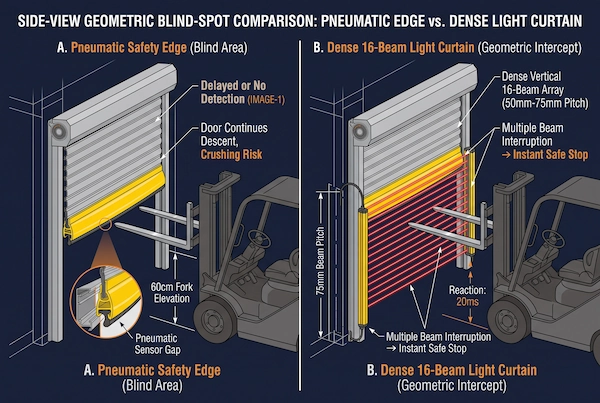
In a large, high-throughput automotive parts manufacturing workshop, a highly typical incident occurred in which a high-speed roll-up door was severely torn. On-site surveillance footage and equipment analysis reconstructed the physical sequence of events leading to this accident:
Geometric penetration by a suspended fork: After unloading a high-rack pallet, a 3-metric-ton counterbalanced forklift was reversing to turn around while unloaded. Based on the driver’s familiarity with the slight undulations in the workshop aisle, he instinctively raised the forged steel forks—which extended 1.2 meters forward—approximately 60 centimeters off the ground;
Misalignment between the descending door curtain and the bottom rail: At this moment, the high-speed roll-up door began to descend at a controlled speed of 1.2 meters per second as the delay countdown ended; the wind-resistant aluminum alloy bottom rail was in the process of lowering from 1.5 meters to 1.0 meters above the ground;
The edge-pressing strip shows no reaction to the force: Since the forklift’s front wheels have not yet crossed the threshold, the tips of the extended forks, suspended 60 centimeters above the ground, probe straight into the interior of the doorway. At this point, the airbag safety bottom edge of the curtain’s lowermost section is positioned above the forks and has not yet made any physical contact with their surface;
The metal tips directly pierced and tore the center of the curtain: As the bottom beam continued its downward plunge, the protruding, sharp steel forks pierced the curtain horizontally right through the center. Under the shearing force generated by the forklift’s forward momentum, they forcibly ripped a two-meter-long gash in the wear-resistant PVC curtain fabric;
It was too late for the bottom edge to be protected: By the time the bottom beam finally pressed against the base of the thick forks, triggering the airbag to rebound, the entire curtain was already destroyed, with the self-repairing zipper teeth on both sides having largely broken off and become jammed in the guide rails.
This incident starkly reveals the fatal blind spot of the airbag’s pressure strip: it can only detect objects directly beneath its vertical downward trajectory. For suspended foreign objects that extend horizontally into the curtain’s plane of motion from above, the pressure strip remains completely blind to them until the moment of impact.
H3: High-Density 16-Beam Resolution Against Low-Profile Hazards
To completely block penetration pathways created by slender, suspended forks and low-profile material-handling equipment, full-height physical interception must be achieved using high-resolution vertical infrared light curtains.
If traditional coarse light curtains with spacing of 200 mm or more are used, the tips of flat forks—which are only 40 mm to 50 mm thick—still have a probability of passing laterally through the gap between two parallel beams. Therefore, for high-risk passages where people and vehicles mix and where sharp, slender forks are frequently used, the high-density 16-beam matrix demonstrates overwhelming geometric blocking capability:
50 mm to 75 mm dense beam spacing:
In a high-density 16-beam configuration (for example, the CL10-16L has a center-to-center beam spacing of just 50 mm, while the CL15-16L has a spacing of only 75 mm), the system divides the vertical monitoring plane into multiple high-density infrared scan lines;
Wiring and Retrofit Reality: Stationary Jambs vs. Moving Edge Cabling
When evaluating upgrades to industrial door safety systems, on-site maintenance electricians and engineering contractors are often more concerned not with theoretical parameters, but with the practical complexity of wiring, installation, and commissioning. Traditional safety edge sensors not only suffer from inherent lag in physical collision protection, but their cable-tracking structure—which relies on the up-and-down reciprocating motion of the door curtain—is also a major source of frequent service calls during routine maintenance. Replacing dynamic tracking cables with static wiring mounted on the door jambs, and utilizing intelligent, non-disassembly commissioning logic to quickly adapt to legacy control panels, is the key breakthrough for achieving low-cost, highly reliable safety retrofits.
Stationary Jamb Mounting Eliminates Moving Flex-Fatigue
Traditional mechanical safety bottom edges must move rapidly up and down with the door curtain’s bottom beam within a door opening several meters high, with signal transmission entirely reliant on a spiral coil cord suspended from the exterior of the jamb. This dynamic mechanical wiring configuration has a critical physical weakness:
Metal fatigue fracture of the copper core due to high-frequency bending:
High-speed rolling doors open and close hundreds to thousands of times daily. As the follow-up cable undergoes high-speed stretching and violent rebound, the internal multi-strand fine copper wires are subjected to ceaseless alternating bending stress;
After several months of use, hidden core breaks are highly likely to occur inside the cable sheath, causing the safety circuit to remain in a critical state of intermittent disconnection. This leads to erratic, sporadic emergency stops or door lockups, and troubleshooting is extremely time-consuming;
Fixed Cabling on Stationary Uprights Completely Eliminates Physical Wear:
The CL Series safety light curtain employs a static installation architecture that is completely decoupled from the moving door panel. The transmitter and receiver columns are directly secured to the stationary bases of the door frame uprights on both sides via sturdy industrial angle steel brackets;
The system utilizes industrial-grade 5-pin M8 threaded anti-disengagement aviation connectors for quick connectivity. All cables are routed statically through pre-installed cable channels on the inner side of the door columns, leading directly to the variable-frequency control box mounted on the wall;
Cables remain absolutely stationary throughout the entire operation of the equipment, with zero stretching, zero bending, and zero mechanical friction, thereby completely eliminating the risk of fatigue-induced wire breakage at its physical root cause.
Tool-Free 5-Tap GND Programming for Instant NC Circuit Matching

When performing safety retrofits on existing older high-speed doors, electricians often encounter the obstacle of incompatible signal polarities in the control panels: To meet basic compliance requirements for automatic wire break detection, most older door operators mandate that their anti-pinch safety input terminals use a normally closed (NC) circuit; however, many off-the-shelf photoelectric sensors come factory-set with only normally open (NO) dry contacts. Traditional solutions require electricians to disassemble the sensor housing to toggle a micro-DIP switch or install an additional intermediate relay in the distribution box to reverse the contact polarity—a process that is not only time-consuming and labor-intensive but also risks damaging the sensor’s original waterproof seal.
The CL Series light curtains feature an innovative, tool-free contact programming algorithm that allows output polarity to be switched on-site in just 10 seconds with one-handed operation:
Factory default polarity: The yellow signal wire and the white common terminal (COM) are configured by default as a normally open (NO) contact;
Tool-Free 5-Touch Ground Reversal Procedure:
Connect the light curtain’s red and black wires correctly to the DC 12V to 24V power supply in the control panel;
Within a 60-second window after the system is powered on, the maintenance technician should strip the green function wire at the receiver end and quickly touch the black ground wire (GND) with the bare copper wire five consecutive times;
At this point, the status indicator light on top of the receiver will immediately begin flashing red rapidly and continuously, indicating that the internal main control chip has successfully captured the reversal command;
The system will then automatically rewrite the output logic of the yellow signal wire to a highly reliable normally closed (NC) safety circuit;
Strict Electrical Installation Precautions:
The yellow signal wire and the white COM terminal are optocoupler-isolated passive dry contacts. Under no circumstances should they be mistakenly connected to the positive supply circuit of a DC power source; otherwise, high-voltage current will instantly damage the internal micro-relay chip;
When wiring, simply connect the yellow and white wires in series directly to the inverter’s “Safety Loop” terminal block to achieve seamless plug-and-play compatibility, significantly reducing project downtime for retrofitting.
Safety Compliance & Regulatory Standards: OSHA and EN 12453
When conducting safety assessments of plant facilities and in day-to-day operations, many companies tend to view door safety devices as optional accessories. It is only after receiving a corrective action notice from safety regulatory agencies or facing workers’ compensation lawsuits that they realize the severity of their compliance gaps. Due to their high-speed and heavy-duty characteristics, modern industrial high-speed doors are legally defined as power-driven machinery posing serious crushing and shearing risks. Faced with stringent international and regional safety inspections, traditional contact-type safety edge strips are rapidly losing their place in compliance, while non-contact vertical light curtains have become the essential key to passing compliance reviews.
The Failure of Safety Edges Under EN 12453 Dynamic Force Limits
As the globally recognized most stringent technical standard in the field of power-operated industrial doors, the European standard EN 12453 (Safety Requirements and Test Methods for Industrial, Commercial, and Garage Doors) sets an insurmountable physical threshold for impact forces during the door closing process.
The standard’s core test provisions explicitly stipulate that when a power-operated door panel strikes a test block during the closing cycle, it must meet two strict mechanical criteria within an extremely short timeframe:
Dynamic Peak Impact Force Limit: The maximum impact force at the moment of impact must rapidly decay to below 150 newtons (approximately 15.3 kilogram-force) within a 0.75-second time window;
Final Static Residual Clamping Force Limit: The subsequent sustained clamping force must not exceed 25 newtons (approximately 2.55 kilogram-force).
In real-world third-party certification and mechanical test bench evaluations, traditional mechanical airbag safety edges almost invariably fail to meet these two criteria:
The impact momentum far exceeds the mechanical threshold: As mentioned earlier, there is an inherent delay of 0.3 to 0.5 seconds in the airbag safety edge mechanism—from the compression and deformation of the rubber, through the transmission of the air pressure wave, to the activation of the microswitch. When the aluminum alloy weighted bottom rail of the door curtain—weighing tens of kilograms—strikes a rigid test block at a descent speed exceeding 1 meter per second, the instantaneous impact force often surges to 500 to 1,500 Newtons or more;
Failure to meet physical force limits results in rejection: Even if the variable-frequency servo motor subsequently responds and reverses direction, during this mechanical rebound lag period of several hundred milliseconds, the peak force decay curve simply cannot be brought below the 150-Newton safety threshold within 0.75 seconds, leading to an immediate determination of failure to meet mechanical compliance standards;
Performance collapse under extreme conditions: Once exposed to low winter temperatures that cause the rubber to harden, or if the airbag develops micro-pores and slowly leaks air after one year of use, the force exceeding the limit multiplies exponentially, rendering the device a completely ineffective and illusory safety mechanism.
True Zero-Impact Safety for Strict OSHA Workplace Audits
In North America and multinational manufacturing facilities that widely adopt its standards, the U.S. Occupational Safety and Health Administration (OSHA) standard 29 CFR 1910.212 (General Requirements for Power-Driven Machinery) serves as the core legal basis for workplace safety inspections. This regulation mandates that employers must install approved guards on power-driven components and at hazardous operating points to ensure that workers’ heads, torsos, or limbs are not exposed to any hazardous areas where they could be crushed, pinched, or severed.
When facing unannounced OSHA on-site inspections or the determination of liability for serious or catastrophic workplace injuries, safety light curtains demonstrate irreplaceable persuasive power in demonstrating compliance:
Zero impact eliminates the risk of personal crushing:
Vertical safety light curtains completely abandon the outdated logic of “rebounding after impact,” instead constructing a virtual three-dimensional isolation zone through a dense array of modulated infrared light grids;
When the edge of a worker’s hard hat, shoulder, or outstretched arm begins to enter the descending curtain’s path, the light curtain immediately breaks the normally closed safety circuit within a time window of less than 20 milliseconds, causing the curtain to hover and reverse mid-air before it makes contact with the worker’s skin or clothing;
The actual physical contact force between the door and the human body is strictly maintained at 0 newtons, eliminating at the physical source all mechanical conditions that could lead to cervical spine contusions, soft tissue tears, or fractures;
Eliminate hefty OSHA fines for “willful violations” or “serious violations”:
During statutory investigations following crush-related workplace accidents, OSHA inspectors will focus on verifying whether the passageway is a high-traffic area and whether the company has implemented protective measures that meet current industry-recognized technical standards;
If a company continues to install only low-profile single-point photoelectric sensors—which have significant delay in triggering when objects fall from above or large blind spots—on main thoroughfares where heavy-duty forklifts and high-traffic pedestrian flow mix, regulatory agencies are highly likely to deem the company “aware of serious hazards but failing to implement adequate technical measures” under general liability provisions. This can result in a single fine of tens of thousands of dollars and may lead to an order to shut down the entire assembly line for rectification;
Passing Rigorous EHS Audits in Multinational Supply Chains:
In EHS qualification audits for third-party suppliers conducted by Apple, Tesla, multinational pharmaceutical companies, and the world’s leading automotive OEMs, “non-contact intrinsically safe” access control systems for entry and exit points are now universally listed as mandatory bonus criteria or even deal-breaker requirements;
By fully equipping high-speed entrance and exit doors with full-facade safety light curtains, and providing clear contactless safety test reports and fail-safe circuit diagrams, companies can easily pass the rigorous on-site safety inspections conducted by multinational giants and solidify their core supply chain qualifications.
Safety Light Curtain vs. Safety Edge FAQ
When deciding to replace traditional mechanical airbag safety bottom edges with vertical safety light curtains, on-site maintenance teams, plant engineers, and procurement managers often encounter specific engineering questions regarding compatibility with retrofitting older door operators, causes of wireless malfunctions, the self-masking logic during door descent, and the actual return on investment (ROI) cycle. The following provides in-depth answers to the four most common core questions encountered on-site.
Can I replace my damaged pneumatic bottom edge with a light curtain directly?
Absolutely. The retrofit process does not require replacing the entire door assembly or the original workshop control panel; installation simply involves a straightforward wiring replacement.
Many factories, after their original pneumatic bottom edge becomes damaged, often worry that the mainboard of the older door operator’s variable-frequency drive will not be compatible with modern optical light curtains. In fact, the CL series uses a universal electrical architecture, making retrofitting and replacement very straightforward:
Completely remove the moving components:
Thoroughly remove the damaged and cracked rubber air bladder strips, the plastic air-conducting tubes, and the pressure-sensitive microswitches on the sides from inside the door curtain’s bottom beam;
Cut or remove the black helical spring cable (or the wireless transmitter box inside the bottom beam) on the outer side of the door frame, which has been subjected to years of pulling and bending, to eliminate the electrical load associated with the moving components beneath the door curtain;
Fixed Installation on Door Frame Uprights:
Using the included L-shaped metal mounting brackets, secure the two light curtain posts (transmitter and receiver) directly to the stationary inner sides of the side guide posts on both sides of the high-speed roll-up door using self-tapping screws;
Plug-and-Play Safety Terminal Block Connection:
The yellow signal wire and white common (COM) wire output from the light curtain are completely electrically isolated, passive solid-state optocoupler dry contacts;
If the safety circuit in the original control panel requires a normally closed (NC) signal, simply perform the following operation within 60 seconds of power-up: “touch the GND with the green wire 5 times” to switch the polarity to NC. Then, directly connect the yellow and white wires to the “Safety Edge” or “Anti-pinch/Emergency Stop” terminal block on the main board of the original control panel. The entire retrofit can typically be completed and handed over independently within 30 minutes.
Why do wireless safety edges frequently cause intermittent door stops?
The core reasons for frequent false stops of wireless air curtain safety edges and unexplained door jamming—where the door remains open—lie in the nonlinear decline of battery power and severe interference with RF signals caused by the high-frequency electromagnetic environment in the workshop.
To avoid the hassle of stretched spiral cables getting snagged, some workshops have attempted to install wireless radio frequency (RF) safety edge transmitter boxes on the bottom rail of the door curtain. However, in actual high-frequency logistics operations, this design has exposed more subtle technical flaws:
Rapid battery drain due to low temperatures and high-frequency vibrations:
The wireless transmitter relies entirely on a built-in lithium battery for power. Under the intense vibrations caused by hundreds of rapid opening and closing cycles each day, as well as in low-temperature environments caused by cold air drafts in winter, the battery’s internal resistance increases sharply, and its effective capacity often experiences a precipitous drop within 3 to 6 months;
When the battery’s output voltage falls below a critical threshold, the periodic heartbeat handshake signals transmitted by the wireless module are lost. The safety receiver built into the control panel interprets this as an anti-pinch protection event and forcibly locks the door in the fully open position;
Spatial Electromagnetic Interference from Large Industrial Servo and Variable-Frequency Motors:
Modern industrial workshops are filled with heavy-duty variable-frequency drives, high-power servo drives, and automated welding and assembly equipment, resulting in strong power-frequency harmonics and high-frequency radiated noise permeating the space;
Wireless safety systems typically operate on open, public ISM radio frequency bands and are highly susceptible to sudden suppression by industrial electromagnetic noise. This causes momentary packet loss and false alarms at the receiving end, manifesting as the gate curtain rebounding inexplicably halfway through its descent, which severely disrupts the rhythm of on-site automated logistics.
How does the light curtain prevent false alarms when the door curtain descends?
Through its built-in Intelligent Blanking Logic, the system can accurately distinguish between the normal mechanical descent of the door curtain and the dangerous penetration of external objects.
On standard light curtains without intelligent blanking functionality, when a high-speed roll-up door curtain closes from top to bottom, the curtain itself interrupts the light beam, causing the system to mistakenly identify the curtain as an obstacle and enter a rebound loop. The CL Series perfectly resolves this logical conflict through a minimalist electrical configuration:
One-Button Hardware Activation of Masking Mode:
During on-site wiring, simply leave the green control wire at the light curtain receiver floating and insulated (not connected to GND); after a self-test, the main controller’s firmware will automatically enable the adaptive top-channel masking algorithm;
Timing and Geometric Logic Verification:
When the door curtain descends at a constant speed and, in physical sequence, first and continuously blocks the topmost infrared channel, the internal microprocessor automatically recognizes this as the curtain’s normal closing action. It then selectively suppresses the safety rebound output of the blocked channel, allowing the door to descend smoothly into position;
Bottom Edge Anti-Pinch Protection Never Degrades:
Throughout the entire closing process of the curtain, any parallel beam that remains exposed beneath the bottom rail of the curtain is 100% in a highly sensitive anti-pinch state;
If a forklift tine intrudes or a person extends a limb, the system will still forcibly interrupt the safety circuit within less than 20 milliseconds as soon as any unshielded beam beneath the door curtain is interrupted, forcing the door operator to brake instantly, come to a halt, and safely reverse.
What is the ROI timeline when switching from safety edges to light curtains?
Based on actual operational calculations at factory entrances and exits, the return on investment (ROI) for upgrading the mechanical safety bottom edge to a vertical safety light curtain typically takes only 3 to 6 months.
Many companies initially focus only on the slightly higher purchase price per unit of safety light curtains, overlooking the hidden costs that mechanical safety edges continue to incur over their lifecycle. Let’s break down the actual financial figures:
Eliminate annual fixed expenses for consumables:
Traditional trailing spiral cables or wireless batteries typically need to be replaced 1 to 2 times per year, with each replacement costing approximately $100 to $200 in materials and labor;
Eliminate major repair costs of up to thousands of dollars per incident caused by beam collisions:
With light curtains, non-contact, zero-impact interception eliminates accidents caused by 0.3-second mechanical lag—such as bent bottom beams, derailed chains, and motor gearbox tooth damage;
In aisles with high forklift traffic, an average of 1 to 2 serious incidents of the door curtain falling and striking personnel can be prevented each year, directly saving $600 to $1,500 in costs for custom-made reinforced aluminum alloy profiles and guide rail repairs;
Eliminates downtime losses caused by critical passageway blockages:
Avoids 4 to 8 hours of paralysis in main passageways due to emergency door repairs, recouping potential high costs associated with logistics downtime and energy losses from cold storage temperature drift.
All told, the savings from spare parts procurement, outsourced emergency repair labor, and production line downtime—resulting from just one potential bottom beam damage incident successfully prevented by the light curtain within its first few months of operation—are sufficient to fully offset the initial investment in the entire light curtain retrofit, while continuing to generate substantial net profits for the company over the subsequent years of service.