
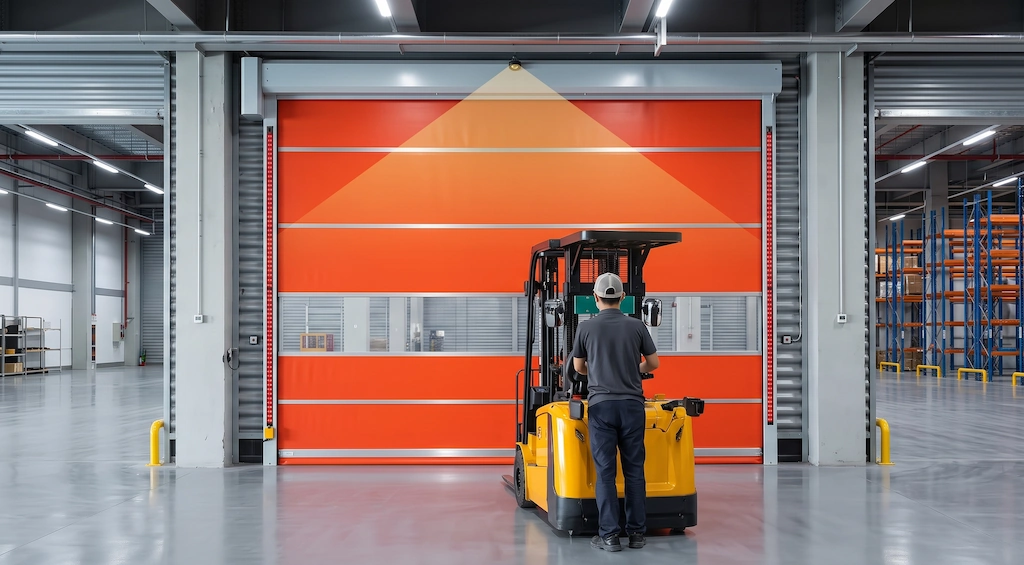
Introduction: The Physics of Industrial Gateway Hazards
In modern warehousing and logistics centers, heavy-industry manufacturing workshops, and high-traffic entry and exit points, doorways are always the physical chokepoints where kinetic energy converges most intensely within a facility.
When it comes to passageway safety, many companies tend to rely on marking warning lines on the floor or on drivers’ visual judgment, yet they severely underestimate the destructive force inherent in heavy-duty material-handling equipment as it passes through. A standard industrial counterbalanced forklift typically has a net weight of 3 to 4 metric tons; if it is carrying a standard 1.5-metric-ton pallet load, the total mass of the vehicle will immediately surge to approximately 5 metric tons. When such a heavy machine approaches a doorway at the speed commonly seen in industrial facilities—12 km/h (approximately 3.3 meters per second)—its total forward kinetic energy exceeds 25,000 joules—which is nearly equivalent to the impact energy of a head-on collision involving a mid-size passenger car traveling at 40 km/h.
Even more dangerous is the combination of the vehicle’s physical limits and the human body’s physiological reaction time: by the time the forklift operator visually detects an anomaly at the gate, the nervous system processes the information, and the operator slams the brake pedal (the industry-average physiological reaction time is approximately 0.75 seconds), the vehicle has already slid forward 2.5 meters due to inertia; Even when performing a full emergency stop on a dry, clean, and level epoxy self-leveling floor, solid polyurethane or rubber tires still require an additional 2 to 3 meters of physical stopping distance to come to a complete halt. This means that within the narrow, hazardous 5-meter zone in front of the doorway, there is no such thing as a truly “instantaneous stop” for the vehicle.
Coexisting with this immense inertial kinetic energy are geometric blind spots that cannot be eliminated. When a forklift is traveling in a straight line while fully loaded with high-level pallets, the forward view is almost completely obstructed by the towering steel mast, the lifting hydraulic cylinders, and the cargo itself. Operators are often forced to drive blindly by turning their heads sideways or even backing up. On the opposite side of the doorway, ground-level workers and order pickers frequently crisscross the area, making it extremely easy for them to inadvertently enter the forklift’s turning radius blind spot or the shadowed blind spot directly beneath the door curtain. When the door fails to raise in time due to slow control logic, or drops prematurely before the vehicle has fully passed through, collisions often occur within half a second: at best, this results in the door curtain derailing or the aluminum alloy guide rails bursting and crushing the vehicle; at worst, it causes the cargo to collapse and crush the forklift, or even leads to irreversible accidents involving personnel being crushed and killed.
In the face of frequent safety crises at entry and exit points, traditional industrial door safety measures have revealed a significant technological gap. Simply installing a single-point photoelectric sensor a few dozen centimeters above the ground on the door frame, or adding a mechanical safety bottom edge to the door curtain’s bottom rail that only activates when physically compressed, are essentially extremely passive “after-the-fact remedies” and “contact-based anti-pinch” measures. Such outdated protection mechanisms are unable to detect the kinetic energy of high-speed approaching vehicles or cover the three-dimensional blind spots created by unloaded, suspended forks and high-level racking. Not only do they frequently result in high downtime and repair costs for companies, but they also expose factory safety and health management (EHS) teams to significant compliance risks during zero-injury compliance audits.
To fundamentally achieve automatic gate collision prevention, the control architecture of modern industrial entry and exit points must undergo a fundamental technological leap from “single-point passive anti-pinch protection” to “dual-zone active prediction (Dual-Zone Motion Sensing).” By establishing a far-field dynamic vector sensing zone extending several meters deep at key points along the gate header, combined with a multidimensional, blind-spot-free anti-crushing safety net in the vertical plane of the gate line, the system can proactively open the gate several seconds before a vehicle reaches the destination and enforce an electrical lockout when stationary personnel or pallets are detected beneath the gate. Only by establishing this spatio-temporal redundant safety loop—combining “active motion vector prediction” with “blind-spot-free locking in response to static presence”—can we maximize throughput efficiency while eliminating the risk of collisions and entrapment, thereby establishing a solid physical foundation for zero-accident production safety.
The Physics of Blind-Spot Collisions at Industrial Portals
At warehouse entrances and exits and passageways connecting to production areas, collisions are often not caused by driver inattention, but are the inevitable result of the combined effects of the physical motion characteristics of heavy-duty material-handling equipment and geometric blind spots in the facility layout. To truly break the chain of collisions, we must set aside subjective speculation and conduct an in-depth analysis of the causes of blind-spot collisions from three key physical dimensions: vehicle dynamics, physiological reaction delays, and field-of-view projection.
Forklift Kinetic Energy, Reaction Times, and Stopping Distances
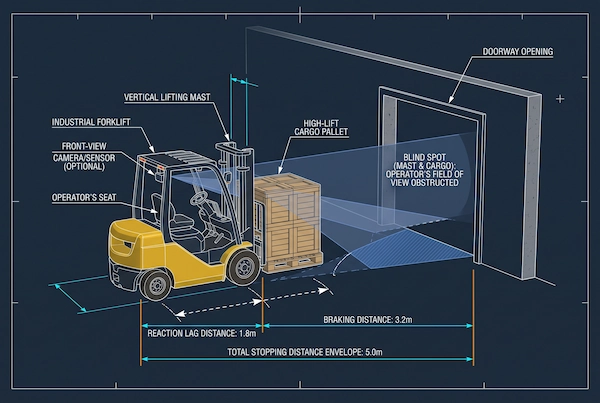
The primary reason for the failure of passive collision prevention measures at facility entrances and exits is that traditional sensor systems overlook the “spatio-temporal rigidity” of forklift braking.
When a counterbalanced forklift with a net weight of 3.5 metric tons and carrying 1.5 metric tons of cargo travels at the standard speed limit of 12 km/h (equivalent to approximately 3.33 meters per second) on a level aisle, the forward inertial kinetic energy it possesses is staggering. Many on-site managers mistakenly believe that “a forklift can stop immediately as long as the driver slams on the brakes,” but in real-world human-machine interaction, the physical deceleration of the vehicle must go through two unavoidable stages:
Perception-Reaction Time: From the moment the operator’s eyes detect that a gate has not fully opened or that someone is passing beneath it, to the visual signal reaching the brain’s neurons to issue the command to “slam on the brakes,” and finally to the foot completing the movement to press the brake pedal, the average human reaction time under high-stress conditions is approximately 0.75 seconds. During these seemingly fleeting 0.75 seconds, the forklift’s braking system does not apply any counterforce whatsoever, and the vehicle continues to move forward blindly at its original speed for a full 2.5 meters.
Pure Mechanical Braking Distance: Once the brake pads clamp tightly around the wheels, intense sliding friction begins between the rubber or solid polyurethane tires and the polished epoxy self-leveling or wear-resistant emery floor. Due to factors such as fine dust on the floor, the degree of tire wear, and a total mass load of 5 metric tons, it takes at least 1.5 to 2.5 meters of actual skid distance for the tires to fully grip the floor and dissipate all kinetic energy.
Adding these two distances together, the total braking distance for a fully loaded forklift—from the moment the operator perceives the danger until the vehicle comes to a complete stop—typically ranges from 4 to 5 meters.
If the entrance or exit relies solely on traditional single-point buried loops or short-range door controls, the sensor is triggered only when the vehicle is 1.5 to 2 meters away from the door opening. This directly results in a complete mismatch between the mechanical response time of the door operator and the forklift’s maximum braking distance. The vehicle crashes directly into the bottom beam of the partially open door curtain without any warning; the immense impact instantly tears the door curtain’s zipper and causes the guide rails on the posts to dent and deform, leaving the driver with virtually no time to react.
Mast-Blocked Visibility and Blind Corner Turning Hazards
In addition to the physical constraints of braking distance, the structural characteristics of the forklift itself create multiple layers of unavoidable geometric blind spots at the entrances and exits of doorways.
When traveling forward, the area directly in front of a counterbalanced forklift is occupied by a high-strength channel steel outer mast, an inner telescoping mast, a robust hydraulic lift cylinder, lifting chains, and the fork carriage. This heavy steel structure alone obstructs the operator’s forward field of view. More seriously, when the forks are loaded with one or even two layers of high-density palletized cargo stacked to a height of 1.5 to 1.8 meters, the driver’s forward field of view is 100% obstructed.
Under these operating conditions, drivers are often forced to resort to extremely dangerous workarounds: either leaning their body to the left or right out of the cab, relying on an extremely narrow side angle to observe the faint road conditions ahead; or simply shifting into reverse and backing up. Regardless of which maneuver is chosen, whenever the forklift enters an opening at an aisle intersection or a right-angle turn at a fire wall, its blind spots are further magnified by the building’s walls.
When turning 90 degrees to enter a doorway, the forklift’s rear wheels have a very wide turning radius, and the door frame columns create a severe blind spot: ground crew members cleaning the floor beneath the door curtain or pushing manual hydraulic pallet jacks across the aisle are positioned precisely in the shadowed area at the lower right of the forklift’s towering load; Furthermore, if there are no forward-facing sensors directly above the doorway, the descent of the door curtain is completely obscured from the driver’s view by obstructions.
By the time the driver rounds the corner and comes into view of the doorway, the vehicle is often less than 1 meter from the door curtain. Even if the driver slams on the brakes instantly, the inertial force of the vehicle and the towering cargo will slam into the door or passing personnel without any cushioning. This physical visual dead zone—created by the interplay of mechanical obstructions and spatial corners—dictates that entrance and exit safety systems must move beyond “line-of-sight reliance” and use 3D sensors to proactively eliminate blind spots from an elevated vantage point.
Passive Anti-Entrapment vs. Active Collision Avoidance
In the safety planning of many factories and logistics facilities, equipment procurement personnel often confuse “anti-entrapment” with “collision avoidance,” and may even mistakenly believe that simply installing photoelectric sensors on a door provides complete collision protection for the entrance or exit. However, there is a fundamental technical gap between the two in terms of underlying control logic and physical mechanisms.
The core of anti-entrapment is “protecting people from being mechanically crushed by a descending door panel”; it assumes that an obstacle is already within the dangerous vertical travel plane of the door curtain, and the system passively halts the door at the very last moment before an incident occurs. In contrast, the mission of collision avoidance is to “completely prevent any physical contact between moving vehicles, cargo, and the door curtain”; it requires the system to actively calculate the motion of approaching objects from several meters away and clear a completely unobstructed physical clearance in advance. Confusing these two concepts is the root cause of frequent collisions that destroy industrial doors.
Single-Point Photoelectric Eyes: Detection Limitations and Blind Zones
On the vast majority of older or stripped-down high-speed roll-up doors, the most common safety configuration involves installing a pair of single-beam infrared photoelectric sensors on both sides of the door frame, 30 to 50 centimeters above the ground. This control scheme, which relies on the interruption or continuity of a single infrared beam, exposes fatal three-dimensional detection blind spots when faced with highly maneuverable, irregularly shaped industrial forklifts:
The first critical blind spot involves the “penetration” caused by unloaded, suspended forks. When operating a standard counterbalanced forklift at high speed or in reverse while unloaded, the operator typically raises the forks horizontally 15 to 25 centimeters off the ground in accordance with standard procedures; however, during certain non-standard operations—or even when turning around while carrying a pallet—the front end of the forks is often suspended 60 to 80 centimeters above the ground. When the forks are extended forward, because the single infrared beam is fixed at a very narrow horizontal line 30 to 50 centimeters above the ground, the slender, flat steel tips of the forks can easily “penetrate” the beam from above or below without being detected. Before the beam is interrupted by the forklift’s vertical mast or tires, the protruding steel forks often pierce the insulated curtain of the high-speed door or even puncture the rapidly rolling bottom counterweight beam.
The second critical blind spot occurs when a high-lift mast collides directly with the door’s top crossbeam. When a forklift is loaded with an empty pallet or equipped with a towering two- or three-stage hydraulic mast, its total height can easily exceed 2.5 to 3 meters. A single-point photoelectric system can only passively inform the door control box “whether an object has crossed the floor below”; it has no knowledge of the clearance status of the space above the door opening. When the door curtain is descending, if the driver mistakenly believes the lower edge of the curtain is high enough to barely allow the vehicle to pass and accelerates toward the door, even though the bottom tires may have already crossed the photoelectric beam and triggered the door to rebound, the rapid-opening door motor’s direction reversal, deceleration, and braking processes involve mechanical inertia. As a result, the descending bottom beam of the door curtain collides violently with the towering door frame approaching at high speed mid-air, causing the roll shaft to be forcibly bent and the drive inverter to trip due to severe overload.
Transitioning from Reactive Stopping to Predictive Door Clearance
To break the vicious cycle of continuous damage to door openings, it is essential to transition access control systems from “reactive stopping” to “predictive door clearance.”
Take the traditional safety edge at the bottom of the door curtain (Safety Edge, such as an airbag or conductive rubber strip) as an example: Its operating logic is based on the premise that “physical contact must occur.” When the door curtain descends and presses against an obstacle or strikes the top of a forklift, the rubber strip is compressed and deformed, causing the internal microswitch or pneumatic sensor to activate and send a reverse signal to the motor. However, the door curtain’s own weight combined with its downward acceleration generates immense downward pressure. The entire physical reversal process—from signal transmission and PLC logic evaluation to the release of the brake caliper and the reversal of the door—typically takes 0.3 to 0.6 seconds. For a sturdy steel vehicle body, these 0.3 seconds are sufficient to pull the aluminum alloy guide rail out of its mounting and cause it to jam; for the soft tissues of a person below, the impact force of several hundred newtons in that instant can easily cause fractures or severe crush injuries.
Proactive detection, however, completely redefines spatiotemporal redundancy: by projecting a high-frequency microwave beam 5 to 8 meters ahead into the travel path, the system begins continuously demodulating the Doppler shift of the target’s reflected signal while the forklift is still outside the safe braking distance.
The algorithm not only determines “whether there is an object in front of the gate,” but also calculates the vehicle’s radial velocity and acceleration in real time, within milliseconds. If the system detects that a forklift is heading straight toward the gate opening at a speed exceeding 10 km/h, the control unit—without waiting for the driver to slowly press a button or pull a cord—promptly instructs the drive motor to rotate at full speed at the maximum frequency of 2.0 meters per second to raise the gate when the front of the vehicle is still 6 meters from the gate line.
By the time the front of the forklift reaches the reference line directly beneath the gate opening, the gate curtain has already been smoothly raised to its maximum effective opening, reserving an absolutely safe vertical clearance for the vehicle to pass through. This predictive design—which shifts the detection window from “a few dozen centimeters below the gate” to several meters ahead—transfers the initiative in hazard avoidance from the driver’s emergency braking to the gate operator’s early response, thereby completely eliminating the temporal and spatial overlap where a collision could occur.
Dual-Zone Motion Sensing Architecture: Technical Mechanics
To ensure that industrial entrances and exits can simultaneously achieve rapid throughput and absolute safety, the control system must resolve an inherent contradiction: while vehicles entering the gate require the gate operator to “open in advance—the sooner, the better,” the anti-pinch mechanism at the bottom of the gate demands that the operator be “absolutely cautious and never lower the gate blindly.” Traditional single-sensor or single-logic control systems often fail to address both requirements simultaneously—if sensitivity is set too high, false openings can occur, leading to energy waste; if sensitivity is set too low, the door is highly likely to slam down and collide with a vehicle.
The core engineering solution to this challenge is the development of a Dual-Zone Motion Sensing Architecture. This system clearly decouples the three-dimensional protective space around the gate opening into two functionally independent, logically interlocked sensing zones: the “Far-Field Motion Prediction Zone (Zone 1),” responsible for actively welcoming vehicles and providing temporal and spatial redundancy for door opening; and the “Near-Field Presence Lockout Zone (Zone 2),” responsible for absolute anti-pinch protection and stationary vehicle protection beneath the gate.
Zone 1 (Far-Field Pre-Activation): Vector-Based Approach Tracking
Zone 1 is defined as the active defense and pre-activation corridor surrounding the door opening. Its core physical function is to eliminate the need for vehicles to slow down and wait while passing through, thereby preventing forklifts from “crashing into the door.”
In engineering deployments, Zone 1 is typically covered by high-frequency microwave or millimeter-wave radars mounted 2.5 to 6 meters above the gate header. The sensor probes project downward at an angle, forming a three-dimensional fan-shaped detection cone in front of the gate opening with a depth of 6 to 8 meters and a lateral width of 3 to 5 meters:
Doppler Shift Velocity Measurement and Vector Analysis: When a forklift with a metal body enters this fan-shaped area, the microwave signal is reflected off the vehicle’s surface. The radar’s internal high-speed digital signal processor (DSP) demodulates the Doppler shift of the echo within a few milliseconds, continuously calculating the target’s real-time displacement and velocity components;
Pure Toward-Only Filtering: The control core incorporates a rigorous dynamic vector algorithm. The system triggers a door-opening response only for moving targets that produce a positive Doppler shift—that is, those “approaching the gate directly head-on”;
Proactive Full-Speed Door Opening: When the algorithm confirms that the vehicle’s approach vector is valid and its speed reaches the preset passage threshold, the normally open (NO) control relay in Zone 1 instantly engages, sending the highest-level acceleration pulse to the variable-frequency servo motor.
This far-field predictive mechanism secures a decisive time and distance buffer for the door curtain to rise: when a forklift traveling at 12 km/h is still 6 meters away from the doorway, the door operator has already begun rolling the curtain up at full speed; by the time the vehicle passes what would otherwise be the driver’s “critical braking point,” the door curtain has already been fully raised to its maximum open position. The driver does not need to release the accelerator or apply the brakes; the vehicle passes through smoothly without decelerating, thereby fundamentally eliminating accidents involving broken beams and cracked tracks caused by the vehicle crashing into the door before it has fully opened.
Zone 2 (Near-Field Door-Line Clearance): Static Presence Lockdown
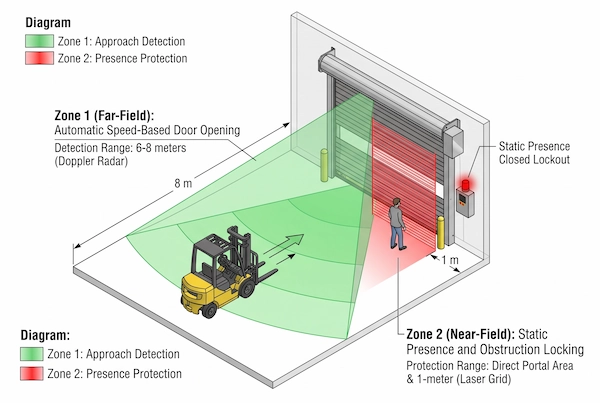
If Zone 1 focuses on “dynamic” aspects, then Zone 2 focuses on “static” ones—its core responsibility is to ensure absolute clearance along the vertical plane of the door curtain’s movement, preventing the door from “crushing vehicles or people.”
In actual warehouse operations, the most dangerous situations are often not when vehicles are passing at high speeds, but rather during sudden stops: a forklift operator temporarily stops the rear of the vehicle directly beneath the door opening to avoid pedestrians in the aisle ahead; ground crew members bend over to organize palletized goods scattered on the threshold; or a manual pallet jack gets stuck between the door frame and the guide rails. If the system relies solely on motion detection, once the target comes to a complete stop, conventional radar—which lacks Doppler shift—will mistakenly interpret this as “the obstacle has left the area,” triggering a countdown for the curtain to automatically lower. This results in the descending door beam, weighing several metric tons, crashing directly onto the roof of a vehicle or the neck and shoulders of a person.
Zone 2 eliminates this dangerous blind spot:
Static micro-motion and infrared light curtain provide seamless coverage: Zone 2 focuses on the narrow, high-risk zone extending from the inner side of the door frame columns to 0.5 to 1 meter in front of the door. This area typically integrates high-density infrared array scanning or micro-motion presence detection modules, projecting a dense, uninterrupted grid of detection beams or high-frequency ranging beams onto the ground;
Physical Reflection Interruption Mechanism: This zone does not rely on whether the target is moving but continuously monitors the reference reflection surface on the floor beneath the door opening. As soon as a corner of a pallet, a forklift’s black solid tire, or even a worker’s foot remains within the Zone 2 protection area, the reference reflection pattern is interrupted and disrupted;
Normally Closed Safety Dry Contact Forced Interlock (Interlock Hold-Open): Zone 2 is linked to a dedicated safety input terminal (Safety Edge / Photocell Input) on the door operator’s mainboard. As long as Zone 2 remains obstructed, the mainboard—regardless of whether it receives a timed door-closing command from the PLC or other external automated closing signals—will be forcibly blocked by the underlying hardware circuitry and locked in the “Hold-Open” state.
Exit Delay Reset: The closing safety interlock is only formally released—and the door curtain is permitted to descend at a uniform, controlled speed—after the stationary object has completely exited Zone 2 and the detected light spot has restored a continuous, stable ground-reflection reference exceeding a preset safety margin (e.g., 1 to 2 seconds).
By implementing millisecond-level hardware and software timing interlocks between Zone 1’s “dynamic vector predictive door lift” and Zone 2’s “static presence safety lockout,” the system forms a three-dimensional, multi-layered protective ring that can proactively create clearance space when moving forward and unconditionally suspend operation to avoid hazards when retreating, truly achieving a balance between zero entry/exit delay and zero risk beneath the door.
Eliminating Risks Associated with Mixed Pedestrian-Forklift Traffic
In large-scale warehouse sorting centers, main workshop thoroughfares, and loading/unloading zones for incoming and outgoing goods, the mixing of pedestrians and vehicles is the primary cause of serious workplace injuries and collisions with gates. Forklifts have a dead weight of several metric tons and extremely high acceleration inertia, while pickers and inspection workers moving through the area have random movement patterns and limited ability to protect themselves. If a gate control sensor system lacks the ability to classify and identify targets—and opens the gate indiscriminately whenever an object moves in front of it—it not only entices pedestrians to blindly cross into the path of high-mobility forklifts but also disrupts the allocation of right-of-way at entrances and exits.
The key technological breakthrough to resolve this chaotic situation lies in equipping sensors with the ability to precisely distinguish between “metal motor vehicles” and “human pedestrians” within microseconds, thereby establishing an active safety corridor at entrances and exits that separates vehicles from pedestrians.
Dual-Relay Discrimination: Vehicle Priority vs. Pedestrian Filtering
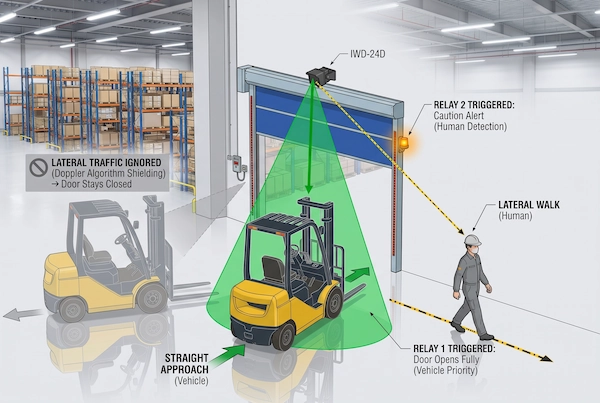
To achieve true traffic separation control at entrances and exits, gate sensors must not merely provide a simple on/off signal; instead, they must employ a dual-relay intelligent classification architecture that integrates hardware and software. At such high-risk mixed-traffic entrances and exits, the direct deployment of the industrial-grade IWD-24D 24GHz Vehicle & Pedestrian Separation Radar Sensor can establish an efficient barrier for separating people and vehicles.
Installed at a height of 2.5 to 8 meters directly above the lintel, this radar sensor uses a 24.125 GHz microwave beam to perform in-depth feature demodulation on oncoming targets:
Radar Cross-Section (RCS) and Echo Energy Segregation: Metal vehicle bodies are excellent reflectors of microwaves. Heavy-duty industrial forklifts, composed of extensive steel frameworks, typically have a radar cross-section (RCS) of several dozen square meters or more, resulting in extremely powerful electromagnetic wave energy reflected to the radar antenna array. In contrast, the water content in the human body and the fabric of clothing significantly absorb and diffusely scatter microwave energy, resulting in a radar cross-section typically ranging from only 0.5 to 1 square meter. The high-speed processing chip inside the radar first performs an initial hard screening of the target’s basic physical dimensions based on the amplitude energy of the echo pulse.
Micro-Doppler Spectrum Feature Demodulation: When pedestrians walk or jog, their composite movements—including torso displacement, forward and backward arm swinging, and alternating leg strides—result in an echo that manifests in the frequency domain as a divergent, broad-bandwidth Micro-Doppler spectrum with periodic fluctuations; in contrast, forklifts exhibit highly rigid, linear, and uniform forward translation during operation, producing an extremely pure and concentrated spectrum. By comparing real-time integrated spectral characteristics, the algorithm can accurately distinguish between workers carrying pallets and those pushing hand trucks, eliminating false positives.
Dual-Relay Independent Hardware Output and Right-of-Way Control: The [IWD-24D 24GHz Vehicle & Pedestrian Separation Radar Sensor] integrates two independent passive dry-contact relay outputs.
Cross-Traffic Rejection in Congested Staging Aisles
In actual warehouse operations, another scenario that frequently leads to door scrapes and accidents is the cross-traffic aisles in front of the doors. Many aisle gates are located right next to loading dock preparation areas or main cross-aisles. Within the narrow passageway 2 to 5 meters in front of the entrance/exit, forklifts frequently travel sideways to transport pallets; these vehicles have no intention of passing through the gate but are merely passing by.
If the entrance is equipped with crude sensors lacking the ability to process motion vectors, the door curtain will fall into an endless vicious cycle of “false openings and false closings”:
As soon as a forklift traveling sideways passes in front of the gate, the curtain is mistakenly triggered and rises to its highest position; just as the curtain reaches the top, the forklift has already moved away, and the gate immediately begins to lower once the delay period ends; however, the next forklift passes by almost immediately, forcing the descending curtain to emergency brake mid-air and rebound upward again.
This frequent, jerky up-and-down movement caused by misjudgments poses significant safety hazards on-site:
Driver distraction and misjudgment: A forklift driver turning sideways who catches a glimpse of the open gate out of the corner of their eye may mistakenly assume the passage is fully clear. When changing lanes to turn, they are highly likely to collide violently with an oncoming vehicle emerging straight ahead in the gate’s blind spot;
The time lag trap between the curtain’s suspension and descent: The door hoist remains in a state of irregular up-and-down fluctuation for extended periods, causing the curtain to often be in the middle of its descent when a vehicle actually attempts to enter or exit. If the driver accelerates to rush through, they are highly likely to collide head-on with the descending counterweight beam;
Mechanical Fatigue and Variable Frequency Drive Alarms: Extremely frequent rapid starts and stops subject the brake clutch of the braking motor and the gears in the reduction gearbox to extreme shear stress, causing the variable frequency drive to frequently trigger overcurrent faults. This directly results in the door hoist locking in a semi-suspended position, disrupting the logistics flow of the entire production line.
Utilizing a Doppler shift vector algorithm, the system thoroughly eliminates the threat of lateral traffic by performing in-depth calculations of the target’s angular and radial velocity vectors: The microwave radar responds only to the forward Doppler shift generated by targets approaching directly head-on; when a forklift passes laterally along a trajectory parallel to the door curtain, its radial velocity component toward the door opening approaches zero. The radar’s internal high-speed digital processor identifies this trajectory as “irrelevant background motion interference” within milliseconds, forcibly filtering out and suppressing the door-opening trigger signal to ensure the door curtain remains completely still and tightly sealed even as vehicles speed past laterally. Only when a vehicle actually slows down to turn, and its front end is aligned directly with the centerline of the doorway as it enters, will the door-opening logic decisively activate. This precise filtering of lateral traffic eliminates all unnecessary door movements in high-density operational corridors, thereby securing the safety rhythm of the entrance and exit.
Full-Height Door-Line Protection: Safety Light Curtains
Even though the top-mounted radar sensors are capable of accurately predicting approaching objects from a distance, the vertical travel plane of the descending door curtain (Door-Line Travel Plane) remains the area with the highest concentration of physical risks at the entire entrance/exit. During actual loading and unloading operations, vehicles may suddenly stall, or drivers may temporarily stop their vehicles at the centerline of the doorway to adjust the height of the forks; even more dangerous is the fact that the slender steel forks of unloaded forklifts often extend several meters and hover in mid-air. In this life-or-death vertical plane, it is essential to establish a three-dimensional protective light grid that penetrates vertically through the floor, regardless of an object’s shape, serving as the final physical line of defense for door safety.
Continuous Optical Grids vs. Mechanical Bottom Safety Edges
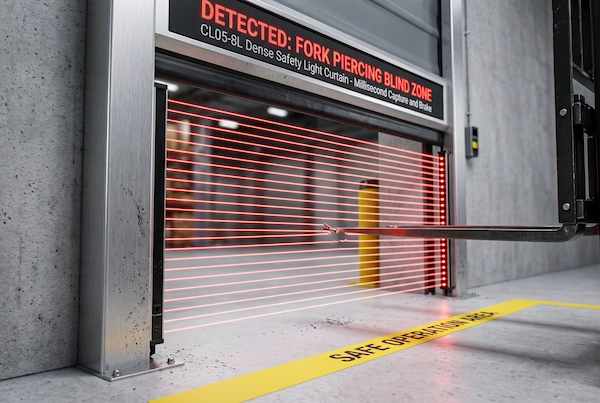
For a long time, industrial high-speed roll-up doors have relied heavily on mechanical bottom safety edges (such as airbag seals or conductive rubber strips) at the lower edge of the door curtain as a means of preventing crush injuries. However, from the perspective of engineering safety evolution, there is a generational gap between mechanical bottom safety edges and vertical light curtains—one involving “contact-based detection” versus “contactless suspension.”
The operating logic of mechanical bottom safety edges is entirely based on “contact and force”: When the door curtain descends at high speed—approximately 1 meter per second—the bottom rubber strip must physically press against the surface of an obstacle. This causes the air bladder inside the strip to deform, activating a pneumatic switch, or the conductive rubber to close under pressure, at which point the circuit sends a stop signal to the main control board. From the moment the rubber strip is compressed and the air pressure pulse is transmitted until the motor brake pads fully engage, there is a rigid mechanical lag of approximately 0.3 to 0.5 seconds. For soft body parts such as the head, shoulders, or neck, the impact force of several dozen kilograms from this instantaneous downward strike can easily cause soft tissue contusions or even severe cervical spine injuries; when encountering protruding, rigid steel forks, the rapidly descending counterweight beam strikes the tips of the forks directly, and the powerful recoil instantly bends and destroys the aluminum alloy wind-resistant beam at the bottom of the door curtain, causing the door curtain’s zipper to derail and tear.
To completely eliminate damage caused by mechanical contact, the standard practice in modern high-grade industrial facilities is to fully replace the contact-type bottom edge with a vertical multi-beam safety light curtain. By integrating the CL05-8L Safety Light Curtain directly on both sides of the door jamb, a high-density, non-contact active safety barrier can be established across the entire door opening.
By forming a high-density crisscrossing infrared grid between the transmitter and receiver, this light curtain achieves a qualitative leap in safety logic:
Millisecond-level response with “stop-on-approach” (Non-Contact Interruption): The CL05-8L Safety Light Curtain forms a vertical “grid wall” of interwoven infrared beams along the door frame’s plane of vertical movement. When an object enters the area beneath the door, without any physical contact—even if just a single infrared beam is interrupted—the normally closed (NC) safety relay circuit immediately breaks within less than 20 milliseconds. The variable-frequency motor instantly engages the brake, causing the door curtain to come to a complete stop within a few centimeters of its downward travel and immediately reverse to a safe elevated position—truly marking a leap from “passive rebound after impact” to “suspended interruption before contact.”
Completely Eliminating Blind Spots Caused by Suspended Forks: Traditional single-point photoelectric sensors are typically mounted at a fixed height of 30 to 50 centimeters above the ground. When a forklift raises its forks to a height of 60 centimeters to 1.5 meters to pass through, or when the long forks of a high-lift stacker extend overhead, the single beam is completely bypassed from beneath the forks. In contrast, the CL05-8L Safety Light Curtain features a continuous, densely spaced detection array that extends upward along the door frame. From the tips of low forks near the ground and solid tires in the middle to overhanging irregularly shaped cargo and towering columns above, any object entering the light curtain array at any point across the full height range is instantly detected, eliminating serious accidents caused by sharp forks tearing through the curtain fabric.
Environmental Immunity: Handling Dust, Vibration, and Ambient Sunlight
Many on-site maintenance teams have reservations about deploying optical safety light curtains in busy workshops, primarily due to concerns that harsh environmental conditions will lead to frequent false alarms: dust-filled workshops, violent vibrations of door frames caused by overhead doors rising and lowering at high speeds, and direct sunlight at low angles during dawn and dusk, which can cause the photosensitive components to saturate and become blind. To maintain stable, round-the-clock operation, industrial-grade safety light curtains must possess robust environmental immunity and self-healing capabilities at the optical and electrical levels.
Professional-grade industrial door safety light curtains are designed with triple redundancy for interference resistance:
Modulated Infrared Coding and Resistance to Direct Strong Light (Optical Code Modulation): When ordinary photodiodes are exposed to direct outdoor sunlight of tens of thousands of lux or high-frequency fluorescent lighting in a workshop, the light-receiving chip is completely overwhelmed by saturated direct light, causing false blockage or false transmission. The infrared beams emitted by industrial light curtains are modulated with a specific high-frequency digital carrier and time-sequenced coding; the receiver’s filter lens synchronously demodulates only the pulse signals within this characteristic frequency band. Even when the door faces due west and is directly exposed to the blinding glow of the setting sun, the system can accurately filter out stray natural light, preventing door lock-ups caused by optical glare.
Adaptive High-Penetration Gain and Dust Tolerance (Dynamic Gain Control): In heavy industrial or high-dust warehouse environments, dust and oil/gas particles gradually accumulate on the surface of the optical lenses. The industrial-grade light curtain’s internal microprocessor is equipped with a dynamic optical gain compensation algorithm. When dust gradually accumulates on the lens surface, causing a slow decline in infrared transmittance, the system automatically increases the drive current of the emitter and the amplification gain of the receiver to penetrate the thin layer of dust and maintain normal communication; only when the dust layer reaches a dangerous light-blocking threshold will the light curtain output a dedicated maintenance warning signal, rather than causing a sudden shutdown that paralyzes the production line.
Vibration and Beam-Blanking Immunity: During high-speed door opening and closing, the start-stop torque of the servo motor causes slight mechanical resonance and micrometer-level torsion in the door frame columns. The light curtain employs a wide-beam lens design with an appropriate beam angle, combined with an internal multi-pulse integration filtering mechanism. Minor high-frequency vibrations in the columns do not cause the light beam to momentarily lose alignment or lose synchronization, eliminating sporadic false braking caused by mechanical resonance and ensuring absolute stability during high-intensity operations.
The True Cost of Portal Impacts: Downtime, Repairs, and Safety Audits
When evaluating safety sensor upgrades for factory entrances and exits, many corporate financial and operational decision-makers tend to focus solely on the unit price of the sensors themselves, while habitually overlooking the staggering hidden costs associated with “a single severe impact.” In modern, high-turnover logistics and smart manufacturing environments, industrial doors are not merely simple barriers but serve as the physical metronome for the entire material flow chain. Once a door curtain is derailed by a forklift or strikes a vehicle, the resulting chain reaction is far more than just replacing a few parts—it can quickly escalate into a financial black hole that devours a company’s profits.
Direct Financial Costs of Door Curtain Derailment and Track Damage
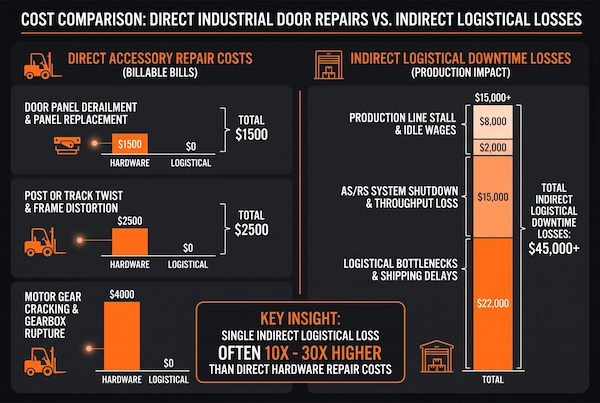
A seemingly ordinary forklift collision with a door often results in direct repair and spare parts costs that far exceed expectations:
Door Structure Damage and Spare Parts Procurement: When a heavy-duty forklift grazes or collides head-on with the door curtain at speeds of over ten kilometers per hour, even with self-repairing zipper teeth, the powerful horizontal impact can easily cause localized tears in the curtain and bending or denting of the reinforced aluminum bottom rail. Even more serious is the deformation of the load-bearing columns on both sides: once the extruded aluminum alloy guide rails experience even a slight distortion exceeding 5 millimeters, the entire self-repairing slide track will become completely jammed. In severe head-on collisions, the immense counter-tensile force often tears directly through the door curtain toward the top pivot shaft, causing the gears in the servo variable-frequency motor’s reduction gearbox to shatter, the brake disc to fracture, or the variable-frequency drive board to burn out instantly. The direct material costs for a single incident—including the replacement of the door curtain assembly, custom guide rail columns, and drive motor—typically range from $1,500 to $4,000;
Emergency repair labor and associated downtime losses: Operations involving high door openings typically require the deployment of specialized scissor-lift platforms, as well as the involvement of at least two electromechanical technicians with specialized certifications to perform disassembly and calibration. From the initial service request and spare parts procurement to on-site reinstallation of the curtain and limit switch calibration, the mean time to repair (MTTR) generally ranges from 4 to 8 hours or more. For pharmaceutical cold chains or automated storage and retrieval systems (AS/RS), a half-day shutdown of a critical main aisle means dozens of forklifts are forced to take detours or halt operations on the spot. Indirect logistics losses caused by loading/unloading delays and production line slowdowns can easily reach several thousand dollars per hour;
Daily spare parts wear and tear place a strain on operations and maintenance: Frequent minor scrapes not only increase the frequency of repairs but also accelerate mechanical fatigue in self-lubricating guide rail liners and limit switches. For facilities that face constant forklift traffic year-round, establishing a standardized emergency stockpile of wear-prone parts is crucial. Equipment maintenance departments can use a one-stop Door Safety Sensors & Parts solution to centrally replace impact-resistant guide rails, anti-pinch photoelectric sensors, and high-sensitivity door safety components, thereby preventing prolonged shutdowns of entire logistics corridors caused by shortages of a single part.
OSHA and EHS Compliance: Mitigating Liability for Worker Injuries
Compared to the dry, impersonal invoices for equipment repairs, workplace injury incidents and occupational safety and health compliance audits often deal a devastating blow to a company. In industrialized nations—such as the U.S. Occupational Safety and Health Administration (OSHA) standards system and the European Union’s EN 12453 industrial door safety standard—as well as in strict domestic corporate EHS (Environmental, Health, and Safety) audits, incidents where falling machinery at doorways crushes people are classified as high-risk mechanical crushing hazards.
Once a major safety incident occurs at an entrance or exit—such as an injury caused by a falling door panel or a forklift colliding with a pedestrian due to obstructed visibility in a blind spot—the legal and administrative consequences for the company will rapidly escalate:
Substantial civil damages and workers’ compensation claims: Injuries such as soft tissue contusions, fractures, or even spinal trauma resulting from the failure of door anti-pinch mechanisms often entail direct medical expenses, lost wages, and subsequent legal settlement costs starting in the tens of thousands of dollars; moreover, commercial liability insurance premiums will surge significantly the following year;
Risk of Regulatory Intervention and Production Suspension for Rectification: When OSHA or local safety regulatory agencies intervene to investigate, their first step is to retrieve the electronic control logs and safety sensor records of the affected gate. If the investigation determines that the entrance/exit was equipped only with single-point through-beam photoelectric sensors—which have severe blind spots—and failed to meet the industry’s highest engineering standards by installing full-height protective barriers (such as safety light curtains) with fault-tolerant redundancy and predictive systems, the company will be issued a “Willful/Serious Violation” citation, face the maximum statutory safety fine, and may even be forcibly ordered to shut down the entire warehouse entry/exit operation line for rectification;
Loss of points in enterprise supply chain qualification reviews: In third-party supply chain safety audits conducted by multinational manufacturers and leading retailers, active collision prevention at gateways and the separation of pedestrian and vehicle traffic are mandatory criteria in EHS on-site audits. Factories lacking a closed-loop safety sensing system often have compliance points directly deducted during on-site factory inspections by top-tier clients, facing systemic risks such as order loss and downgrading of supplier qualifications.
Therefore, implementing dual-zone detection and a full-facade, blind-spot-free safety light curtain is not merely a technical upgrade to avoid repair bills; it is also a highly cost-effective compliance investment for companies in terms of legal risk prevention, workplace injury risk control, and authoritative EHS audits.
Impact Frequency, Damage Severity, and ROI Comparison Matrix
When evaluating the safety protection level of industrial door entrances and exits, vague technical concepts are often insufficient to support retrofit decisions made by equipment management and finance departments. Only by placing traditional, simplified configurations and modern smart sensing systems on the same benchmark—and quantifying data across multiple dimensions such as the rate of blind spots, component damage frequency, economic losses from downtime, and regulatory compliance—can the actual return on investment (ROI) of safety retrofits be clearly demonstrated.
Traditional Safety Devices vs. Modern Dual-Zone Smart Sensing
Based on the most common entrance and exit sensing configurations currently used in warehousing, logistics, and heavy manufacturing enterprises—and considering standard high-load operating conditions with an average of 30,000 door cycles per year per door—the following data compares results from field testing with maintenance statistics:
| Evaluation and Comparison Criteria | Option A: Traditional bottom-beam airbag + single-point through-beam photoelectric sensor | Option B: Basic Underground Induction Coil + Mechanical Safety Bottom Edge | Option C: Dual-Zone Directional Microwave Radar + Vertical High-Density Safety Light Curtain |
| Sensor Blind Spot Range | Severe vertical blind spots (the beam covers only a single line segment 30 to 50 cm above the ground; there is no predictive detection zone on the vertical plane or outside the gate) | Significant blind spots (detects only metal vehicle bodies on the ground; no optical protection at high positions on the gate frame, in lateral blind spots, or on the vertical surface beneath the gate) | Virtually zero blind spots (3D fan-shaped predictive detection 6 to 8 meters outside the gate + dense, continuous vertical light grid beneath the gate) |
| Fork Penetration Detection Capability | Complete failure (slender forks suspended more than 60 cm above the ground can easily pass through the single beam, resulting in missed detection) | Complete failure (the underground coil cannot accurately detect the tips of flat forks that are suspended in the air) | 100% millisecond-level interception (dense vertical light grid provides continuous coverage from ground level to high positions; stops immediately upon detection of an object) |
| Pedestrian-Vehicle Separation Capability | No ability to distinguish between objects (any single-point obstruction is treated as an obstacle; cannot determine the nature of the object) | Mechanical limitations (detects only metal; personnel do not trigger the gate to open at all, leading to severe confusion in vehicle and pedestrian traffic patterns) | Intelligent Traffic Separation (Independently outputs control signals for pedestrians and vehicles based on radar cross-section and micro-Doppler spectrum) |
| Average Annual Frequency of Gate Impacts | 3 to 6 times per year (primarily caused by forklift tines penetrating the beam, high mast racking hitting the beam, and sudden braking in blind spots while turning) | 2 to 4 times per year (primarily due to the fixed sensing range of the loops, causing high-speed forklifts to collide with the partially open door curtain when they cannot brake in time) | Average annual incidents approaching 0 (Doors open fully in advance based on far-field speed detection; forced locking prevents downward closure if an object is detected beneath the door) |
| Average Annual Downtime and Maintenance Costs | $4,500 to $9,000 per year (frequent replacement of bent guide rails, torn door curtains, and detached zippers, plus labor costs for emergency repairs) | $3,000 to $6,000 per year (repairs for aging ground-mounted loops, cracked seams, dented door panels, and damaged motor gearboxes) | Less than $300 per year (Involves only routine surface dust removal and daily inspections to tighten screws) |
| EHS Safety Compliance Rating | Non-compliant / High-risk (relies on contact-based rebound, which can easily cause soft tissue contusions and makes it difficult to pass authoritative inspections) | Low to moderate compliance (lacks redundant anti-pinch protection on the pedestrian side, unable to prevent hazards from falling cargo at high elevations or side impacts) | Excellent / Meets the highest compliance standards (Fully compliant with OSHA anti-pinch regulations and the European EN 12453 safety standard) |
The return on investment period can be clearly derived from actual engineering data:
For an industrial overhead door with high traffic volume, if a company continues to use a traditional, stripped-down anti-pinch system like Option A, it will not only have to pay thousands of dollars annually in direct repair costs for damaged curtain panels, guide rails, and motors, but will also incur losses due to logistics disruptions caused by blocked passageways; In contrast, a one-time initial investment to upgrade to Solution C (dual-zone directional radar paired with a vertical safety light curtain system)—although the hardware procurement cost is slightly higher than that of a standard switch—typically allows the investment in hardware upgrades to be fully recouped within 4 to 8 months after operation begins, simply through savings on emergency door repairs and the elimination of downtime caused by collisions. More importantly, this active redundant architecture eliminates the legal and workplace injury risks associated with personnel entrapment, establishing an impenetrable safety firewall for the company’s daily production operations.
Preventive Maintenance and Alignment Verification Checklist
No matter how precise the sensor hardware and intelligent control algorithms may be, their performance will degrade over time if they are not subject to proper on-site installation, calibration, and periodic maintenance. In the complex environment of industrial facilities—characterized by vibrations, dust, and high-frequency traffic—door safety systems must establish a standardized set of practical inspection procedures. On-site equipment engineers and electrical maintenance teams should conduct rigorous parameter verification and calibration checks on a weekly and monthly basis to ensure that active collision prevention and anti-pinch safety systems remain in optimal operating condition at all times.
Walk-Test Protocols and Radar Pitch/Yaw Angle Calibration
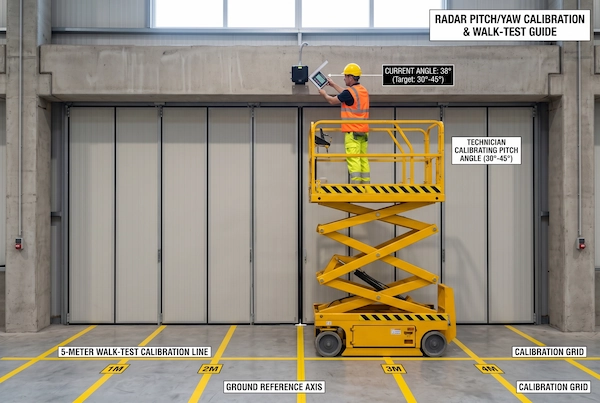
The detection accuracy of the Doppler microwave radar installed above the door lintel depends directly on the probe’s geometric installation angle and signal gain threshold. During new equipment handover or quarterly inspections, maintenance teams must strictly follow the following four-step engineering calibration procedure:
Physical Alignment of Pitch and Yaw Angles:
Pitch Angle Setting: Based on the clearance height of the gate opening (typically 3 to 6 meters), use a dedicated adjustment bracket to lock the radar probe’s vertical downward pitch angle within the range of 30 to 45 degrees. If the tilt angle is too flat, the beam will hit the ceiling or the opposite wall at the far end too early, causing long-range clutter interference; if the tilt angle is too steep, it will significantly reduce the forward detection range, resulting in a narrow reaction window as vehicles approach;
Yaw Axis Calibration: The probe’s horizontal yaw angle must be strictly perpendicular to the door header plane, and the center beam must be precisely aligned with the centerline of the lane on the road surface to ensure symmetry between the left and right detection sectors, preventing excessive blind spots on one side and incorrect lane detection on the other.
Doppler Sensitivity and Filter Threshold Calibration:
Adjust the gain using the digital potentiometer or DIP switches on the radar mainboard. The calibration principle is as follows: while ensuring a maximum detection range of 6 to 8 meters, adjust the sensitivity to a critical stable value. Avoid at all costs blindly maxing out the gain, as this can cause false signals triggered by slight air turbulence or vibrations from the gate itself.
Standardized Walk-Test Verification Procedure:
Straight-Line Approach Verification: Test personnel simulate both walking at low speed (approximately 1 meter per second) and driving a forklift (approximately 10 to 12 km/h) straight along the centerline into the doorway, observing the radar indicator light status changes. The system must respond and output a door-opening signal before the test subject reaches the 5-meter mark in front of the door;
Lateral Passage Blocking Test: Drive the forklift at normal speed across the lateral passage 2 to 3 meters in front of the gate. The radar must remain silent, and the gate curtain must not exhibit any slight movement or unintended opening;
Departure Vector Suppression Test: When the vehicle reverses through the gate opening to exit, the radar must immediately cut off the trigger pulse, and the gate operator must lower smoothly according to the preset minimum delay.
If conflicts involving doors opening too early or too late are detected during peak traffic periods, the overall logistics flow must be comprehensively evaluated. For detailed debugging strategies, please refer to our Forklift Traffic Flow Optimization Guide, which balances the elimination of door-collision risks with the high-frequency turnover efficiency of forklifts in the warehouse area.
Optical Axis Alignment Audits and Lens Cleaning Schedules
As the core component of anti-crushing protection for the vertical surfaces beneath the door, the stability of safety light curtains and infrared photoelectric beam systems relies heavily on the coaxiality of the optical axis and the transparency and cleanliness of the lens surfaces. If the support columns experience even a slight misalignment due to vibration, the system is highly prone to frequent alarms or a failure state where the door remains locked in the “always open” position.
Maintenance teams must establish a routine optical system audit mechanism:
Optical Axis Alignment and Coaxiality Calibration:
The metal guide rail posts on both sides of industrial doors are highly susceptible to micron-level deformation or bolt loosening after prolonged exposure to the rolling motion of the roller shutter and the vibrations caused by heavy loads rolling over the floor. During electrical inspections, technicians must use a laser aligner or the multi-stage status indicator lights built into the light curtain to check the optical axis misalignment between the infrared transmitter and receiver, one beam at a time;
ensure that both columns are perfectly aligned on the same vertical projection plane; columns must not be twisted inward or outward at the top and bottom ends in a “V-shape.” Once the coaxiality deviation exceeds the optical tolerance, the light curtain will mistakenly detect a continuous obstruction by a foreign object, preventing the door from closing;
If, during on-site inspections, the door curtain frequently fails to lower automatically after reaching the top or repeatedly reverses direction to open on its own when no obstacles are present, this is most often caused by poor alignment of the optical axis at the critical point or loose signal connections. Troubleshooting steps should strictly follow the Industrial Door Ghost Opening Troubleshooting guide, comparing each item one by one to thoroughly eliminate the root cause of the malfunction.
Lens Contamination Control and Graded Cleaning Plan:
Routine Dust Removal Inspection (Once a Week): In high-dust or oil-mist environments—such as cement plants, flour mills, and metal stamping workshops—fine particles can form an electrostatically charged layer on the surface of optical filters. Maintenance personnel must use a dry, clean, lint-free microfiber cloth to gently wipe the transmitter and receiver lenses in a single direction. The use of rough fabrics is strictly prohibited to prevent scratching the optical coatings;
Deep Decontamination and Degreasing (Once a Month): For sensor ports contaminated with diesel exhaust fumes or antifreeze crystals, use isopropyl alcohol (IPA)-soaked cotton swabs to carefully wipe the filter lenses, removing stubborn oil films and restoring high infrared light transmittance;
Housing and Seal Inspection: After cleaning, simultaneously inspect the fastening screws and rubber O-rings of the optical probe protective cover to ensure they are intact, preventing moisture and rinse water from seeping into the inner walls of the housing and causing internal condensation.
By establishing a closed-loop maintenance system comprising “quarterly calibration of radar angle and dynamic vectors + periodic cleaning of the optical axis coaxiality and mirror surfaces,” companies can minimize unexpected downtime caused by failures in entrance and exit safety sensor systems, ensuring a long-term, stable safety barrier.
FAQ on Automatic Gate Collision Prevention
When planning safety upgrades and collision prevention system retrofits for industrial gate entrances and exits, plant engineering staff, safety and compliance managers (EHS), and equipment procurement managers often face a variety of complex installation scenarios and product selection trade-offs. Addressing the most common physical constraints and technical challenges encountered at actual construction sites, the following section outlines four of the most representative engineering questions and provides in-depth answers.
Can safety light curtains completely replace motion radar sensors?
The answer is very clear: Safety light curtains can never completely replace motion detection radar, and vice versa. The two fulfill distinctly different physical roles in industrial access control and form a complementary, mutually reinforcing closed-loop relationship.
This division of labor stems from fundamental differences in spatial dimensions and control logic:
Differences in Functional Scope (Door-edge anti-pinch vs. far-field door opening):
The physical monitoring range of safety light curtains (such as vertical multi-beam infrared light grids) is strictly confined to the vertical movement plane below the door frame. Their sole mission is to serve as the “final line of defense against crushing.” Their control output is a normally closed (NC) safety signal, primarily responsible for emergency braking the motor and preventing the door curtain from closing when a beam is interrupted;
Microwave motion radar, on the other hand, monitors the dynamic passageway 5 to 8 meters outside the door. Its core mission is to serve as a “proactive door-opening trigger.” It is responsible for sending a door-opening command (NO—normally open signal) to the variable frequency drive in advance, before a vehicle enters the braking danger zone, to clear a passage for the vehicle.
Fatal operational hazards posed by pure light curtain control:
If one attempts to control the gate solely by relying on the safety light curtain installed on the gate posts, a forklift must force its front end or forks to come within tens of centimeters of the gate curtain to interrupt the light beam before the gate operator receives the signal to begin lifting;
Given the maximum coasting braking distance of 3 to 4 meters for heavily loaded forklifts, this “close-range triggering” effectively forces the driver to either slam on the brakes or risk colliding with the gate on every single pass.
Therefore, an entrance/exit system that truly complies with industrial safety standards must consist of a dual, coordinated system: “high-mounted directional radar at the top of the door for perimeter far-field speed detection and door opening + vertical safety light curtains on the door frame for static anti-crushing protection with no blind spots beneath the door.” Both components are indispensable.
How do dual-zone radars protect forklifts that stall right under the door header?
In busy logistics aisles, unexpected situations often arise: forklift operators may be forced to temporarily park the vehicle—including the forks—directly beneath the door header to avoid oncoming traffic or because a pallet of cargo has tilted. If a sensing system relies solely on the Doppler shift principle to detect motion, once the vehicle comes to a complete stop—and the reflected waves no longer exhibit a frequency shift—a standard single-function radar will mistakenly interpret this as “the vehicle has departed,” thereby triggering a countdown that forces the door curtain to close, resulting in serious accidents where the curtain crashes down onto the vehicle.
A radar system with dual-zone sensing capability eliminates this risk by integrating a near-field static presence detection mechanism:
Static Micro-movement and Reference Phase Scanning: In addition to a Doppler antenna responsible for long-range speed measurement, the radar probe also integrates a micro-movement scanning channel specifically designed to cover the near-field area in front of the door (the area directly below the door curtain and 0.5 to 1 meter in front of and behind it);
Continuous Locking of the Environmental Reference Plane: During its initial self-learning process upon power-up, the radar memorizes the reference values of the reflection signals from the open ground beneath the door. When a forklift is stationary beneath the door, even though the vehicle itself has not moved, its massive metal chassis, towering steel mast, or palletized cargo disrupts the original reflection geometry of the ground, causing continuous distortion in the static reflection amplitude and delay phase captured by the radar receiver;
Normally Closed Safety Terminal Forced Lockout (Hold-Open): The near-field presence detection channel is directly hardwired to the emergency stop circuit in the door motor control box. As long as the phase distortion in this area persists (i.e., an object remains near the vertical projection plane of the door curtain), the system’s low-level logic will unconditionally lock out the motor’s closing command, forcibly keeping the door curtain in the top limit normally open position;
Only after the fault has been resolved, the forklift has completely exited the near-field protection zone, and the floor reflection reference has stabilized for longer than the set safety confirmation delay (typically 1 to 2 seconds) will the door mechanism be permitted to resume controlled, uniform descent.
What is the optimal sensor mounting height for detecting high-mast forklifts?
In automated storage and retrieval systems (AS/RS) or work environments equipped with two- or three-stage free-lift masts, improper sensor mounting height can easily result in high-mast forklifts or unloaded, extended forks protruding forward becoming detection blind spots.
Based on extensive field testing, the recommended optimal installation height for sensors at entrances and exits where high-mast forklifts operate is between 3.5 and 6 meters (the maximum should not exceed 8 meters, and the minimum should not be lower than 2.5 meters):
Avoid installing sensors too low (below 2.5 meters): If the radar probe is installed too low, the angle of the projected beam becomes too flat. When a forklift carrying large containers or tall pallets approaches, the cargo itself acts like a wall, completely blocking the radar beam ahead. This prevents the radar from forming a fan-shaped scanning area with sufficient depth, severely reducing the reaction buffer time as the vehicle approaches;
Avoid mounting too high (above 8 meters): When the installation height exceeds the limit, the attenuation of microwave signals in the air over long distances increases significantly, making it easy to miss the tips of low forks with small radar cross-sections;
Precise Adjustment of the Tilt Angle:
For standard dock height installations ranging from 3.5 to 4.5 meters, it is recommended to adjust the probe’s downward tilt angle to a range of 30 to 45 degrees;
This angle ensures that the main lobe of the radar beam not only fully covers unloaded, horizontally extended forks approaching from the ground (15 to 30 centimeters above the ground), but also that the beam’s upper spread zone simultaneously encompasses the tops of telescopic masts as high as 3 meters or even 4 meters;
This wide-angle coverage ensures that both low, sharp forks extending 2 meters forward and tall metal posts reaching the top of the gate first will trigger a detection response simultaneously when entering the 5-meter danger zone in front of the gate, completely preventing serious collisions between the mast and the gate beam.
How does the system prevent false alarms caused by airborne dust and exhaust soot?
In heavy industrial workshops, grain and feed processing plants, and at entrances and exits where heavy-duty diesel trucks frequently pass through, the air is often filled with extremely high concentrations of fast-moving dust, airborne fibers, and black diesel exhaust smoke (carbon black particles). In these operating conditions, low-quality sensors are highly prone to frequent false triggers and may even become “blinded” by dust, causing the gate to completely malfunction. Professional anti-collision systems establish a dual-layer defense against interference at both the physical level and through modulation algorithms:
The physical advantage of 24 GHz millimeter-wave radar lies in its penetration capability:
The physical particle sizes of dust particles, water mist, and diesel exhaust fumes suspended in the air typically range from micrometers to tens of micrometers;
whereas the wavelength of electromagnetic waves in the 24 GHz band is approximately 12.5 millimeters. According to the principle of electromagnetic wave scattering, when the geometric dimensions of medium particles are much smaller than the wavelength of the electromagnetic wave, the resulting Rayleigh scattering attenuation is minimal;
Millimeter-wave beams can penetrate heavy dust and dense exhaust fumes directly without obstruction; effective reflection occurs only when the beam encounters macroscopic, dense objects such as a metal vehicle body or a human body. Therefore, from an electromagnetic physics perspective, the system is completely immune to false door-opening triggers caused by airborne dust.
Multi-pulse coding and dynamic threshold self-healing in optical safety light curtains:
For the infrared safety light curtains mounted on the door frame, the infrared light emitted by the system is not a continuous, constant beam, but rather a sequence of ultra-high-frequency narrow pulses that have been deeply encoded and modulated by a microprocessor;
A single dust particle drifting through the space or a brief wisp of exhaust fumes passing through will only cause an extremely weak, momentary disturbance in the receiver’s signal. The internal digital signal processor employs a multi-pulse continuous integral filtering algorithm to automatically identify such high-frequency transient fluctuations as environmental noise and filter them out directly;
At the same time, the industrial-grade light curtain is equipped with a chip that adaptively adjusts the transmission power. When a thin layer of dust gradually accumulates on the surface of the optical lens due to prolonged use, the light curtain automatically and gradually increases the drive current of the emitter and the receiver gain in a linear manner, powerfully penetrating the lens contamination to maintain normal communication; only when the lens surface is completely obscured by stubborn, thick dirt to a level below the safety margin will it precisely issue a maintenance alert, thereby eliminating unexpected shutdowns and production halts caused by false triggers due to dust.